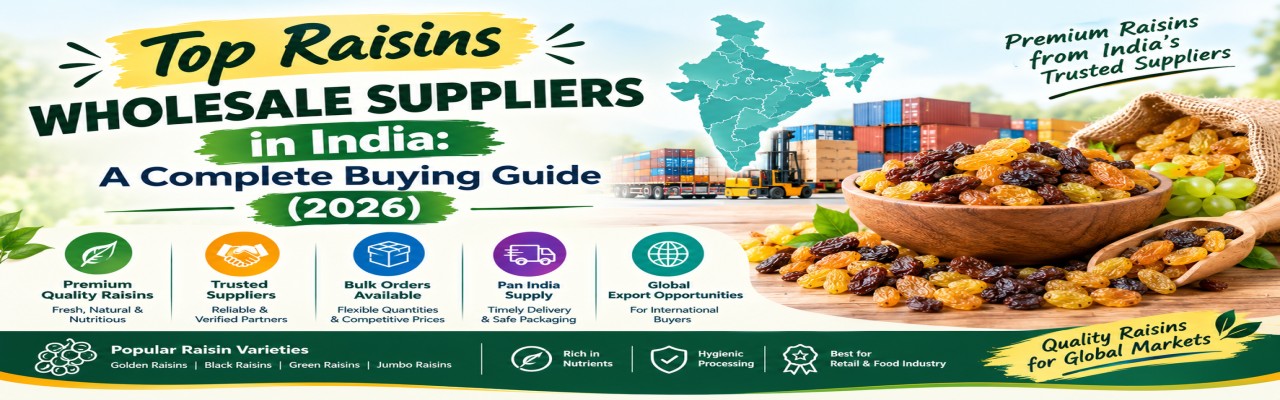
India has a well-established raisin supply chain, with producers and processors concentrated mainly in Maharashtra and Karnataka. Wholesale distributors, dry fruit traders and importers also supply raisins to retailers, bakeries, sweet shops, hotels, food manufacturers and other businesses across the country.
Finding the right raisins wholesale supplier in India is important if you want consistent quality, competitive prices and reliable deliveries. However, the best supplier for a small retailer may not be the right choice for a food manufacturer purchasing several tonnes of raisins.
There is no universally accepted official ranking of India's top raisin wholesalers. Instead of relying on an unverified list of companies, buyers should compare suppliers based on product quality, grade, pricing, minimum order quantity, food safety compliance and delivery terms.
This guide explains where to find raisin wholesalers, how to compare bulk prices, which varieties to consider and how to verify a supplier before placing an order. Whether you run a retail shop, bakery, catering business or packaged food brand, this guide will help you make a more informed purchasing decision.
Who Are India's Top Raisins Wholesale Suppliers?
India's major raisin wholesale suppliers generally fall into four categories: grower-processors, agricultural market traders, dry fruit distributors and importers. Each supplier type serves different business needs. The right choice depends on how much you want to purchase, where your business is located and whether you need standard raisins or a particular variety and grade.
|
Supplier type |
Common sourcing locations |
Best suited for |
Main advantage |
|
Grower-processors and processors |
Maharashtra and Karnataka grape-growing regions |
Large and regular buyers |
Closer access to the source and processing facilities |
|
Agricultural market traders |
Major agricultural market yards and trading centres |
Bulk buyers and traders |
Opportunities to compare prices and available lots |
|
Dry fruit wholesalers |
Delhi, Mumbai, Chennai, Kolkata and other cities |
Retailers, caterers and small businesses |
Convenient access to different products and quantities |
|
Importers and import-focused traders |
Major trading hubs and port-connected markets |
Buyers seeking imported varieties |
Access to raisins from different countries |
These categories are not an official ranking. Supplier capabilities, prices and order requirements vary from one business to another.
Where Do Raisins Wholesale Suppliers Source Their Products?
Maharashtra and Karnataka are important raisin-producing states because of their established grape-growing industries. Raisins are produced by drying grapes, followed by sorting, grading, processing and packing according to the intended market.
- Traders in production regions supply raisins to wholesalers and distributors across India. Imported raisins also enter the domestic market through importers and trading companies.
- Buying directly from a processor may reduce the number of intermediaries, but it can involve larger minimum orders. A city-based wholesaler may offer greater flexibility for businesses that need smaller quantities or frequent deliveries.
- Before choosing a supplier, compare the total cost, including packing, transport, taxes where applicable and handling charges.
Which Raisin Brand Is Best in India?
There is no single raisin brand that is best for every buyer. The right choice depends on the intended use, product consistency, price and quality requirements. Packaged raisin brands available in the Indian retail market include Tata Sampann, Happilo, Nutraj and Farmley.
These are examples of retail brands, not a verified ranking of the best brands or bulk suppliers. Local processors and regional packers may also supply suitable products for business use. For wholesale purchasing, evaluate the actual product lot rather than relying only on brand recognition.
How to Evaluate Raisin Quality?
Use the following checklist when comparing brands, processors or wholesale suppliers.
- Appearance: Look for a reasonably uniform colour and size appropriate to the variety and grade.
- Texture: Raisins should have a texture suitable for their intended use, without being excessively hard, wet or sticky.
- Smell: Avoid products with musty, sour or fermented odours.
- Cleanliness: Check for excessive stems, stones, debris, insects or visible mould.
- Taste: Sample the product for sweetness and any unusual or off-flavours.
- Packaging: Look for clean, intact packaging that protects the product from moisture and contamination.
- Labelling: Check the applicable food business licence details, batch or lot information, net quantity, dates and other required declarations.
- Consistency: Compare samples from different lots and check whether the delivered product matches the approved sample.
Visual inspection alone cannot establish every aspect of food safety. For large or institutional orders, consider suitable laboratory testing and written product specifications.
Retail Raisin Brands vs Bulk Suppliers
|
Factor |
Packaged retail brands |
Bulk raisin suppliers |
|
Typical pack size |
Small consumer packs |
Sacks, cartons or other bulk packaging |
|
Branding |
Usually ready for retail shelves |
May be unbranded or supplied for private labelling |
|
Price per kg |
Often includes consumer packaging and branding costs |
Depends on grade, quantity and delivery terms |
|
Quality specifications |
Based on the product label and brand offering |
Should be agreed with the supplier in writing |
|
Best suited for |
Consumers and retailers buying ready-packed goods |
Retailers, food businesses and manufacturers purchasing larger lots |
If you plan to repack raisins under your own brand, confirm the applicable FSSAI registration or licence and labelling requirements before selling the product.
Who Is the Largest Producer of Raisins in the World?
Turkey, the United States, China and Iran are among the important raisin-producing countries. Their relative positions can vary depending on the reporting period, crop conditions and whether a source measures production, exports or another indicator.
This article does not assign a definitive first-place ranking because a current, comparable production dataset has not been established here. For the latest figures, consult the relevant reports from the Food and Agriculture Organization (FAO), the International Nut and Dried Fruit Council (INC) or national agricultural authorities.
How Global Raisin Production Affects Indian Buyers?
India's domestic raisin market can be influenced by both local production and international supply conditions. When harvests are affected by weather or other agricultural problems, available supply and prices may change. Imported raisins can also be affected by exchange rates, freight costs, customs duties and import requirements. If your business buys raisins in large quantities, monitor:
- Harvest conditions in important producing countries.
- Domestic availability and prices in Indian wholesale markets.
- Currency movements affecting imported products.
- Freight and other import-related costs.
- Seasonal demand around festivals and other high-consumption periods.
These factors can help you plan purchases, but they do not guarantee that prices will rise or fall in a particular direction.
Where Can I Buy Raisins in Bulk in India?
Businesses can source raisins from agricultural market traders, processors, dry fruit wholesale markets, importers and online B2B platforms.
The most suitable channel depends on your order size, location, ability to inspect samples and need for regular supplies.
1. Dry Fruit Wholesale Markets
- Wholesale dry fruit markets in major cities can be useful for retailers, caterers and small businesses. Buyers may be able to compare several varieties and inspect products before purchasing.
- When buying from a local market, ask for an invoice, confirm the net weight and compare the quality of different lots. Do not assume that every seller in a wholesale market offers the same grade or level of documentation.
2. Agricultural Market Yards and Trading Centres
- Market yards and trading centres in grape-growing regions can provide access to traders handling locally produced raisins.
- This channel may suit buyers who can purchase larger quantities, inspect the product and arrange transportation. However, quality can vary between suppliers and individual lots.
- Ask whether the quotation is for a specific grade and whether cleaning, sorting, grading and packing are included.
3. Direct from Raisin Processors and Packers
- Processors may offer sorted, graded and packed raisins for wholesale buyers. This can be helpful for businesses that need repeat orders or consistent product specifications.
- Before placing a large order, request a sample, discuss the minimum order quantity and confirm the supplier's capacity to deliver the same grade regularly.
- If you need private-label packaging, ask about printing, packaging materials, minimum production quantities and applicable labelling requirements.
4. Online B2B Marketplaces
- B2B marketplaces can help buyers discover raisin suppliers across different cities and compare available product options.
- Platforms such as IndiaMART and TradeIndia are examples of places where buyers can search for suppliers. TradeMart can also support product and supplier discovery for businesses exploring wholesale sourcing opportunities.
- However, an online listing is only a starting point. It does not automatically prove that a supplier is genuine, that its product meets your requirements or that its quoted price is competitive.
- Before ordering, verify the business details, request samples, check documentation and agree on the transaction terms in writing.
5. Raisin Importers and Traders
- Importers can be useful if you need raisins from a particular origin or require a specific product specification.
- Imported raisins may differ in size, colour, processing, grade and price. Ask the supplier to identify the country of origin, product type, batch details and any relevant import documentation.
- For regular purchases, also consider how exchange rates, freight costs and import-related charges affect the final delivered price.
Online vs Offline Raisin Wholesale Purchasing
|
Factor |
Online or B2B sourcing |
Offline market purchasing |
|
Supplier reach |
Can cover multiple cities and regions |
Usually concentrated in the areas you can visit |
|
Product inspection |
Samples or documented specifications may be needed |
Physical inspection may be possible |
|
Price comparison |
Easier to request several quotations |
May require visiting multiple traders |
|
Convenience |
Useful for initial supplier discovery |
Requires travel and in-person coordination |
|
Verification |
Must be completed independently |
Must also be completed independently |
Neither channel is automatically safer. A well-verified online supplier may be suitable, while an in-person purchase can still carry risks if the product and transaction are not checked properly.
Tips Before Placing a Bulk Raisin Order
- Request samples of the exact variety and grade you intend to purchase.
- Start with a trial order before committing to a large quantity.
- Get the quotation in writing, including product grade, packing, taxes where applicable and delivery terms.
- Confirm whether the quoted weight is net weight or gross weight.
- Check payment terms, dispatch timelines and the procedure for handling defective goods.
- Verify the supplier's business details and relevant food safety credentials.
- Keep a record of the approved sample and written product specifications.
How to Compare Raisin Wholesale Quotations?
A lower price is not necessarily a better deal if the product grade, packing or delivery terms are different. Compare at least three suppliers using the same basis:
- Variety and grade: Make sure each supplier is quoting for the same product specification.
- Pack size: Compare the same net quantity and type of packaging.
- Delivery terms: Establish whether the quote is ex-warehouse, ex-factory or delivered to your premises.
- Taxes and charges: Check which taxes, freight charges and handling costs are included.
- Payment terms: Compare advance payments, credit terms and other conditions.
- Quality: Check the samples for cleanliness, size, texture and other agreed requirements.
Calculate the total delivered cost rather than comparing only the headline price per kilogram. Also consider the usable quantity after accounting for any agreed quality tolerances or rejected material.
Which Country's Raisins Are Best?
No single country produces raisins that are best for every purpose. Product quality depends on the grape variety, growing conditions, drying method, processing, storage and grade.
India and several other countries supply raisins to domestic and international markets. Afghan, Iranian, Turkish, American, Australian and Chilean raisins are among the origins buyers may encounter, depending on availability and the supplier. The following table is a general sourcing guide, not a quality ranking.
|
Origin |
What buyers may consider |
|
India |
Domestic availability and suitability for everyday cooking, retail and food preparation |
|
Afganistan |
Different raisin varieties and colours available through relevant trading channels |
|
Iran |
A range of raisin types and grades, subject to current availability and import conditions |
|
Turkey |
Sultana-type raisins commonly used in baking and food manufacturing |
|
United States |
Commercially processed raisins and established supply chains |
|
Australia and Chile |
Raisins available through international suppliers, depending on grade and market conditions |
Which Raisins Should Businesses Buy?
The best variety depends on how the raisins will be used.
- For sweets and kheer: Choose raisins with a suitable texture, sweetness and colour.
- For cakes and bakery products: Look for a grade that meets your size, moisture and processing requirements.
- For biryani and pulao: Consider uniformity, flavour and the desired finished appearance.
- For premium dry fruit packs: Focus on appearance, sorting, cleanliness and consistent sizing.
- For snack mixes and food manufacturing: Prioritise product specifications, food safety, batch consistency and reliable supply.
How Can You Find the Best Price for Raisins?
The most practical way to find a competitive raisin wholesale price is to compare current quotations from multiple suppliers and assess the full cost of purchasing and delivery. The cheapest quotation may not offer the best value if it involves inconsistent quality, additional freight charges or unreliable deliveries.
Practical Ways to Reduce Raisin Purchasing Costs
- Compare at least three suppliers. Include different supplier types, such as processors, wholesalers and distributors.
- Ask about quantity-based pricing. Check whether a larger order offers a meaningful discount.
- Plan purchases carefully. Monitor supply and demand conditions instead of assuming that prices always fall after harvest.
- Negotiate total costs. Discuss transport, packaging, payment terms and delivery schedules.
- Build reliable supplier relationships. Regular purchasing may help establish more predictable terms.
- Choose the right grade for your use. A premium grade may not be necessary for every recipe or manufacturing process.
- Avoid excessive inventory. Buying more than you can store safely may lead to wastage and financial losses.
How to Choose a Reliable Raisin Wholesale Supplier
A reliable supplier should be able to explain its product specifications, provide the relevant business details and meet the agreed delivery conditions. Use the following process to evaluate potential suppliers.
Step 1: Shortlist Potential Suppliers
Search through wholesale markets, processors, trade contacts, referrals and B2B marketplaces. Build a shortlist of three to five suppliers rather than relying on a single quotation.
Step 2: Verify Business Details
Request the supplier's registered business name, business address, contact details and GST registration information where applicable. Verify the details through the relevant official channels.
Step 3: Check Applicable Food Safety Credentials
Ask for the FSSAI registration or licence details applicable to the supplier's activity. Verify them through official FSSAI channels where relevant. The exact requirements depend on the business activity and applicable regulations. Do not assume that one document proves the supplier meets every food safety requirement.
Step 4: Request Product Samples
Evaluate a sample of the exact grade you intend to purchase. Check its appearance, texture, smell, cleanliness and suitability for your intended use. For large orders, consider suitable testing against the product specification.
Step 5: Check Supply Capacity
Ask about available stock, minimum order quantity, repeat-order capacity, lead times and delivery arrangements. A supplier who can fulfil one small order may not necessarily be able to meet your ongoing requirements.
Step 6: Agree on Commercial Terms
Document the product grade, quantity, price, packaging, delivery date, payment terms and procedure for handling quality disputes.
Step 7: Place a Trial Order
Start with a manageable quantity. Check whether the delivered goods match the approved sample and whether the supplier meets the agreed delivery terms.
How to Store Raisins in Bulk
- Proper storage helps preserve product quality and reduce spoilage.
- Store raisins in a clean, cool and dry area away from direct sunlight.
- Use suitable food-grade packaging or sealed containers.
- Keep stock off the floor and away from walls where moisture may accumulate.
- Protect the product from pests and contamination.
- Keep raisins away from strong-smelling materials.
- Follow a first-in, first-out inventory system.
- Inspect stored stock regularly for moisture, pests, packaging damage and unusual odours.
- Follow the supplier's storage instructions and the product's best-before date.
- Shelf life depends on the product, moisture level, packaging and storage conditions. Do not assume every raisin variety has the same storage life.
Who Buys Raisins in Bulk?
Raisins are used across several food and retail categories, which creates demand from different types of business buyers.
Retailers and Dry Fruit Shops
Retailers purchase raisins for loose sales or packaged products. They may prioritise competitive pricing, attractive appearance and the ability to reorder regularly.
Bakeries and Confectionery Businesses
Bakeries use raisins in cakes, breads, biscuits, cookies and other products. Buyers need a consistent grade suitable for their recipes and production processes.
Hotels, Restaurants and Caterers
Food-service businesses use raisins in dishes such as biryani, pulao and desserts. Their purchasing requirements may depend on recipe specifications, menu volume and delivery frequency.
Food Manufacturers
Manufacturers may use raisins in snack mixes, cereals, bars, bakery products and other packaged foods. They may require defined specifications, traceability, batch consistency and additional quality documentation.
Gift Box and Hamper Businesses
Gift packers may prefer larger, uniform raisins with an attractive appearance. Packaging, sorting and consistency can be especially important for premium products.
How B2B TradeMart Can Help You Discover Raisin Suppliers?
Finding a supplier that matches your quantity, grade and delivery needs is an important step in wholesale purchasing.
- B2B TradeMart can help businesses explore product listings and discover potential suppliers for raisin sourcing and related dry fruit requirements. Buyers can use B2B platforms to build a shortlist, request quotations and compare product options across different suppliers.
- However, a supplier listing should be treated as a starting point rather than a guarantee of quality or credibility.
- Before finalising an order, verify the supplier's business details, request samples, check applicable food safety credentials and agree on the product specifications and commercial terms in writing.
- For wholesale buyers, a successful sourcing decision combines competitive pricing with consistent quality, reliable delivery and appropriate documentation.
Conclusion
Finding the right raisin wholesale supplier in India is about more than choosing a well-known brand or the lowest price. Businesses need to consider product grade, cleanliness, consistency, order quantity, delivery costs and supplier reliability.
Grower-processors and market traders may suit larger purchases, while city-based wholesalers can offer convenience and flexibility. Importers may be useful when a buyer needs a particular origin or variety, and B2B platforms can help businesses discover and compare potential suppliers.
Before placing an order, request samples, verify relevant business and food safety details, compare at least three quotations and document the agreed terms. A careful sourcing process can help retailers, bakeries, caterers and food manufacturers build more reliable supply relationships. For businesses looking to discover potential raisin suppliers, TradeMart can be one starting point for product and supplier research. Always complete your own checks before making a purchase.