Coffee is one of the world's most widely traded agricultural commodities. From everyday instant coffee to premium specialty brews, millions of people depend on coffee for their daily routines. Behind every cup is a global supply chain connecting coffee farmers, processors, exporters, importers, roasters and retailers.
But which country produces the most coffee? Who are the world's biggest coffee exporters? And where does India stand in the global coffee market?
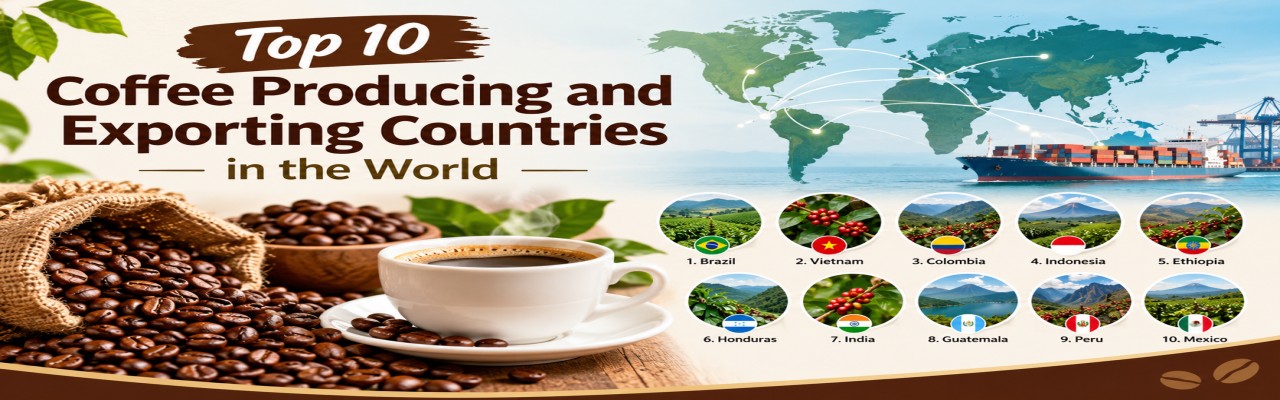
Brazil leads global coffee production, followed by Vietnam. Colombia, Ethiopia and Indonesia are also major producers. Other important coffee-producing and exporting countries include Honduras, Uganda, India, Peru, Guatemala and Mexico.
This guide explores the leading coffee-producing countries, major coffee-exporting companies, global production forecasts for 2026/27, India's coffee industry and the factors that influence international coffee trade.
Quick Overview: Top Coffee-Producing Countries
According to the USDA forecasts cited in the source material, Brazil, Vietnam, Colombia, Ethiopia and Indonesia are the five largest coffee-producing countries for the 2026/27 marketing year.
|
Rank |
Country |
2026/27 production forecast |
Main coffee types |
|
1 |
Brazil |
71.9 million bags |
Arabica and Robusta |
|
2 |
Vietnam |
32.5 million bags |
Mostly Robusta |
|
3 |
Colombia |
13.4 million bags |
Mostly Arabica |
|
4 |
Ethiopia |
12.1 million bags |
Arabica |
|
5 |
Indonesia |
11.4 million bags |
Robusta and Arabica |
The report cited in the source material forecasts global coffee production of approximately 189.7 million 60-kg bags in 2026/27. Global exports are forecast at 131.4 million bags, while consumption is projected at 179.7 million bags. These figures suggest an increase in global supply. However, actual production and trade can change because of weather, crop disease, transport costs and changing market conditions.
Top 10 Coffee-Producing Countries in 2026
Coffee grows in tropical and subtropical regions across Latin America, Africa and Asia-Pacific. Each producing country has different growing conditions, farming practices and coffee varieties.
The first five positions in the production forecast cited above are clearly identified. The remaining countries are better treated as a group because their positions can change between seasons and data sources.
1. Brazil
- Brazil is the world's largest coffee-producing country and a leading exporter. It grows both Arabica and Robusta, locally known as Conilon in many Brazilian growing regions.
- Minas Gerais is an important coffee-producing state, while Espírito Santo and Rondônia are known for Robusta production. Brazil's large farms, established processing facilities and developed export infrastructure support its position in the global market.
- The USDA forecast cited in the original article places Brazil's 2026/27 production at 71.9 million bags, or approximately 4.31 million metric tonnes.
- Brazilian coffee is often associated with chocolatey, nutty and balanced flavours, making it popular in espresso blends and other commercial coffee products. However, flavour varies by region, variety, processing method and roast.
Why Brazil matters: Its large production volume means that weather conditions and harvest forecasts in Brazil can influence international coffee prices.
2. Vietnam
- Vietnam is the world's second-largest coffee producer and a major supplier of Robusta beans.
- Most Vietnamese coffee comes from the Central Highlands. Robusta is widely used in instant coffee, commercial blends and espresso products because of its strong flavour and higher caffeine content compared with Arabica.
- The USDA forecast cited in the source material places Vietnam's 2026/27 production at 32.5 million bags.
- Vietnam has also been working to improve supply-chain traceability. Exporters supplying regulated markets may need to meet additional documentation and sourcing requirements, including applicable deforestation-related rules.
Why Vietnam matters: Its large Robusta supply makes the country particularly important for instant coffee manufacturers and commercial coffee buyers.
3. Colombia
- Colombia is one of the world's best-known Arabica coffee producers. Its mountainous landscape and varied growing conditions support coffee cultivation across several regions.
- Colombian coffee is commonly associated with balanced acidity, sweetness and a smooth flavour profile. Many farms are relatively small, and coffee cherries are often harvested by hand.
- The USDA forecast cited in the original article places Colombia's 2026/27 production at 13.4 million bags.
- Weather remains an important factor in Colombian coffee production. Excess rainfall, insufficient sunshine and plant diseases can affect the size and quality of the harvest.
Why Colombia matters: Its Arabica coffee is widely used in roasted coffee products, specialty offerings and origin-specific blends.
4. Ethiopia
- Ethiopia is widely recognised as the historical home of Arabica coffee and is Africa's largest coffee producer among the countries featured in this list.
- Coffee is grown across several Ethiopian regions, including Sidama, Guji and Yirgacheffe. The country is known for diverse Arabica coffees, which may have floral, fruity or citrus-like characteristics depending on the origin and processing method.
- The USDA forecast cited in the source material places Ethiopia's 2026/27 production at 12.1 million bags.
- Coffee is also an important source of income for many Ethiopian farming households and a central part of the country's culture.
Why Ethiopia matters: Its distinctive coffee origins and variety of flavour profiles make it important to specialty coffee roasters and buyers.
5. Indonesia
- Indonesia produces both Robusta and Arabica coffee. Important coffee-growing areas include Sumatra, Java and Sulawesi.
- Indonesian coffee is often associated with a full body and earthy flavour, although individual lots can vary significantly. Certain regional coffees are especially popular among specialty coffee enthusiasts.
- The USDA forecast cited in the original article places Indonesia's 2026/27 production at 11.4 million bags, with a decline expected compared with the previous season.
- Excess rainfall and other weather conditions can affect harvests and the quality of coffee beans.
Why Indonesia matters: Its Robusta production supports commercial coffee supply, while its distinctive Arabica origins contribute to the specialty coffee market.
6. Honduras
- Honduras is an important coffee producer in Central America. Its mountainous regions support Arabica cultivation, with production involving many smallholder farmers.
- Honduran coffee is often described as sweet and balanced, with flavour notes that vary according to altitude, variety and processing.
- Coffee exports are important to the country's agricultural economy. However, farmers can face challenges from changing weather, plant diseases and fluctuations in international prices.
7. Uganda
- Uganda is a major African coffee producer and exporter, particularly known for Robusta. It also grows Arabica in highland areas, including around Mount Elgon.
- Coffee plays an important role in Uganda's export earnings and supports many farming households.
- The USDA forecast cited in the source material expects Uganda to achieve record production in 2026/27. The exact forecast should be checked against the original report before publication.
Why Uganda matters: Its Robusta supply makes it an important origin for international buyers looking for coffee used in commercial blends and instant products.
8. India
- India is an established coffee-producing country in Asia, with cultivation concentrated in Karnataka, Kerala and Tamil Nadu.
- Indian coffee is often grown under shade, sometimes alongside spices such as pepper and cardamom. Both Arabica and Robusta are cultivated, and Indian Robusta is used in several commercial blends.
- India is also known for Monsooned Malabar coffee, a distinctive style produced through a controlled exposure of green coffee beans to humid monsoon conditions.
- The source material indicates that Indian production is forecast to decline in 2026/27. A precise production figure was not verified in the original article, so it should not be added without checking the official data.
9. Peru
- Peru is an important South American Arabica origin. Coffee is cultivated in highland and forest regions, often by smallholder farmers and cooperatives.
- Peruvian coffee is available through conventional and specialty supply chains. Some producers and cooperatives offer certified products, including organic or Fairtrade-certified coffee, where the relevant certification has been obtained.
- For international buyers, Peru can be a sourcing option when looking for Arabica coffee with traceability or specific sustainability credentials.
10. Guatemala and Mexico
- Guatemala and Mexico are established coffee-producing countries in Central America and North America, respectively.
- Guatemala is known for Arabica grown in different highland regions, with some coffees offering chocolatey flavours, sweetness and bright acidity. Mexico produces coffee in regions such as Chiapas, Oaxaca and Veracruz.
- Their positions in the global production ranking can vary depending on the year and source. For that reason, it is more accurate to describe them as important coffee-producing countries than to assign them a fixed rank without a matching dataset.
What Country Produces the Most Coffee?
Brazil is the world's largest coffee producer. The USDA forecast cited in the source material estimates production of 71.9 million 60-kg bags for 2026/27. Several factors contribute to Brazil's position:
- Large growing areas: Coffee is cultivated across multiple regions.
- Arabica and Robusta production: The country supplies different segments of the coffee market.
- Mechanisation: Many farms use mechanised harvesting where terrain and growing conditions allow.
- Established infrastructure: Processing facilities, transport networks and export channels support large-scale trade.
- Farm investment: Investment in cultivation and farm management can influence productivity.
Coffee production in Brazil can still rise or fall from year to year. Arabica also experiences a natural biennial production cycle in many growing areas, although weather and farm management can affect the pattern.
Which Country Produces More Coffee: Brazil or Vietnam?
Brazil produces substantially more coffee than Vietnam. The USDA forecasts cited in the source material put Brazil's 2026/27 production at 71.9 million bags and Vietnam's at 32.5 million bags. This means Brazil's projected production is more than twice Vietnam's.
However, the two countries play different roles in the market. Brazil is a major producer of both Arabica and Robusta, while Vietnam specialises mainly in Robusta.
Top Coffee-Exporting Countries in the World
Coffee production and coffee exports are closely related, but they are not the same thing. A country may produce large quantities of coffee while also consuming a significant share domestically.
Brazil and Vietnam are leading coffee exporters, followed by major origins such as Colombia, Ethiopia and Indonesia. Honduras, Uganda, India, Peru, Guatemala and Mexico also supply international markets. The export volumes of individual countries change according to harvests, domestic demand, inventories and international prices.
Major Coffee Exporters and Their Market Roles
|
Country |
Role in the global coffee trade |
|
Brazil |
Major exporter of Arabica and Robusta |
|
Vietnam |
Leading Robusta exporter |
|
Colombia |
Important supplier of Arabica |
|
Ethiopia |
Major African coffee exporter |
|
Indonesia |
Exports Robusta and distinctive Arabica coffees |
|
Honduras |
Supplies Arabica to international buyers |
|
Uganda |
Important exporter of Robusta |
|
India |
Exports Arabica and Robusta, including specialty coffees |
|
Peru |
Supplies Arabica, including some certified specialty products |
|
Guatemala and Mexico |
Established suppliers of Arabica coffee |
The USDA forecast cited in the original article places Brazil's 2026/27 coffee exports at 49.07 million bags, including approximately 45 million bags of green coffee. The source material also cites a forecast of 13.4 million bags of Colombian exports. These figures should be verified against the relevant USDA tables before publication, as production and export estimates can be revised.
What Country Is the Biggest Exporter of Coffee?
Brazil is the leading coffee exporter by volume in the forecast cited in the source material. Vietnam is another major exporter and the largest supplier of Robusta coffee. Brazil's export strength comes from its large crop, established shipping infrastructure and long-standing relationships with international traders, roasters and manufacturers.
However, the biggest exporter by volume is not necessarily the highest-value specialty supplier. Buyers should consider coffee type, grade, origin, processing method and quality requirements when choosing a source.
Top Coffee Exporter Companies in the World
Coffee-exporting companies are different from coffee-producing countries. A country produces coffee within its borders, while an exporter or trading company may source beans from several countries and sell them to buyers worldwide.
Large coffee-trading companies help connect farms, cooperatives, processors, roasters and manufacturers. Their activities may include purchasing green coffee, grading, blending, logistics, financing, risk management and traceability.
The source material cites a Trase analysis published in 2026 that identifies several large companies in global coffee trade.
Leading Coffee Trading and Export Companies
|
Company |
Role in the coffee industry |
|
Olam (ofi) |
Global food and agricultural supply-chain business involved in coffee sourcing and trading |
|
Louis Dreyfus Company (LDC) |
Global agricultural merchant with coffee trading activities |
|
Neumann Kaffee Gruppe |
International green coffee trading and services group |
|
Sucafina |
Coffee trading and supply-chain company |
|
ECOM Agroindustrial |
Global commodity merchant with coffee operations |
|
Volcafe |
Green coffee merchant and supply-chain business |
|
COFCO International |
Global agricultural supply-chain company |
|
Sucden |
Commodity trading group with coffee activities |
|
Atlantica Coffee |
Coffee trading and export business |
|
Racafé |
Coffee export and trading company |
This is a representative list of major coffee-trading businesses, not a verified current ranking from first to tenth. Company market shares depend on the dataset, reporting period and method used.
The source material cites the Trase analysis as estimating that ten companies handled around 35% of global coffee exports, while the top 30 handled around 55%. These percentages should be checked against the original analysis before being used as definitive current figures.
Short Profiles of Major Coffee Traders
- Olam (ofi): Operates across agricultural supply chains and sources coffee from multiple producing regions. Its activities connect producers with international buyers.
- Louis Dreyfus Company: A global agricultural merchant involved in coffee and other commodities. Its coffee activities include sourcing and trading.
- Neumann Kaffee Gruppe: An international coffee group involved in green coffee trading and related services.
- Sucafina: A coffee trading and supply-chain company working with producers and buyers in different markets.
- ECOM, Volcafe, COFCO International and Sucden: These businesses also participate in global commodity and coffee supply chains.
For buyers, the suitability of an exporter depends on the required coffee grade, origin, quantity, certifications, delivery terms and commercial arrangements—not only its overall market share.
What Are the Top Coffee Companies in the World?
The answer depends on what you mean by a coffee company. Some businesses are primarily coffee traders, while others roast beans, manufacture packaged coffee or operate coffee shops. Examples of well-known coffee brands and businesses include:
- Nestlé
- Starbucks
- Lavazza
- Tata Consumer Products
- Massimo Zanetti Beverage Group
- Illycaffè
- Tchibo
These companies should not be treated as a single ranked list. They operate in different parts of the coffee industry, and their scale can be measured by revenue, sales volume, store count, brand reach or green coffee purchasing.
Exporters vs. Coffee Brands: What's the Difference?
The coffee industry includes several types of businesses.
- Coffee producers: Grow and harvest coffee cherries.
- Processors: Remove the fruit, dry and prepare the beans for sale.
- Exporters and traders: Source coffee and arrange its sale and shipment to international buyers.
- Importers: Bring coffee into a destination country and supply local buyers.
- Roasters and brands: Roast coffee and sell it under their own brand or to other businesses.
- Retailers and cafés: Sell prepared coffee or packaged products to consumers.
One company may perform several of these functions. However, a well-known retail coffee brand is not automatically one of the world's largest exporters of green coffee.
What Influences Coffee Exporter Rankings?
Several factors can change the order of coffee exporters:
- Measurement method: Rankings may be based on export tonnage, shipment volume, value or market share.
- Harvest size: Weather and crop conditions influence the quantity available for export.
- Domestic consumption: Some producing countries retain a substantial portion of their coffee for local use.
- Company structure: Mergers, acquisitions and changes in business operations can affect company-level rankings.
- Data coverage: Trade datasets may not identify every exporter or shipment.
- Market prices: Rankings based on revenue can change even when export volumes remain similar.
When publishing a company ranking, always identify the source, measurement method and reporting period.
Where Does Coffee Grow in the World?
Coffee is grown mainly in tropical and subtropical regions near the equator, often referred to as the coffee belt. These areas provide the warm temperatures and growing conditions required by coffee plants.
Important coffee-growing regions include Latin America, Africa and Asia-Pacific. Coffee plants generally need suitable temperatures, adequate rainfall, appropriate soil conditions and protection from damaging frost. Arabica often grows well in cooler highland areas, while Robusta generally tolerates warmer conditions.
|
Region |
Major coffee-growing countries |
General characteristics |
|
Latin America |
Brazil, Colombia, Honduras, Peru, Guatemala and Mexico |
Includes large commercial producers and many Arabica specialty origins |
|
Africa |
Ethiopia, Uganda, Kenya, Tanzania and Rwanda |
Produces both Arabica and Robusta, depending on the country |
|
Asia-Pacific |
Vietnam, Indonesia and India |
Important for Robusta production as well as distinctive Arabica origins |
These are broad regional patterns. Flavour depends on the specific farm, variety, altitude, harvesting, processing and roasting methods.
Does Europe Grow Coffee?
Europe is not a major commercial coffee-producing region. Its climate is generally unsuitable for large-scale cultivation of conventional coffee crops.
However, Europe is a major coffee-consuming and importing market. European businesses import green coffee, roast it locally and distribute finished products to retailers, cafés and other buyers.
How Much Coffee Is Grown in the United States?
The United States produces only a small amount of coffee compared with leading producing countries. Hawaii is the best-known commercial coffee-growing region, particularly the Kona area.
Most coffee consumed in the United States is imported from producing countries such as Brazil, Colombia and Vietnam. Exact import shares can change from year to year, so current trade statistics should be consulted when specific percentages are needed.
Coffee Production in Africa
Africa is an important coffee-producing region, with Ethiopia and Uganda among its leading producers.
- Ethiopia is particularly significant for Arabica coffee, while Uganda is an important source of Robusta. Kenya, Tanzania and Rwanda are also known for their coffee industries.
- Coffee contributes to export earnings and supports farming households, processors, cooperatives and transport businesses in several African countries.
- However, producers face challenges such as changing weather, crop disease, price volatility and limited access to finance or infrastructure in some areas.
- For international buyers, supplier evaluation should include origin, grade, processing method, traceability, consistency and the relevant certification documents.
Which 10 Countries Have the Best Coffee?
There is no official ranking of the ten countries with the best coffee. Taste is subjective, and the quality of a particular coffee depends on its variety, growing conditions, processing and roast. However, the following countries are often associated with distinctive or highly regarded coffees.
|
Country |
What its coffee is often known for |
|
Ethiopia |
Floral and fruity Arabica coffees |
|
Colombia |
Balanced Arabica with sweetness and acidity |
|
Kenya |
Bright acidity and fruit-forward flavour profiles |
|
Guatemala |
Coffees that may have chocolatey, sweet or full-bodied characteristics |
|
Costa Rica |
Carefully processed coffees with clean and balanced profiles |
|
Panama |
Premium specialty coffees, including Geisha varieties |
|
Brazil |
A broad range of coffees, including nutty and chocolatey profiles |
|
Indonesia |
Full-bodied coffees, including distinctive Sumatran styles |
|
Yemen |
Historic coffee-growing traditions and distinctive regional lots |
|
Jamaica |
Jamaica Blue Mountain, a recognised premium coffee origin |
This is a descriptive list, not a scientific quality ranking. Individual coffees from other origins can be equally impressive.
What Country Has the Best Coffee Beans?
There is no single best country for every coffee drinker or business. If you are selecting coffee for a business, consider your target customers, brewing method, flavour requirements and budget.
- For fruity or floral profiles: Explore selected Ethiopian or Kenyan Arabica coffees.
- For balanced, sweet profiles: Consider coffees from Colombia or Costa Rica.
- For nutty or chocolatey profiles: Explore Brazilian coffees and suitable Guatemalan lots.
- For bold, full-bodied profiles: Consider selected Indonesian coffees or Robusta-based blends.
- For wholesale buyers and roasters, request samples and compare the actual lots rather than choosing only by country name.
Is the Biggest Coffee Producer Also the Best?
Not necessarily. Production volume and coffee quality measure different things. Brazil is the largest producer, but Ethiopia, Colombia, Kenya, Panama and other origins have strong reputations in specialty coffee. Brazil also produces specialty-grade coffee, so large-scale production does not mean that every coffee from the country is intended for mass-market use.
What Is India's Rank in Coffee Production?
India is an established coffee producer and is generally included among the world's leading coffee-producing countries. However, its exact position varies by year and source.
The source material indicates that India is often placed around seventh in recent rankings, while the USDA forecast cited in the article expects lower Indian production in 2026/27. Because a precise figure for India's 2026/27 output was not verified in the source material, it is better not to publish an exact rank or volume without checking the latest official dataset.
Major Coffee-Growing Regions in India
India's main coffee-growing states include:
- Karnataka: A major coffee-producing state, with well-known growing regions such as Coorg and Chikmagalur.
- Kerala: An important producer of Robusta and other coffee varieties.
- Tamil Nadu: Produces coffee in selected hill regions.
Coffee is often cultivated under shade in India, sometimes alongside spices and other crops. This farming system is one of the features associated with Indian coffee production.
What Makes Indian Coffee Distinctive?
Indian coffee offers both Arabica and Robusta varieties, along with different regional characteristics and processing styles.
- Monsooned Malabar is one of India's best-known specialty coffee styles. It is produced through a process in which green coffee beans are exposed to humid monsoon conditions, changing their physical characteristics and flavour profile.
- India also participates in the international coffee trade as an exporter. Buyers should evaluate individual suppliers based on the product grade, origin, processing, available quantity and export documentation.
Where Does the United States Get Most of Its Coffee?
The United States relies heavily on imported coffee because domestic production is small compared with consumption.
- Brazil, Colombia and Vietnam are among the important coffee origins supplying international markets, including the United States. Import patterns vary depending on prices, crop availability, trade policy and buyer requirements.
- For exporters, the US market may offer opportunities for green coffee, roasted products and specialty coffee. However, businesses should check the destination's current food import requirements, documentation rules and any applicable trade measures before shipping.
Which Countries Drink the Most Coffee?
The European Union and the United States are among the largest coffee-consuming markets by total volume. Brazil also has a substantial domestic coffee market.
- The USDA forecast cited in the source material places global coffee consumption at approximately 179.7 million bags for 2026/27.
- Total consumption and per-person consumption are different measures. A country with a large population may consume a high total volume even if average consumption per person is moderate.
- Some Nordic countries are widely known for high per-capita coffee consumption.
- For businesses planning to export coffee, market selection should consider consumer preferences, import demand, product specifications, competition and distribution costs.
Impact of Coffee Farming on Producing Countries
Coffee farming has economic, social and environmental effects in producing countries.
Economic and Social Benefits
- Export earnings: Coffee can generate foreign exchange for producing countries.
- Employment: Farms, processing facilities, cooperatives and logistics businesses create work.
- Rural livelihoods: Coffee provides income for many smallholder households.
- Local business development: Coffee production supports transport, warehousing, processing and trading activities.
Challenges Facing Coffee-Producing Countries
- Price volatility: Changes in global prices can affect farmer income and business profitability.
- Climate risks: Drought, excessive rain, heat and frost can reduce production or affect quality.
- Plant diseases: Coffee leaf rust and other agricultural problems can damage crops.
- Environmental pressure: Expansion of agricultural land can contribute to deforestation in some areas.
- Supply-chain requirements: Buyers and regulators increasingly expect reliable information about origin and sourcing practices.
- Traceability and sustainability requirements can create additional work for producers and exporters, but they can also help buyers understand where their coffee comes from.
Coffee Industry Trends to Watch in 2026
The 2026/27 outlook cited in the source material points to higher global coffee production and exports. However, forecasts can change as new harvest information becomes available.
1. Higher Global Production
The USDA forecast cited in the article estimates global production at approximately 189.7 million bags in 2026/27, around 6% above the previous season. Brazil's projected recovery is a major factor in this increase.
2. Higher Export Volumes
Global coffee exports are forecast at approximately 131.4 million bags. Actual shipments will depend on harvest results, domestic consumption, inventories and logistics.
3. Changes in Coffee Prices
Larger harvest expectations can put downward pressure on prices, but prices are also affected by weather risks, currency movements, freight costs, inventories and market demand. Do not assume that higher production automatically guarantees cheaper coffee for every buyer.
4. Different Production Trends Across Countries
Brazil, Vietnam, Ethiopia and Uganda are expected to benefit from stronger production in the forecast cited in the source material. Indonesia and India are identified as countries where production is expected to decline. These are forecasts, so final figures should be checked after the relevant reporting period.
5. Growing Importance of Traceability
International buyers increasingly need to understand the origin of coffee and the conditions under which it was produced. Depending on the destination market and applicable rules, exporters may need to maintain stronger supply-chain records, origin information and supporting documentation.
6. Demand for Specialty Coffee
Specialty coffee continues to create opportunities for businesses offering traceable origins, distinctive varieties, careful processing and consistent quality. However, a country or supplier's reputation alone does not guarantee a particular grade. Buyers should evaluate samples and product specifications.
Conclusion
Coffee production and trade are concentrated among several major countries, with Brazil leading by a substantial margin and Vietnam ranking second. Colombia, Ethiopia and Indonesia are also important producers, while Honduras, Uganda, India, Peru, Guatemala and Mexico contribute to global supply.
The 2026/27 outlook cited in the source material points to higher global production and exports, led by improved output in several major producing countries. However, weather, harvest conditions, domestic demand and international trade requirements can change the market outlook.
For businesses sourcing or trading coffee, understanding the difference between production, exports and company-level trading activity is essential. Buyers should compare coffee origins, product grades, quality, prices and traceability requirements before choosing a supplier. For the latest production figures and export rankings, consult the original USDA and International Coffee Organization data rather than relying on a static ranking alone.