India is one of the world's major consumers of dry fruits and nuts. Almonds, cashews, walnuts, raisins, dates and makhana are used in everyday snacks, sweets, bakery products and festive gift packs. These products also create business opportunities for farmers, wholesalers, food manufacturers, retailers and exporters. But where do these dry fruits come from? Which state produces the most walnuts, cashews or almonds? And where can businesses find reliable dry fruit suppliers in India?
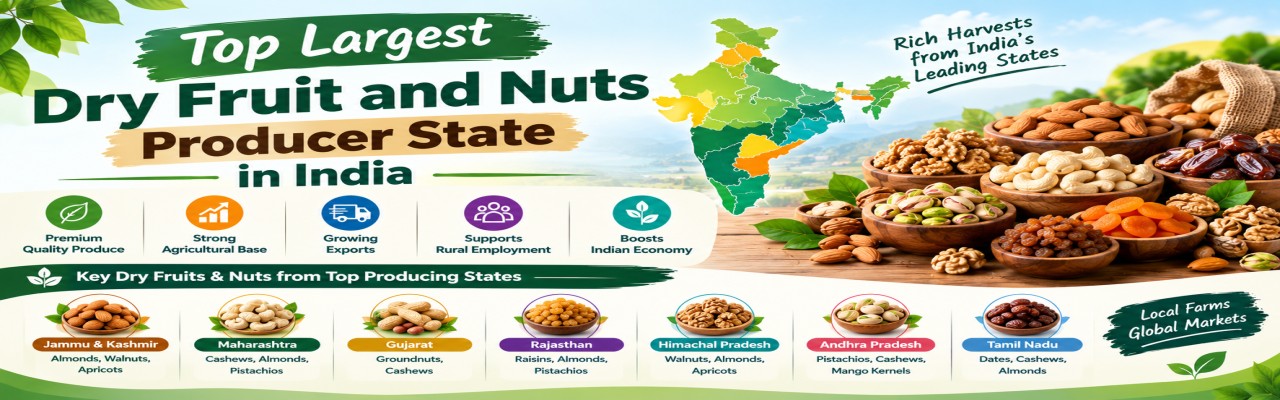
The answer depends on the product. Jammu & Kashmir is India's traditional walnut-growing region, Maharashtra and other coastal states are important for cashews, Maharashtra is known for raisins, and Bihar is the main centre for makhana cultivation.This guide covers the major dry fruit-producing states in India, well-known wholesale markets, popular dry fruit brands, and practical tips for sourcing dry fruits in bulk.
Which State Is the Largest Producer of Dry Fruits in India?
Jammu & Kashmir is best known as India's traditional dry fruit-producing region, particularly for walnuts. However, there is no single state that leads every dry fruit category. Production varies according to the crop, climate and annual harvest.
For example, cashews are grown across several coastal states, while Bihar is particularly known for makhana. India also imports substantial quantities of certain nuts, including almonds and pistachios.
Here is a quick overview of the major dry fruit-producing regions in India.
|
Dry fruit or nut |
Major producing regions |
Key information |
|
Walnuts |
Jammu & Kashmir |
India's traditional walnut-growing region |
|
Almonds |
Jammu & Kashmir, Himachal Pradesh |
Domestic production is limited compared with demand |
|
Cashews |
Maharashtra, Andhra Pradesh, Odisha, Kerala, Karnataka, Tamil Nadu and Goa |
Several states contribute to domestic production |
|
Raisins |
Maharashtra, Karnataka |
Sangli in Maharashtra is a well-known raisin hub |
|
Dates |
Gujarat, Rajasthan |
Grown in suitable arid and semi-arid regions |
|
Dried apricots |
Ladakh, Jammu & Kashmir, Himachal Pradesh |
Associated with the Himalayan region |
|
Makhana (fox nuts) |
Bihar |
Mithila is a traditional cultivation centre |
|
Figs (anjeer) |
Maharashtra, Karnataka |
Produced in selected growing regions |
|
Pistachios |
Very limited domestic production |
India relies largely on imports |
Note: This table provides a general overview of major growing regions, not an official production ranking. Check the latest National Horticulture Board (NHB), Ministry of Agriculture & Farmers Welfare or APEDA data before publishing exact production figures.
Top Dry Fruit-Producing States in India
Different states specialise in different crops. Understanding these regional strengths can help consumers and business buyers identify suitable sourcing locations.
1. Jammu & Kashmir: Walnuts, Almonds and Dried Apricots
Jammu & Kashmir is widely associated with India's traditional dry fruit industry. Its climate and mountainous terrain support the cultivation of temperate crops, including walnuts and almonds.
Walnuts are especially important to the region's agricultural economy.
Kashmiri walnuts are available in different forms, including whole nuts in shells and shelled kernels. Dried apricots are another product associated with the Himalayan dry fruit trade.
Best known for:
-
Walnuts with and without shells
-
Almonds
-
Dried apricots
-
Regionally sourced dry fruit products
For bulk buyers: Businesses can explore regional growers, cooperatives, processors and wholesalers. Before placing an order, confirm the product's origin, variety, grade, moisture level, packaging and available quantity.
2. Himachal Pradesh: Almonds, Walnuts and Dried Apricots
Himachal Pradesh is another part of India's Himalayan horticulture belt. Its hill districts support the cultivation of walnuts, almonds and other temperate fruits. The state's contribution differs by crop and production year, so it should not automatically be considered the largest producer of every nut.
Best known for:
-
Walnuts
-
Almonds in limited quantities
-
Dried apricots and other regional dried fruits
Buyers interested in Himalayan dry fruits can compare suppliers from Himachal Pradesh and Jammu & Kashmir based on variety, freshness, availability and price.
3. Maharashtra: Cashews, Raisins and Figs
Maharashtra is an important state for several horticultural products. Its Konkan region is associated with cashew cultivation, while grape-growing areas contribute to raisin production.
Sangli is particularly well known for its raisin trade. Maharashtra also grows figs in selected regions.
Best known for:
-
Cashew nuts
-
Raisins
-
Figs
For businesses: Maharashtra offers opportunities to explore both agricultural suppliers and processing businesses. However, buyers should distinguish between locally grown products and goods purchased from other regions.
4. Kerala: Cashew Processing and Trade
Kerala has a long history of cashew processing, and Kollam is widely associated with the cashew industry.
An important distinction for buyers is that a processing centre is not necessarily a growing centre. Cashew processors may handle raw cashew nuts sourced from different Indian states or imported from other countries.
Best known for:
-
Cashew processing
-
Cashew kernels
-
Cashew trading and export-related activities
Wholesale buyers should ask about the origin of raw nuts, processing methods, kernel grades, breakage percentage, packaging and food safety documentation.
5. Andhra Pradesh, Odisha, Karnataka, Tamil Nadu and Goa: Important Cashew Regions
Several other Indian states contribute to cashew cultivation and processing. Their role in the industry depends on factors such as plantation area, harvest conditions, processing capacity and market demand. No single state should be declared the largest cashew producer without checking the relevant year's official statistics.
For bulk buyers: Compare suppliers across these states instead of selecting a supplier only because it operates in a well-known cashew region.
6. Gujarat and Rajasthan: Dates
Gujarat, particularly the Kutch region, is associated with date cultivation. Suitable areas of Rajasthan also support date production. India imports significant quantities of dates, so buyers may encounter both domestically grown and imported varieties in the market.
For traders and retailers: Confirm the variety, country of origin, grade, moisture level, storage conditions and packaging date before purchasing dates in bulk.
7. Bihar: Makhana
Bihar is India's traditional makhana-producing state, with the Mithila region particularly associated with its cultivation.
Makhana, also known as fox nuts, is widely used as a snack and in various food preparations. It has also gained popularity among packaged-food businesses looking to expand their healthy-snacking product ranges.
Best known for:
-
Raw makhana
-
Popped makhana
-
Roasted and flavoured makhana products
Businesses can explore farmers, aggregators, processors and wholesalers in Bihar. Product size, popping quality, breakage, moisture and packaging are important factors when comparing bulk quotations.
What Are the Top 3 Most Popular Dry Fruits in India?
Almonds, cashews and walnuts are among the most popular dry fruits and nuts consumed in India. Raisins and dates are also widely used in households, sweets, bakery products and festive gifting.
There is no single official ranking because popularity can be measured by consumption, sales value or trade volume.
|
Dry fruit |
Why it is popular |
Common uses |
|
Almonds (badam) |
Widely consumed and used in traditional food preparations |
Snacking, sweets, milk and baking |
|
Cashews (kaju) |
Mild flavour and creamy texture |
Curries, snacks, sweets and gifting |
|
Walnuts (akhrot) |
Popular for their flavour and nutritional profile |
Snacking, salads and desserts |
|
Raisins (kishmish) |
Versatile and commonly used in cooking |
Pulao, cereals, sweets and bakery products |
|
Dates (khajur) |
Naturally sweet and available in many varieties |
Snacks, desserts, shakes and festive foods |
Dry fruits provide nutrients such as healthy fats, fibre, vitamins and minerals, depending on the product. However, they can also be energy-dense, and nutritional value varies by variety and processing.
Who Is the King of Dry Fruits?
Almonds, commonly called badam in India, are often referred to as the king of dry fruits. This is a popular expression rather than an official or scientific title.
Almonds are widely consumed and used in sweets, desserts, beverages and traditional food preparations. They are also sold in retail packs and gift boxes, making them an important product for dry fruit retailers and distributors.
Walnuts and pistachios also have strong consumer demand, particularly in premium dry fruit mixes and gifting products.
Which Is the Richest Dry Fruit?
The word "richest" can refer to nutritional content or market price, and the answer differs depending on the meaning.
Richest in Nutrients
Different dry fruits provide different nutrients:
-
Almonds: A source of vitamin E, magnesium and fibre.
-
Walnuts: Known for their plant-based omega-3 fatty acid, alpha-linolenic acid (ALA).
-
Pistachios: Provide protein, fibre and several micronutrients.
-
Cashews: Provide copper, magnesium and other minerals.
-
Dates: Supply carbohydrates, natural sugars and some fibre.
No single dry fruit is the best choice for everyone. Individual nutritional needs and portion sizes matter.
Most Expensive Dry Fruits
-
Dry fruit prices depend on variety, grade, size, country of origin, harvest conditions, import duties, exchange rates and market demand.
-
Premium grades of almonds, walnuts and pistachios can command higher prices. However, prices change regularly, so buyers should compare current quotations for products of similar quality rather than relying on a fixed ranking.
Who Is the Largest Producer of Dry Fruits in the World?
There is no single country that leads every dry fruit and nut category. Global production varies by crop.
-
The United States is a major almond producer, China is a major walnut producer, Turkey is a leading hazelnut producer, and Iran, Turkey and the United States are important pistachio producers. Cashew production is spread across several countries in Africa and Asia.
-
India is an important cashew producer and processor, but it also imports substantial quantities of certain nuts to meet domestic demand.
-
For businesses involved in importing or exporting dry fruits, current production and trade statistics should be checked through the relevant national agriculture departments and trade authorities.
Which Indian State Is the Largest Producer of Fruits?
This is a different question from dry fruit production. Andhra Pradesh, Maharashtra, Uttar Pradesh, Gujarat and Karnataka are among India's important fruit-producing states, although the leading state varies by crop and year.
|
Fruit category |
Important growing regions |
|
Mangoes and citrus fruits |
Andhra Pradesh, Uttar Pradesh and Maharashtra, among others |
|
Bananas |
Tamil Nadu, Maharashtra, Andhra Pradesh and Gujarat, among others |
|
Grapes |
Maharashtra and Karnataka |
|
Apples |
Jammu & Kashmir and Himachal Pradesh |
Some dry fruits are made by drying fresh fruits. For example, raisins are produced by drying grapes, and dried apricots are made from apricots. However, nuts such as almonds, walnuts and cashews are different agricultural products.
Which City Is Famous for Dry Fruits in India?
Several Indian cities are known for dry fruit trading, wholesale distribution or processing. The best location for a buyer depends on the product and the quantity required.
|
City or market |
Known for |
|
Srinagar, Jammu & Kashmir |
Kashmiri walnuts, almonds and dried apricots |
|
Khari Baoli, Delhi |
Wholesale dry fruits, spices and other food commodities |
|
Amritsar, Punjab |
Dry fruit retail and trade |
|
Mumbai, Maharashtra |
Wholesale distribution and access to regional trading networks |
|
Kollam, Kerala |
Cashew processing and trade |
|
Sangli, Maharashtra |
Raisins and grape-related products |
Tips for Buying Dry Fruits from Wholesale Markets
If you are buying dry fruits for a shop, food business or distribution operation, keep these points in mind:
-
Compare quotations from at least two or three suppliers.
-
Ask for samples before confirming a large order.
-
Confirm whether the product is locally grown, processed locally or imported.
-
Check the grade, size, moisture level, breakage and packaging.
-
Ask for the minimum order quantity (MOQ) and bulk pricing.
-
Include transport, taxes and handling charges when comparing the final cost.
For commercial orders, a lower quoted price is not always the best deal. Consistent quality, reliable delivery and proper documentation are equally important.
In Which State Are Dry Fruits Cheapest in India?
Dry fruits may be more competitively priced near production centres and established wholesale markets. However, there is no single state that is guaranteed to offer the lowest price for every dry fruit.
For example, buyers can explore Jammu & Kashmir for walnuts, cashew-growing and processing regions for cashews, Sangli for raisins, and Bihar for makhana. Delhi's Khari Baoli is another established wholesale market where buyers can compare a range of dry fruits. Prices depend on several factors:
-
Distance from the source: Transport costs can affect the final price.
-
Order quantity: Wholesale orders may offer lower per-kilogram rates.
-
Product grade: Premium whole nuts often cost more than broken or mixed grades.
-
Import costs: Duties, exchange rates and international supply affect imported nuts.
-
Seasonal demand: Prices can change around harvest periods and festivals.
-
Storage and packaging: These add to the overall cost.
How to Reduce Dry Fruit Purchasing Costs?
Businesses can manage procurement costs by comparing multiple suppliers, negotiating based on realistic order volumes, requesting samples and planning purchases in advance.
-
If you are buying dry fruits for sweets, bakery products or food manufacturing, broken or mixed grades may be suitable for some applications.
-
Confirm the required specifications before choosing a lower-priced grade.
-
Always check the product's freshness and storage conditions. An unusually low price may reflect old stock, poor handling or inconsistent quality.
What Are the Top Dry Fruit Companies in India?
India has several packaged dry fruit brands, wholesalers, importers and processors. Some familiar consumer-facing brands include Happilo, Nutraj, Farmley and Tulsi.
However, there is no single verified ranking that establishes these as India's definitive top five dry fruit companies. Brand recognition, market share, wholesale capacity and export volume are different measures.
How to Evaluate a Dry Fruit Company?
Before choosing a company for retail or bulk purchasing, consider the following factors.
|
Evaluation factor |
What to check |
|
Food safety |
Valid FSSAI licence, where applicable |
|
Product origin |
Clear information about sourcing and country of origin |
|
Quality consistency |
Samples, specifications and batch consistency |
|
Packaging |
Sealed packs, batch details and relevant dates |
|
Pricing |
Quotations for comparable grades and quantities |
|
Business documentation |
GST details and relevant import/export documents |
|
Customer feedback |
Credible reviews and references from existing buyers |
|
Order terms |
MOQ, payment terms, delivery timelines and replacement policy |
For larger orders, request product specifications and relevant laboratory reports where appropriate. Verify certification claims rather than relying only on promotional statements.
How to Find Dry Fruit Suppliers in India in 2026
Businesses looking for dry fruit suppliers should start by identifying the product, required quantity and intended use. A retailer buying branded 250-gram packs has different requirements from a food manufacturer purchasing several tonnes of cashew kernels.
Instead of relying on an unverified "top 10" ranking, shortlist suppliers based on the following categories:
-
Packaged dry fruit brands: Suitable for retailers and distributors looking for established consumer products.
-
Wholesale dry fruit traders: Useful for shops, resellers and businesses purchasing multiple varieties.
-
Kashmir-based suppliers: Worth exploring for walnuts, almonds and dried apricots.
-
Cashew processors: Suitable for buyers looking for specific cashew kernel grades and bulk quantities.
-
Raisin suppliers in Maharashtra: Relevant to retailers, bakeries and food manufacturers.
-
Makhana suppliers in Bihar: Useful for snack brands, distributors and private-label businesses.
-
Date importers and distributors: Relevant to retailers and wholesalers sourcing imported varieties.
-
Agricultural cooperatives and aggregators: Potential sourcing channels for regionally grown products.
-
Food ingredient suppliers: Useful for manufacturers requiring consistent specifications.
-
Export-oriented suppliers: Worth considering when purchasing requirements include international shipment and export documentation.
These are supplier categories, not a ranked list of ten verified companies. Buyers should evaluate individual businesses before placing an order.
Where Can You Find Dry Fruit Suppliers for Bulk Orders?
B2B sourcing platforms such as B2B TradeMart can help buyers discover businesses offering dry fruits, nuts and related food products. When searching a supplier directory, narrow your search by product type, location and intended use. Contact shortlisted suppliers to confirm availability, pricing and order requirements. Before finalising a supplier, request:
-
A current product catalogue and price quotation
-
Available grades and packaging options
-
Minimum order quantity
-
Sample products, where available
-
Valid FSSAI and GST details, as applicable
-
Importer-Exporter Code (IEC), where relevant to import or export activities
-
Relevant product test reports or certificates, if required
-
Delivery timelines, payment terms and replacement conditions
For international transactions, also confirm the exporter's documentation capability, destination-country requirements and shipping arrangements.
How to Choose Good-Quality Dry Fruits?
The appearance and smell of dry fruits can help identify obvious quality problems, but visual inspection alone cannot confirm food safety.
Use these basic checks when evaluating products.
Almonds
-
Look for clean, reasonably uniform nuts without visible mould.
-
Avoid nuts with a rancid or unusual smell.
-
Check the grade, origin and packaging details.
Cashews
-
Check kernel size, colour, grade and the percentage of broken pieces.
-
Avoid products with visible mould or a stale, rancid smell.
-
Ask for a sample when buying in bulk.
Walnuts
-
Check kernels for excessive darkening, visible mould or rancid odours.
-
For in-shell walnuts, compare the condition and weight of the nuts.
-
Confirm whether you are purchasing whole kernels, halves or broken pieces.
Raisins
-
Check for unwanted moisture, contamination or visible mould.
-
Compare colour, size and texture with the supplier's specifications.
-
Confirm whether the product contains added ingredients, if relevant.
Dates
-
Check the variety, texture, packaging and storage conditions.
-
Avoid products with visible mould or an unusual fermented smell.
-
Confirm the country of origin for imported varieties.
For commercial buyers, quality checks should also include suitable documentation and laboratory testing when required by the product, buyer or destination market.
How to Store Dry Fruits Properly?
Proper storage helps maintain the freshness and quality of dry fruits.
-
Store products in clean, airtight containers.
-
Keep them away from heat, moisture and direct sunlight.
-
Follow the supplier's storage instructions, particularly for large quantities.
-
Refrigerate products when appropriate for the product and climate.
-
Keep different products separate to avoid odour transfer and cross-contamination.
-
Use stock rotation practices so older batches are sold or used first.
-
Inspect stored products regularly for moisture, pests and spoilage.
For businesses, storage conditions are especially important because a large stock loss can affect profitability. Follow applicable food safety and warehouse hygiene requirements.
Conclusion
India's dry fruit industry is spread across several states, with each region contributing different products. Jammu & Kashmir is especially known for walnuts and other Himalayan dry fruits, Maharashtra and coastal states are important for cashews, Maharashtra is associated with raisins, and Bihar is the traditional centre for makhana.
For consumers, the main considerations are freshness, quality and price. For wholesalers, retailers, manufacturers and exporters, sourcing decisions should also account for product grades, order quantities, supplier documentation, storage and delivery.
If you are purchasing dry fruits in bulk, compare suppliers from relevant production and trading regions, request samples, and verify product specifications before placing an order. B2B sourcing platforms such as B2B TradeMart can help businesses discover potential suppliers and begin the procurement process.