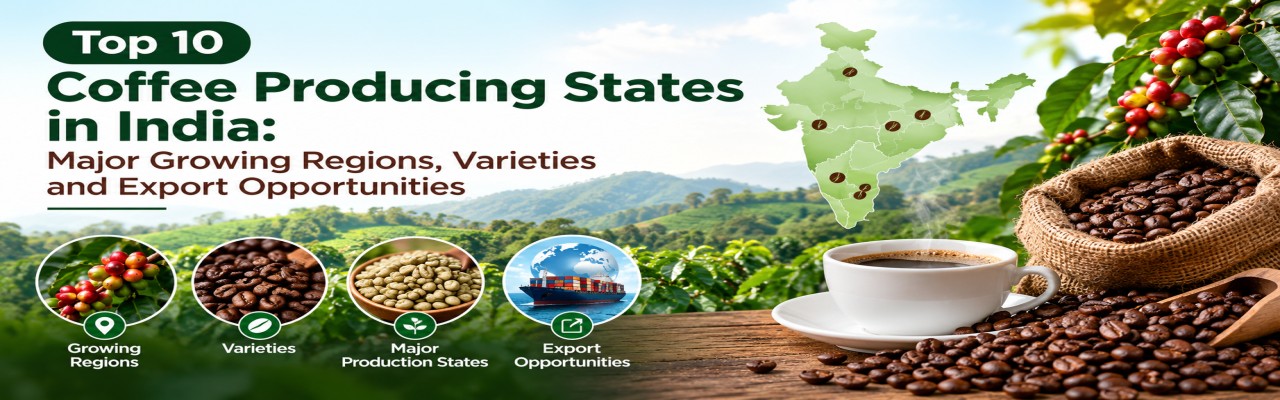
India is a recognized global coffee producer, known for its shade-grown plantations, distinctive regional flavors, and production of both Arabica and Robusta coffee. Most Indian coffee comes from the southern states of Karnataka, Kerala, and Tamil Nadu, while Andhra Pradesh, Odisha, and several North-Eastern states are developing their own coffee-growing regions.
For coffee buyers, roasters, manufacturers, wholesalers, and exporters, understanding these regions can help identify suitable sourcing locations, compare coffee varieties, and connect with suppliers.
In this guide, we explore India's top 10 coffee-producing states, their major growing areas, popular varieties, regional coffee characteristics, and opportunities in domestic and international markets.
Quick Overview: Top 10 Coffee-Producing States in India
Karnataka is India's largest coffee-producing state, followed by Kerala and Tamil Nadu. Andhra Pradesh is the leading non-traditional coffee-growing region, while Odisha and several North-Eastern states contribute smaller quantities.
The full list, from the traditional heartland to emerging regions, looks like this:
|
Rank |
State |
Major coffee varieties |
Key growing regions |
|
1 |
Karnataka |
Arabica and Robusta |
Kodagu, Chikkamagaluru, Hassan |
|
2 |
Keralam |
Mainly Robusta Wayanad, Idukki |
Robusta Wayanad, Idukki |
|
3 |
Tamil Nadu |
Arabica and Robusta |
Nilgiris, Shevaroy Hills, Palani Hills |
|
4 |
Andhra Pradesh |
Mainly Arabica |
Araku Valley, Eastern Ghats |
|
5 |
Odisha |
Mainly Arabica |
Koraput, Rayagada |
|
6 |
Assam |
Arabica and Robusta |
Karbi Anglong, Dima Hasao |
|
7 |
Nagaland |
Mainly Arabica |
Selected hill districts, including Wokha |
|
8 |
Manipur |
Mainly Arabica |
Selected hill districts, including Ukhrul |
|
9 |
Mizoram |
Mainly Arabica |
Selected hill areas |
|
10 |
Arunachal Pradesh |
Mainly Arabica |
Foothill and hill districts |
Which State Is the Largest Producer of Coffee in India?
Karnataka is India's largest coffee-producing state and has traditionally accounted for roughly 70% of the country's coffee output. Its extensive plantations, suitable climate, established processing facilities, and experienced growers make it the center of India's coffee industry. The state's coffee production is concentrated in three major districts:
- Kodagu (Coorg): One of India's most important coffee-growing districts, producing both Arabica and Robusta.
- Chikkamagaluru: A historic coffee-growing region associated with Baba Budan Giri and several well-known Indian coffee origins.
- Hassan: Another established growing region with plantations in the foothills of the Western Ghats.
Karnataka is also an important center for coffee curing, processing, trading, and export operations. For bulk buyers and coffee businesses, the state offers a broad sourcing network, including plantation owners, curing works, processors, exporters, and suppliers of green coffee beans.
Kerala: The Second-Largest Coffee-Producing State
Kerala is generally the second-largest coffee-producing state in India, contributing approximately one-fifth of national output in commonly cited production patterns. Robusta accounts for most of its coffee production.
- Major coffee-growing areas in Kerala
- Wayanad: The state's principal coffee-growing district, known especially for Robusta.
- Idukki: A hill district where coffee is cultivated alongside spices and other plantation crops.
- Other highland areas: Smaller plantations contribute to regional production.
- Wayanad Robusta is a recognized regional coffee with a Geographical Indication (GI) tag.
- Kerala is also associated with Monsooned Malabar coffee, a distinctive Indian coffee style produced by exposing processed beans to humid monsoon conditions along the west coast.
Why source coffee from Kerala?
Kerala is worth exploring for buyers looking for Robusta beans for espresso blends, instant coffee, and other commercial applications. However, a lot's suitability depends on its grade, processing method, screen size, moisture content, and quality specifications.
Tamil Nadu: A Major Producer of Indian Hill Coffee
Tamil Nadu is India's third-largest coffee-producing state. Its coffee plantations are mainly located in the elevated regions of the southern hill ranges.
Important coffee-growing regions
- Shevaroy Hills: The Yercaud region is known for established coffee plantations.
- Nilgiris: Coffee is grown alongside tea and other plantation crops.
- Palani Hills: The Kodaikanal region includes high-altitude coffee-growing areas.
- Anamalai Hills: The forested hill landscape supports mixed plantation farming.
Tamil Nadu produces both Arabica and Robusta. Coffee grown at higher elevations may develop brighter acidity and more complex aromas, although flavor depends on the variety, farm conditions, processing, and roasting. For specialty coffee roasters and retailers, the state offers opportunities to source region-specific beans and differentiated coffee lots.
Andhra Pradesh: Araku Valley Coffee
Andhra Pradesh is one of India's most important non-traditional coffee-growing states. Its best-known coffee origin is Araku Valley in the Eastern Ghats, where Arabica is widely cultivated.
Coffee production in the region is associated with tribal farming communities and smallholder plantations. Cooperative initiatives and agricultural support programs have helped promote coffee cultivation and market access.
What makes Araku coffee distinctive?
- It is associated with smallholder and community-based cultivation.
- Arabica is the main variety.
- The region has developed a reputation in the specialty coffee market.
- Araku Valley Arabica has a GI tag.
For buyers, Araku offers an opportunity to explore origin-focused coffee rather than purchasing only commodity-grade beans. Businesses should confirm the origin, lot details, processing method, certifications, and traceability claims before placing an order.
Odisha: Coffee Production in the Koraput Hills
Odisha is an emerging coffee-producing state, with cultivation concentrated in southern hill districts such as Koraput and Rayagada.
Arabica is an important variety in the region, and smallholders cultivate coffee in suitable hill areas. Development programs and interest from specialty coffee businesses have helped bring greater attention to Odisha's coffee potential.
Opportunities for coffee buyers
- Odisha may be worth exploring for businesses interested in emerging Indian coffee origins, smallholder sourcing, and differentiated products.
- However, buyers should assess available volumes, processing infrastructure, supply consistency, and transportation arrangements before committing to large orders.
Assam: Coffee Beyond Tea
Assam is widely associated with tea, but it also cultivates coffee in selected hill districts, including Karbi Anglong and Dima Hasao.
Coffee production remains relatively small compared with the southern states. Both Arabica and Robusta are grown in the region, and mixed farming provides an additional income source for some growers. Developing processing facilities, technical support, and access to larger markets will be key to expanding commercial coffee production in Assam.
Nagaland: An Emerging Coffee-Growing State
Nagaland has been developing coffee cultivation in selected hill districts, including Wokha. Arabica is an important variety in the state's coffee-growing initiatives.
Coffee can provide farmers with an additional cash crop alongside traditional agricultural activities. However, production volumes, processing capacity, and access to commercial buyers remain important considerations
For specialty coffee businesses, Nagaland is an emerging origin to monitor rather than a major source for large-volume commodity purchases.
Manipur: Small-Scale Coffee Cultivation
Coffee is grown in selected hill areas of Manipur, including parts of Ukhrul district. Arabica is the principal variety cultivated in these areas.
The sector remains comparatively small, and its development depends on suitable planting material, farmer training, post-harvest processing, and market connections.
Buyers interested in sourcing from Manipur should confirm the availability of commercially graded lots and the supplier's ability to meet required quantities and delivery schedules.
Mizoram: Coffee as an Alternative Plantation Crop
Mizoram has suitable hilly terrain in some areas for coffee cultivation, and coffee has been introduced as part of agricultural diversification initiatives.
- Plantations are relatively small, with Arabica commonly grown in the state.
- Limited processing facilities and distance from major trading centers can hinder commercial expansion.
- Improved infrastructure, quality control, and links with roasters and distributors could help emerging growers access more specialized markets.
Arunachal Pradesh: Coffee in the Eastern Himalayan Region
Arunachal Pradesh has seen coffee cultivation initiatives in selected foothill and hill districts. Arabica is the variety most commonly associated with these efforts.
Coffee production remains an its early stages compared with Karnataka, Kerala, and Tamil Nadu. The long-term potential depends on suitable growing conditions, infrastructure, farmer support, and the ability to deliver consistent quality.
Other North-Eastern states, including Meghalaya and Tripura, have also reported small-scale coffee cultivation, although production may be too limited for a consistent annual ranking.
Where Is Coffee Grown in India?
Coffee is grown mainly in the hill regions of the Western Ghats and Eastern Ghats, along with selected areas in the North-East. The traditional coffee-growing regions are Karnataka, Kerala, and Tamil Nadu. Andhra Pradesh and Odisha are important non-traditional regions, while the North-Eastern states contribute smaller quantities.
Why does Southern India dominate coffee production?
The Western Ghats provide several conditions suitable for coffee cultivation:
- Moderate temperatures and limited exposure to extreme heat.
- Seasonal rainfall that supports flowering and berry development.
- Hilly terrain with good drainage.
- Suitable soils with organic matter.
- Shade from trees that helps protect coffee plants.
Altitude, rainfall distribution, plant varieties, pest pressure, and farm management also influence coffee cultivation.
Arabica vs Robusta: What Is the Difference?
India produces both Arabica and Robusta coffee. They differ in growing conditions, flavour, caffeine content, and common commercial uses.
|
Feature |
Arabica |
Robusta |
|
Typical growing conditions |
Often higher elevations |
Often lower elevations |
|
Flavour profile |
Aromatic, often brighter and more complex |
Stronger, fuller-bodied, often earthy |
|
Caffeine |
Generally lower |
Generally higher |
|
Growing characteristics |
More sensitive to pests and weather |
Generally hardier |
|
Common uses |
Specialty coffee, filter coffee, pour-over |
Espresso blends, instant coffee, commercial blends |
These are general characteristics, not guaranteed outcomes. Actual flavour and quality depend on the coffee's origin, variety, harvesting, processing, storage, and roasting.
Popular Indian Coffee Varieties and Processing Methods
Indian coffee is sold in several forms, from green beans for commercial processing to roasted coffee for retail and food service. Popular coffee varieties
- S.795: An established Arabica selection grown in India.
- Chandragiri: An Arabica variety developed for disease tolerance.
- Cauvery (Catimor): An Arabica type used in Indian plantations.
- S.274 and CxR: Robusta selections used by coffee growers.
Variety names may not appear on every commercial coffee listing. Buyers should request detailed specifications when variety identity matters to the purchase.
Plantation coffee vs cherry coffee
- Plantation or washed coffee: The fruit is removed from the beans, then the beans are fermented, washed, and dried. This method often produces a cleaner flavor profile.
- Cherry or natural coffee: The whole coffee cherries are dried before separating the beans. Depending on the lot and processing conditions, this method can produce a fuller-bodied or fruitier cup.
For B2B purchases, consider processing methods alongside grade, moisture, defect count, screen size, and intended use.
Famous Indian Coffee Origins and GI Tags
Geographical Indication (GI) recognition connects certain products with a specific geographical origin and established reputation. It can help regional coffee producers differentiate their products in the market. Five recognised Indian coffee origins include:
- Coorg Arabica — Karnataka
- Wayanad Robusta — Kerala
- Chikmagalur Arabica — Karnataka
- Araku Valley Arabica — Andhra Pradesh
- Bababudangiri Arabica — Karnataka
Monsooned Malabar is another distinctive Indian coffee style known for its processing method and characteristic flavor.
What Is Monsooned Malabar Coffee?
Monsooned Malabar coffee is produced by exposing selected coffee beans to humid monsoon conditions along India's west coast.
The process changes the beans' appearance and cup characteristics, often resulting in a heavy body and low acidity. The style developed from historical sea transport, when coffee beans were exposed to humidity during long voyages. Today, roasters deliberately reproduce the process.
Roasters use it to create distinctive coffees for specific blends or customers who prefer lower-acidity profiles.
Why do GI tags matter to coffee buyers?
GI recognition can help businesses communicate regional identity and distinguish origin-specific products. However, buyers should verify the supplier's right to use GI-related claims and check any applicable product specifications. A GI tag should not replace quality testing, traceability, or supplier verification.
Coffee Production in India: What Affects Output?
India's coffee production changes from season to season. Even established coffee-growing districts can experience fluctuations in yield and quality. The main factors affecting production include:
- Rainfall: The timing of pre-monsoon showers and the distribution of monsoon rain influence flowering and berry development.
- Temperature: Unusual heat or cold can affect crop development.
- Pests and diseases: Pests such as the white stem borer and diseases such as leaf rust can affect coffee plants.
- Labor availability: Harvesting requires timely picking, often involving seasonal workers.
- Plant varieties: Variety selection and disease tolerance can influence yield stability.
- Alternate bearing: Coffee plants may produce a heavier crop in one season and a lighter crop in the next.
For buyers and processors, these factors can affect supply availability, prices, lot consistency, and delivery schedules.
India Coffee Market: Domestic Demand and Export Opportunities
India's coffee industry serves both domestic consumers and international markets. Its products include green coffee beans, roasted coffee, instant coffee, and soluble coffee extracts.
The growth of cafés, specialty roasters, online retail, and home brewing has also created more ways to sell Indian coffee within the country.
Major export markets for Indian coffee
- India exports coffee to several international markets, including Europe and other regions. Italy, Germany, and Belgium have historically been important destinations, alongside markets such as Russia and countries in the Middle East.
- Export destinations and shipment values change from year to year. Businesses should consult current Coffee Board and Ministry of Commerce and Industry data before relying on a particular country's ranking.
What types of coffee can businesses export?
Depending on their sourcing and processing capabilities, exporters may deal in:
- Green Arabica coffee beans.
- Green Robusta coffee beans.
- Roasted whole beans and ground coffee.
- Instant coffee and soluble extracts.
- Origin-specific and specialty coffee products.
Each product category may have different buyer requirements, quality specifications, packaging needs, and import rules.
How can coffee exporters find international buyers?
Coffee exporters can use several approaches to build a buyer network:
- B2B marketplaces: Create a detailed company profile and list available coffee products, grades, packaging options, and minimum order quantities.
- Industry trade fairs: Connect with roasters, importers, distributors, and food-service businesses.
- Direct outreach: Contact coffee importers, private-label brands, wholesalers, and roasting companies in target markets.
- Industry associations and trade networks: Use sector-specific resources to identify potential buyers and understand market requirements.
- Company website and digital marketing: Publish product specifications, sourcing details, certifications, and export capabilities to support buyer inquiries.
On a B2B platform such as TradeMart, suppliers can present their coffee offerings and help prospective buyers understand their product range before starting a commercial discussion. When evaluating an inquiry, verify the buyer's company details, requested specifications, payment terms, destination requirements, and shipping arrangements.
How to Choose an Indian Coffee Supplier for Bulk Purchases?
Choosing a supplier involves more than comparing the quoted price per kilogram. Buyers should assess product quality, consistency, documentation, supply capacity, and delivery terms. Use this checklist when comparing coffee suppliers:
|
Evaluation factor |
What to check |
|
Origin |
State, district, estate, or producing region |
|
Variety |
Arabica, Robusta, or a specified selection |
|
Product form |
Green beans, roasted beans, ground coffee, or instant coffee |
|
Quality specifications |
Grade, screen size, moisture, defects, and cup profile where applicable |
|
Processing |
Washed, natural, or another stated process |
|
Quantity |
Available stock, minimum order quantity, and repeat supply capacity |
|
Packaging |
Bag type, weight, and suitability for storage or transport |
|
Certifications |
Verify any claimed certification and its scope |
|
Documentation |
Commercial invoice, packing list, and applicable export documents |
|
Commercial terms |
Price basis, payment terms, Incoterms, and delivery schedule |
For large orders, request a sample and agree on written product specifications before confirming the purchase. For repeat business, establish a clear process for quality checks and handling rejected or non-conforming lots.
Challenges and Opportunities in India's Coffee Industry
India's coffee industry has a strong agricultural base, but growers and businesses must manage several challenges.
Major challenges
- Climate variability and unpredictable rainfall.
- Pest and disease management.
- Rising labor, input, and processing costs.
- Volatility in international coffee prices.
- Limited processing and curing infrastructure in emerging regions.
- Inconsistent access to large commercial markets for some smallholders.
Business opportunities
- Specialty coffee: Buyers increasingly differentiate products by origin, processing method, and cup profile.
- Regional branding: Origin-focused products can help businesses stand out in competitive markets.
- Value-added products: Roasted, ground, and instant coffee let businesses serve different customer segments.
- Emerging origins: Andhra Pradesh, Odisha, and North-Eastern states may offer opportunities as production and market access develop.
- Sustainable sourcing: Shade-grown production and responsible sourcing practices can support differentiated market positioning when claims are properly verified.
Businesses should match these opportunities with realistic assessments of supply, costs, quality requirements, and target-market demand.
Conclusion
Karnataka, Kerala, and Tamil Nadu lead India's coffee industry, while Andhra Pradesh, Odisha, and several North-Eastern states contribute to the country's expanding coffee-growing landscape. Each region offers different varieties, growing conditions, and sourcing opportunities.
For coffee manufacturers, roasters, wholesalers, importers, and exporters, selecting the right supplier requires a clear understanding of origin, variety, processing, quality, quantity, and documentation.
Whether you are sourcing green coffee beans for commercial production or looking for distinctive Indian origins for specialty products, comparing suppliers and verifying product specifications can help you make better purchasing decisions. For the latest production figures, export statistics, and state-wise data, refer to the Coffee Board of India's official publications and relevant government trade statistics.