Makhana, also known as fox nuts, lotus seeds, puffed lotus seeds or phool makhana, has moved beyond its traditional role as a fasting food in India. It is increasingly being positioned as a healthy snack in international markets, creating opportunities for Indian manufacturers, processors, exporters, wholesalers and private-label brands.
For businesses looking to export makhana, one of the most important questions is: which countries import Indian makhana in 2026-27?
The strongest demand comes from markets with large Indian and South Asian communities, established ethnic-food distribution networks, and growing interest in plant-based, better-for-you snacks. This guide covers the top importing countries and regions, major buyer types, makhana prices, grades, sourcing locations, export requirements and ways to find international buyers.
Data note: India does not publish one simple, universally accepted country-by-country ranking for makhana alone. Makhana may be recorded under broader customs classifications, and shipment volumes and values change year to year. Therefore, treat the markets below as key demand markets rather than an audited ranking. For exact 2026-27 trade figures, exporters should verify current data through APEDA, DGCIS/Ministry of Commerce, ITC Trade Map or reliable trade-data providers.
Quick Overview of Indian Makhana Exports
|
Question |
Answer |
|
Main producing state |
Bihar |
|
Main production region |
Mithila region of Bihar |
|
Famous makhana centers |
Darbhanga and Madhubani |
|
Major export markets |
USA, UAE, UK, Canada, Australia and parts of Europe and Southeast Asia |
|
Common international names |
Fox nuts, lotus seeds, puffed lotus seeds, phool makhana |
|
Popular export grades |
Larger, uniform, white and crunchy popped makhana |
|
Key quality factors |
Size, color, crunch, moisture, cleanliness and processing |
|
Best source of current prices |
Exporter quotations and recent trade/market data |
Which Countries Import Makhana from India?
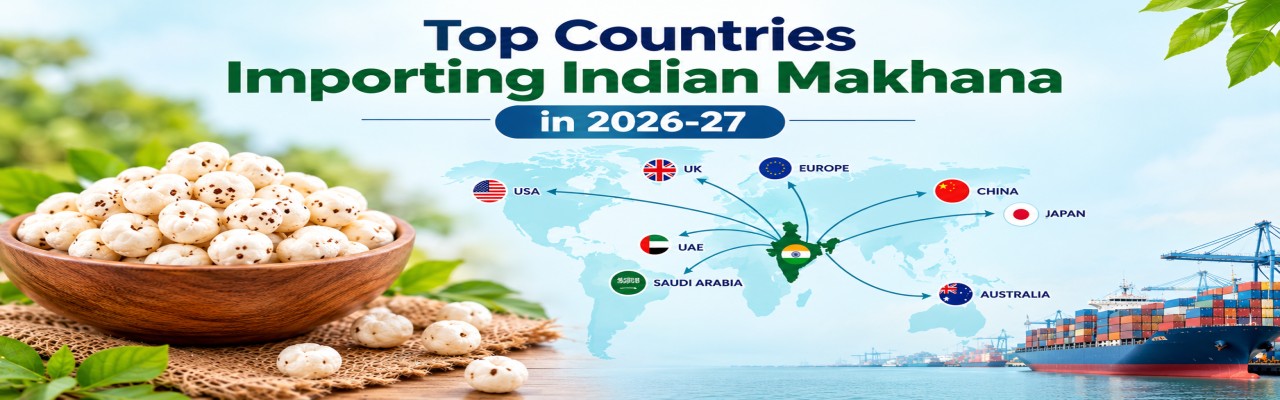
India exports makhana to several international markets. The USA, UAE, UK, Canada, Australia and other Gulf, European and Southeast Asian markets are key demand centers. Demand generally comes from two major consumer groups:
Indian and South Asian diaspora communities familiar with makhana. Health-conscious consumers looking for plant-based, gluten-free and convenient snack products.
Major Markets for Indian Makhana
|
Region |
Important Markets |
Why They Buy Indian Makhana |
|
North America |
USA, Canada |
Indian diaspora, health-food brands, grocery chains and online sellers |
|
Middle East |
UAE, Saudi Arabia, Qatar, Oman, Kuwait |
Indian communities, supermarkets and regional re-export trade |
|
Europe |
UK, Germany, Netherlands and others |
Indian grocery networks and growing healthy-snack demand |
|
Oceania |
Australia, New Zealand |
Indian diaspora and specialty food retailers |
|
Southeast Asia |
Singapore, Malaysia |
Indian communities, food distributors and premium retail |
These markets are not necessarily listed in exact order of import volume. Demand and trade volumes can change from one year to another.
Which Country Imports the Most Makhana from India?
The United States is commonly cited as one of the largest single consumer markets for Indian makhana, and the UAE is also a particularly important market and trading hub. However, exporters should be careful with claims such as "No. 1 importer" because exact rankings depend on:
-
The year being measured
-
Customs classification
-
Whether the data represents imports or consumption
-
Whether re-export activity is included
-
The data source used
For an exact 2026-27 ranking, exporters should use the latest official trade statistics or a reliable shipment database.
What Are the Top 3 Importers of Indian Makhana?
The USA, UAE and UK are frequently identified as leading markets for Indian makhana, while Canada is also an important demand market.
1. USA
The US market offers opportunities for:
-
Indian grocery importers
-
Food distributors
-
Healthy-snack brands
-
Online retailers
-
Private-label companies
-
Specialty food stores
The market can also support premium products such as roasted, flavored, organic and retail-packed makhana.
2. UAE
The UAE is important not only as a consumer market but also as a food-trading and re-export hub. Dubai, in particular, provides access to:
-
Supermarket chains
-
Food wholesalers
-
Indian grocery businesses
-
Import-export companies
-
Regional Gulf markets
3. UK
The UK has an established Indian grocery and distribution network, making it an attractive market for Indian food products. Makhana can be sold through:
-
Indian grocery chains
-
Ethnic-food distributors
-
Health-food stores
-
Online retailers
-
Snack brands
Canada, Australia and other European markets can also be considered depending on the exporter's product, certifications and buyer requirements.
Why Is Demand for Indian Makhana Growing in 2026-27?
Several factors are supporting international interest in makhana.
Growing Healthy-Snack Demand: Consumers increasingly seek alternatives to heavily fried or highly processed snacks. Makhana can be positioned as a light roasted snack, depending on preparation and ingredients.
Growth of Indian Food Products: Indian food products already have established distribution networks in countries with large Indian communities.
Rise of Branded Makhana: Exporters are increasingly moving beyond bulk products toward:
-
Roasted makhana
-
Flavoured makhana
-
Organic products
-
Retail-ready packs
-
Private-label products
These products can offer more value than unprocessed bulk supply, although they also require greater investment in processing, packaging and marketing.
Government and Industry Support: Makhana has received increasing policy attention in India, including the announcement of a Makhana Board for Bihar in the Union Budget 2025-26. Exporters should monitor government announcements for developments in 2026-27.
GI Recognition: Mithila Makhana has a Geographical Indication (GI) tag, which can support origin-based branding and help differentiate products from other sources.
What Is Makhana Called in the USA?
Indian makhana may be sold in the US market under several names, including:
-
Fox nuts
-
Lotus seeds
-
Puffed lotus seeds
-
Phool makhana
-
Popped lotus seeds
The botanical name is Euryale ferox. Because terminology varies between sellers and consumers, exporters searching for US buyers should use several relevant product terms rather than relying on "makhana" alone.
Who Buys Makhana in the USA?
No single category of makhana buyer exists in the United States. Potential buyers include:
|
Buyer Type |
Typical Requirement |
|
Importers and distributors |
Bulk makhana and consistent supply |
|
Indian grocery distributors |
Popular grades and ethnic-food packaging |
|
Snack brands |
Clean, uniform popped makhana for roasting and flavoring |
|
Online sellers |
Retail-ready packaging and shelf-life information |
|
Private-label companies |
Custom packaging and repeat supply |
|
Foodservice businesses |
Suitable grades for recipes and food preparation |
Indian exporters can identify potential US buyers through:
-
Import and shipment databases
-
Indian grocery chains
-
Specialty-food distributors
-
Food trade fairs
-
Natural and organic food exhibitions
-
LinkedIn
-
B2B marketplaces
-
Private-label food companies
When approaching a buyer, prepare a professional product profile containing:
-
Product photographs
-
Grade and size
-
Available quantity
-
Packaging options
-
Certifications
-
Lab reports where applicable
-
Minimum order quantity
-
Payment terms
-
Incoterms
-
Export experience
Always conduct appropriate buyer verification before agreeing to shipment and payment terms.
What Is the Price of 1 kg Makhana in the USA?
There is no single fixed price for 1 kg of makhana in the USA. The retail price can vary according to:
-
Grade
-
Brand
-
Pack size
-
Organic certification
-
Flavouring
-
Packaging
-
Import costs
-
Distributor margins
-
Retailer margins
One kilogram is approximately 35.3 ounces. To compare US retail prices, convert the listed pack price into a per-ounce price and multiply it by approximately 35.3. For B2B exporters, wholesale and import prices are more relevant than retail shelf prices.
What Determines the Price of Makhana in International Markets?
The price of Indian makhana varies by destination. Major cost factors include:
-
Makhana grade
-
Size and quality
-
Harvest season
-
Processing
-
Cleaning and sorting
-
Packaging
-
Freight
-
Insurance
-
Import duties and taxes
-
Certification
-
Distributor margins
-
Retail positioning
A premium branded product can cost substantially more than bulk raw or unbranded makhana.
Makhana Export Price Per Kg
There is no permanent export price per kilogram. Export quotations depend on the product specification and commercial terms.
Factors Affecting Export Price
|
Factor |
Impact on Price |
|
Size/grade |
Larger, uniform pops generally command higher prices |
|
Colour |
Clean, naturally bright product is preferred |
|
Processing |
Sorting, cleaning and quality control add value |
|
Packaging |
Retail packaging costs more than bulk packing |
|
Order quantity |
Larger orders may receive different pricing |
|
Incoterms |
EXW, FOB and CIF prices cannot be compared directly |
|
Certification |
Organic and other certifications may increase costs |
|
Destination |
Freight and import costs vary by market |
What Is the Price of 1 kg Makhana in Bihar?
Bihar generally offers competitive source-level prices because it is India's primary production and processing region. However, the price of 1 kg makhana depends heavily on:
-
Grade
-
Season
-
Supplier
-
Processing quality
-
Quantity
Whether you buy from a farmer, processor, wholesaler or retailer. For a genuine current quotation, buyers should contact processors and wholesalers in Darbhanga, Madhubani and other Bihar production areas and clearly specify the required grade. Never compare two quotations without confirming that the grades and specifications are the same.
In Which State Is Makhana the Cheapest?
Bihar is generally the most competitive sourcing state for makhana because it is the country's main production region. Buying closer to the source can reduce:
-
Transportation costs
-
Additional trader margins
-
Handling costs
However, seasonal availability and grade can cause prices to vary.
Who Is the Leading Makhana Importer in Dubai?
No universally verified public ranking identifies the "No. 1" makhana importer in Dubai. The UAE market includes:
-
Food importers
-
Wholesale distributors
-
Indian grocery suppliers
-
Supermarket suppliers
-
Food-trading companies
-
Re-export businesses
Dubai matters because it serves as both a consumer market and a regional trading hub.
How to Find Dubai Makhana Buyers
Exporters can:
-
Search food-import directories
-
Attend UAE food trade fairs
-
Study supermarket shelves
-
Check importer information on product packaging
-
Use B2B platforms
-
Contact food distributors
-
Request buyer references from established exporters
Which Country Produces the Most Fox Nuts?
India leads makhana production, with Bihar accounting for the largest share of Indian production. Makhana is also grown or harvested in parts of countries such as:
-
Nepal
-
Bangladesh
-
China
-
Japan
-
Korea
-
Russia's Far East
However, India has a particularly strong commercial ecosystem around makhana cultivation, processing and export.
Where Is Makhana Produced in India?
Bihar is the main production center, especially the Mithila region. Important production and trading areas include:
-
Darbhanga
-
Madhubani
-
Saharsa
-
Supaul
-
Purnia
-
Katihar
-
Araria
-
Kishanganj
Other states and regions have smaller or emerging makhana cultivation, including:
-
Assam
-
West Bengal
-
Manipur
-
Odisha
-
Tripura
-
Uttar Pradesh
-
Madhya Pradesh
-
Rajasthan
There is no reliable official district-by-district "top 10 producer" ranking that can be used to assign exact positions to these regions.
Which City Is Famous for Makhana?
Darbhanga and Madhubani are among the most well-known cities associated with makhana. Both are located in Bihar's Mithila region, which has a long history of makhana cultivation, processing and trade. Makhana is deeply connected with the food culture of Mithila and is used in:
-
Fasting foods
-
Sweets
-
Kheer
-
Traditional dishes
-
Snacks
-
Religious offerings
Makhana's regional identity is also reflected in the Mithila Makhana GI tag.
Which Grade of Makhana Is Best?
The best grade depends on the buyer's intended use. For premium retail and export products, buyers generally prefer large, uniform, naturally white and crunchy pops. Makhana is commonly sorted into size grades, often described as 3 suta, 4 suta, 5 suta or larger. However, grading terminology can vary between suppliers.
Makhana Grade by Application
|
Buyer Requirement |
Suitable Product |
|
Premium retail |
Large, uniform and bright-white pops |
|
Flavoured snacks |
Medium to large uniform pieces |
|
Sweets and kheer |
Medium or smaller grades |
|
Budget bulk supply |
Smaller or mixed grades, clearly specified |
What Should Buyers Check?
Before placing a bulk order, check:
-
Size uniformity
-
Natural colour
-
Broken pieces
-
Black or brown spots
-
Crunch
-
Moisture
-
Odour
-
Cleanliness
-
Packaging
-
Batch information
Always request a physical sample before placing a large order.
How to Identify Poor-Quality or Fake Makhana?
There is no single home test that can guarantee authenticity, but buyers can identify several quality warning signs.
1. Check the Colour: Good-quality makhana is generally creamy or naturally white. An unnaturally bright or chalky appearance may require further investigation.
2. Check the Smell: Fresh makhana should not have a strong chemical, stale or musty smell.
3. Check the Size: Premium grades should have reasonably consistent sizing.
4. Check the Texture: Properly processed and popped makhana should be light and crisp rather than rubbery or unusually soft.
5. Check the Packaging: For packaged products, look for:
-
Manufacturer/packer details
-
Batch number
-
Food licence details where applicable
-
Packaging date
-
Relevant certifications
6. Check the Price: An unusually low price compared with other quotations for the same grade can be a warning sign.
For commercial export purchases, buyers should rely on samples, specifications, laboratory testing and contractual quality clauses rather than visual inspection alone.
How to Export Makhana from India?
Indian businesses interested in exporting makhana need to combine product sourcing with regulatory compliance, quality control, packaging and international logistics.
Step 1: Set Up the Business
Establish the appropriate business structure and open a business/current bank account.
Step 2: Obtain IEC
An Importer-Exporter Code (IEC) from DGFT is generally required for export activities, subject to applicable exemptions.
Step 3: Complete Food-Related Registrations
Obtain the applicable food licence and determine whether APEDA registration/RCMC or other registrations are required for the proposed product and export activity.
Step 4: Understand GST Requirements
Exporters should understand the applicable GST treatment, including procedures for zero-rated exports and refund/ITC mechanisms.
Step 5: Confirm Product Classification
Determine the correct customs/HS classification with the help of an experienced customs professional where necessary.
Step 6: Source and Test the Product
Work with reliable processors and check parameters relevant to the buyer and destination market, which may include:
-
Moisture
-
Microbial limits
-
Pesticide residues
-
Aflatoxin or other contaminants
-
Product cleanliness
-
Shelf life
Step 7: Choose Export Packaging
Use food-grade packaging that protects the product from:
-
Moisture
-
Contamination
-
Physical damage
-
Loss of quality during transportation
Step 8: Meet Destination Labelling Rules
Labels must comply with the regulations of the destination country.
Step 9: Prepare Export Documents
Depending on the shipment, documentation may include:
-
Commercial invoice
-
Packing list
-
Certificate of origin
-
Bill of lading
-
Air waybill
-
Food or quality certificates
-
Other destination-specific documents
Step 10: Select Incoterms and Freight
Exporters should understand the commercial implications of terms such as:
-
EXW
-
FOB
-
CIF
-
Other agreed Incoterms
Use a freight forwarder or customs professional experienced in food exports.
Step 11: Verify Payment and Buyer
For new buyers, use appropriate payment-security measures and verify the buyer's business details before shipping.
Destination-Wise Makhana Export Requirements
Requirements vary by destination and product type.
|
Market |
Areas to Check |
|
USA |
Food facility requirements, prior notice, labelling and importer responsibilities |
|
EU/UK |
Food safety, residue limits, labelling and importer documentation |
|
UAE/Gulf |
Labelling, shelf life, importer licensing and buyer-specific certifications |
|
Canada/Australia |
Food import requirements, labelling and applicable biosecurity rules |
These are general areas to verify rather than a complete legal checklist. Exporters should confirm current requirements with the relevant destination-country authorities and their importer.
How to Find Makhana Buyers Internationally?
Finding the right buyer is just as important as having a quality product. Indian makhana exporters can use:
-
B2B marketplaces
-
International food trade fairs
-
Trade-data platforms
-
Export promotion bodies
-
LinkedIn
-
Direct outreach to importers
-
Private-label companies
-
Grocery distributors
-
Health-food brands
A Practical Buyer-Finding Strategy
Here is a practical buyer-finding strategy for you:
1. Build a professional supplier profile
You must include:
-
Company information
-
Product photographs
-
Grades
-
Available quantity
-
Packaging
-
Certifications
-
Testing information
-
Production capacity
-
Export markets
2. Target the right buyer
Instead of sending the same message to everyone, target:
-
Import managers
-
Procurement managers
-
Category managers
-
Food distributors
-
Private-label buyers
-
Snack brands
3. Offer Samples
International food buyers generally need to evaluate quality before committing to a large order.
4. Provide Clear Specifications
Mention the exact:
-
Grade
-
Size
-
Moisture specification
-
Packaging
-
Quantity
-
Shelf life
-
Price basis
-
Incoterm
5. Verify the Buyer
Before shipping, check the buyer's:
-
Company registration
-
Website
-
Business address
-
Import history where available
-
References
-
Payment record
-
Proposed payment terms
-
Where Is the Best Place to Buy Makhana Wholesale?
For buyers looking to source directly from the main production region, Bihar particularly Darbhanga and Madhubani is one of the most important wholesale sourcing locations. Other options include established food wholesalers and verified B2B marketplaces.
Before buying in bulk:
-
Request a sample.
-
Confirm the grade in measurable size terms.
-
Ask for food-safety and batch information.
-
Compare at least three quotations.
-
Check processing and packing facilities where possible.
-
Start with a trial order.
-
Finalise quality specifications in writing.
Is Makhana a Profitable Business?
Makhana can be a profitable business, but profitability depends on the business model. Simply buying and reselling bulk makhana is different from operating a branded snack business or exporting value-added products.
|
Business Model |
Potential Advantage |
Main Challenge |
|
Raw bulk trading |
Lower setup requirement |
Lower margins and price fluctuations |
|
Graded and packed makhana |
Better price realisation |
Sorting and quality-control costs |
|
Branded/flavoured snacks |
Higher value potential |
Marketing and competition |
|
Export business |
Access to international buyers |
Compliance, logistics and payment risk |
Profitability depends on:
-
Purchase price
-
Grade
-
Wastage
-
Processing costs
-
Packaging
-
Freight
-
Working capital
-
Selling price
-
Buyer acquisition costs
-
Market demand
Therefore, businesses should prepare a detailed cost sheet before entering the makhana trade rather than relying on a fixed profit percentage.
How to Choose the Best Makhana Supplier?
There is no single company that is objectively the "best" makhana supplier for every buyer. The right supplier depends on your requirement. Look for:
-
Consistent quality
-
Clear grading
-
Reliable supply
-
Food licence and certifications where applicable
-
Laboratory reports
-
Proper packaging
-
Transparent pricing
-
Sample availability
-
Export experience
-
Good communication
-
Repeat-buyer references
For bulk procurement, compare samples from at least three suppliers before making a large purchase.
Current Makhana Market Trends in 2026-27
The makhana industry is receiving increased attention because of:
-
Growing international snack demand
-
Expansion of branded makhana
-
Export opportunities
-
Increasing interest in value-added products
-
GI-based origin branding
-
Government attention to Bihar's makhana sector
The Makhana Board for Bihar, announced in the Union Budget 2025-26, is another development that has increased attention around the sector.
Conclusion
Indian makhana has developed from a traditional Indian food into a product with growing international potential. The USA, UAE, UK, Canada, Australia, Gulf countries and selected European and Southeast Asian markets are important demand centres. Among these, the USA offers a particularly large consumer market, while the UAE also functions as a major regional trading and re-export hub.
For Indian exporters, Bihar remains the most important sourcing region, with Darbhanga and Madhubani serving as major makhana centres.
However, entering the international market successfully requires more than finding a buyer. Exporters should focus on consistent grading, quality testing, appropriate packaging, destination-country compliance, competitive pricing and reliable buyer verification.
Since makhana prices and export volumes change with season, grade, demand and destination, businesses should use current trade data and supplier quotations rather than relying on outdated price or volume claims.
For manufacturers, wholesalers, exporters and international buyers, the opportunity is strongest when makhana is treated not simply as a commodity but as a quality-controlled, export-ready food product with clear specifications and reliable supply.