What is B2B Trade, and how is it different from B2C and C2C?
The market cap of B2B trade is far higher than that of B2C. According to a recent report by Mordor Intelligence, business-to-business (B2B) trade is expected to exceed $60 trillion by 2031. Several reasons contribute to this massive growth:
- B2B transactions usually involve bulk purchases and higher order values, which make them larger than B2C transactions.
- Revenue streams are more stable as B2B deals are generally based on long-term relationships.
- Today, online B2B marketplaces also play an important role in helping businesses connect, generate leads, and expand their reach.
- In fact, these platforms have made B2B trade more accessible for small and medium-sized businesses.
So whether you are a manufacturer, supplier, wholesaler, or entrepreneur, it is important for you to understand B2B and how it works. This blog explains different business models, including B2B, B2C, and C2C, and how they differ.
What is B2B Trade?
B2B stands for "business to business”. As the name itself suggests, Business-to-Business (B2B) dealings are between two businesses.
Unlike the conventional business model, where the target audience is direct consumers, in B2B trade, business owners are the primary targets.
Generally, B2B deals can involve raw materials, finished goods, machinery, software, consulting services, or any other business requirement. In B2B, a company is selling products or services to another company.
Here are two examples of B2B transactions for products and services:
- B2B Product Example: A manufacturer supplying equipment and raw materials to factories.
- B2B Service Example: A digital marketing company offering SEO services to a luxury apparel brand.
What is B2C Trade?
B2C (business-to-consumer) refers to businesses selling products and services directly to individual consumers. This is the type of transaction most people experience every day.
The main objective in B2C is to satisfy consumer needs and preferences. Retailers have direct contact with consumers. A common cycle of the economy is-
- Manufacturers→ Wholesalers→ Retailers→ Consumers
Consumers come at the last stage of finished goods and personalised services.
Unlike B2B buyers, consumers make purchasing decisions faster and are influenced by several other factors, such as advertising, reviews, convenience, and most importantly, emotions.
What is the C2C Trade?
Though not as popular as B2B and B2C, C2C is another form of profit-generating business model. Here, the transfer of goods and services is between two consumers.
In simple words, the C2C trade involves transactions between individual consumers, often facilitated by online marketplaces.
Today, anyone can become a seller using an online marketplace. Common examples of C2C trade include:
- Selling used furniture
- Trading collectible
- Reselling electronics or a used vehicle

Real Difference between B2B vs B2C vs C2C
B2B, B2C, and C2C all sound similar, but they are different business models. The key differences between these models are as follows:
|
Feature |
B2B |
B2C |
C2C |
|
Full Form |
Business to Business |
Business to Customer |
Customer to Customer |
|
Buyer |
Business |
Individual customer |
Individual customer |
|
Seller |
Business |
Business |
Customer |
|
Product Purpose |
Business operations |
Mostly for personal use |
Personal use |
|
Order Value |
Large |
Generally small |
Small |
|
Sales cycle |
Long |
Short |
Short |
|
Pricing |
Negotiated |
Fixed |
Fixed |
Advantages of B2B Over Other Trade Models
The business-to-business model offers more advantages as compared to other trade models. Here are the key benefits:
- Higher Revenue Potential
- Strong Customer Retention
- Predictable Revenue
- Reduced Operational Costs
1. Higher Revenue Potential
A single deal in B to B trade can bring revenue worth millions of rupees. Businesses take time before engaging in BtoB trade and placing orders.
But when they do, generally bulk orders are placed. And these orders bring higher revenues.
So, unlike the B2C trade, the number of orders may be lower, but the overall revenue is higher.
For example, manufacturers often secure contracts that cover months or years of supply for different businesses.
2. Strong Customer Retention
According to the McKinsey B2B survey, suppliers and manufacturers are far more cordial in B2B trade.
This is possible because many businesses prefer maintaining long-term supplier relationships once trust has been established.
3. Predictable Revenue
Successful business owners do not change suppliers or manufacturers too often.
Instead, long-term contracts are established to foster better partnerships. This ultimately helps in getting a predictable revenue stream.
Unlike individual loyalty in B2C or C2C, which can shift at any time when better pricing options arise. Business to business deals last longer.
4. Reduced Operational Costs
The operational costs of running a business are not much higher. There is no need to have a large store or shop to provide goods, as the target audience is not individual consumers.
This essentially reduces the per-unit cost of packaging, shipping, and fulfilment.

How Does B2B Trade Work? Step-by-Step Process
The buying process in the B2B trade is quite complex compared to B2C.
As you already know, B2B involves two businesses dealing mostly in long-term partnerships, so the process has multiple steps, which are:
Step 1: Identifying a Business Need
The process begins by identifying a challenge or opportunity for a business. For example, if you are a mobile phone manufacturer, you may need chips.
You may look for a supplier who can supply these chips for your business.
Step 2: Finding the Supplier
Businesses rarely buy from suppliers they find for the first time. Instead, they evaluate multiple vendors. Before you finalise a supplier for your business, you need to consider these factors:
- Industry experience
- Product quality
- Pricing
- Reputation
- Delivery capabilities
Step 3: Comparing Solutions
This is also another important part of the B to B trade deal; it is vital to compare different solutions. The common questions can include:
- Which solution provides the best value?
- Which supplier offers reliable support?
- Can the product scale with business growth?
- What are the long-term costs?
Step 4: Negotiation and Contract Discussion
After comparing different options, the next step is to negotiate and discuss the contracts. Generally, in a B to B deal, prices are not fixed.
As businesses place bulk orders, there is a possibility to negotiate pricing and come to better terms. Generally, at this step, the business:
- Try to reach better pricing
- Sign long-terms contracts
Step 5: Purchase and Implementation
The last step involves implementation. If you have purchased the products, you need to integrate them into the inventory.
However, if you have purchased services or software, the implementation process may include training sessions, onboarding, and process integration.
Types of B2B Trade
All B2B are not the same. And the business to business models are also divided into different categories. These are different types of B2B trade:
- Manufacturer to Manufacturer
- Wholesaler to Retailer
- Service-Based B2B
1. Manufacturer to Manufacturer
When one manufacturer supplies materials or components to another manufacturer. This is the most common business model that comes to mind when we talk about B2B.
For example, when a car manufacturer purchases tyres, batteries, and steel components from a specialised supplier.
These partnerships are quite important, and the final product would not exist without them.
2. Wholesaler to Retailer
Wholesalers generally buy or manufacture the products in bulk and then sell them to the retailers. These retailers then sell these products to the consumers, which becomes B2C.
Generally, retailers have direct access to consumers, making it easy for them to reach out and offer products at better prices.
3. Service-Based B2B
As the name itself suggests, this business model involves service providers offering their services to different businesses.
There are various businesses that specialise in providing customised services to meet the needs of other businesses.
Examples of service-based B2B include SaaS, legal consultation, and corporate law.
Example of B2B Trade Marketplace
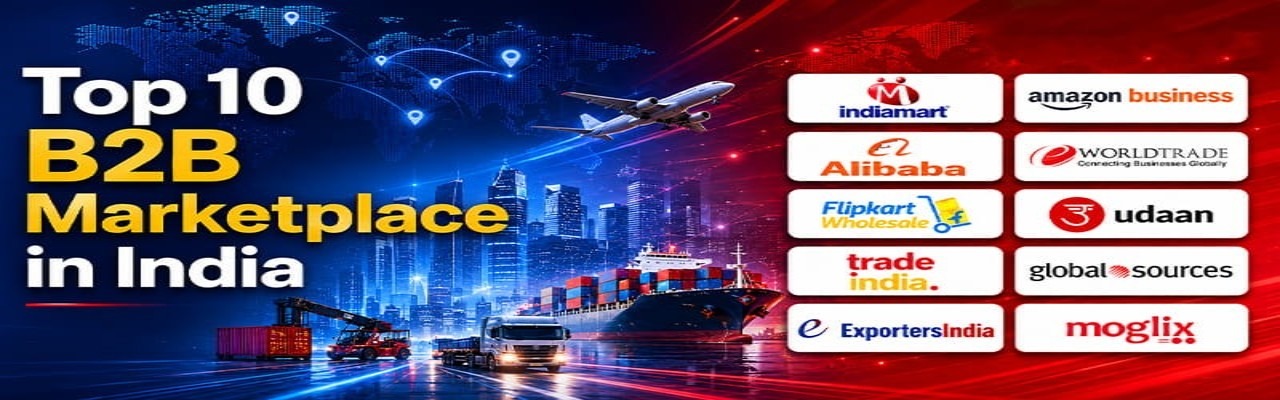
A B2B marketplace is an online business-to-business platform that connects manufacturers, suppliers, wholesalers, and buyers in one place. These platforms make it easier for businesses to find products, compare suppliers, send inquiries, and close deals without visiting multiple vendors.
Some of the examples of B to B trade marketplaces are as follows:
- IndiaMart
- B2B Trademart
- Trade India
- Exporters India
- Just Dial
India Mart
IndiaMart is a well-known online B2B marketplace in India. It caters to many different industries, including machinery, electronics, mechanics, packaging, healthcare, and construction.
This platform helps businesses generate leads from buyers. Not only that, but IndiaMart also allows suppliers to respond with quotations and details.
For instance, suppose you are a restaurant owner and want to purchase commercial kitchen equipment. You can easily post a request for kitchen equipment on IndiaMart and receive quotations from several suppliers in a short time. Based on the available options, you can compare and negotiate better prices.
B2B Trademart
B2B Trademart is also one of the emerging online marketplaces in India that helps manufacturers, exporters, suppliers, and traders to promote their products and connect with buyers. The platform allows businesses to list their products, create company profiles, and generate leads across a wide range of industries.
For small and medium-sized enterprises (SMEs), B2B Trademart is ideal, as it helps them gain online visibility and grow their customer base.
B2B Trademart’s core strength is its wide range of product categories, which are:
- Industrial Machinery
- Industrial Suppliers
- Ayurvedic and Herbal Products
- Home and Furniture Suppliers
- Textile, Yarns, and Fabrics
- Food Products and Beverages
Trade India
Trade India is one of India’s oldest B2B marketplaces. Founded in 1996, Trade India connects buyers and sellers across various industries. Different suppliers can create a business profile on this platform to showcase their products and services to potential buyers.
Even buyers can search for products by category, compare different products from suppliers, and request a quotation directly through the platform.
For example, a textile manufacturer in Surat looking for industrial dye can search on TradeIndia and find multiple suppliers from Gujarat, Maharashtra, Madhya Pradesh, and other states. Similarly, a buyer can compare prices, product specifications, and supplier ratings before making a final decision.
Exporters India
For domestic and international businesses and suppliers, Export India works as a common marketplace. Export India allows businesses to promote their products in global markets and export to international markets.
On this platform, businesses can easily create a detailed company profile, list products, and receive queries from buyers. Export India ultimately allows businesses to:
- Build relationships through an international buyer-seller network
- Promote their products for exporters
- Get quality trade leads and inquiries
Just Dial
Just Dial primarily works as a business directory platform. Buyers can use this platform to discover suppliers, service providers, manufacturers, and wholesalers for a specific location. It essentially plays a role in B2B commerce and works as a local search platform.
Why Choose the B2B Trademart for B2B Trade?
Here are some of the reasons why you should choose the B2B Trademart for B to B trade:
- B2B Trademart gives you a platform to showcase your products and services to a broader audience.
- On our platform, you can generate better leads for your business. In fact, you can connect with buyers who are actively looking for your products and services, thereby increasing your chances of generating leads.
- You get a stronger brand presence in the online marketplace. Your business’s online profile improves your business’s visibility and establishes credibility in competitive markets.
- Compared to traditional advertising and offline marketing, B2B Trademart offers you a more affordable way to promote your business.
- Other than marketing benefits, B2B Trademart gives you long-term support for business growth.
Conclusion
To sum up the blog, B2B trade is much more than businesses selling products to other businesses. And a lot of people get confused between B2B, B2C, and C2C. But they are fundamentally different.
While B2B involves business-to-business transactions, B2C means business to customer dealinng which are also known as retail, and C2C has customer to customer transactions.
Ultimately, all these business models work differently. Businesses need specialised strategies for B2B growth and for identifying the right sales models.
If you are looking to grow your business, generate high-quality leads, and connect with trusted buyers and suppliers across industries, we at B2B Trademart can assist you in taking the next step.