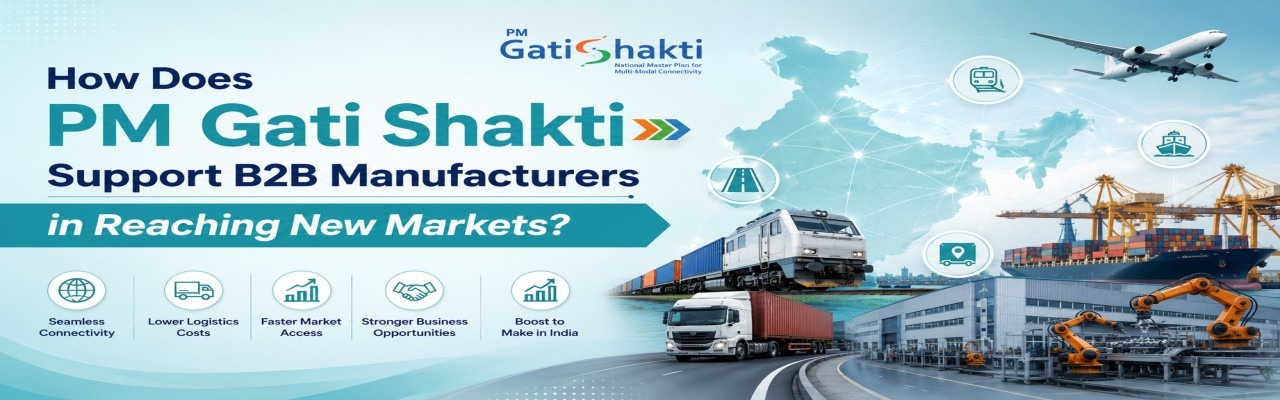
PM Gati Shakti Yojana is a multimodal connectivity program to empower the interactive Geographic Information System through roads, railways, ports, airways, waterways, and logistics infrastructure.
But how PM Gati Shakti master plan support B2B manufacturers in reaching new markets?
Infrastructure plays a crucial role in making transportation efficient so that businesses can integrate their logistics effectively.
In simple words, the PM Gati Shakti plan will boost India’s infrastructure, which will significantly help the business sector in channeling their transportation and logistics promptly.
To understand how PM Gati Shakti supports B2B manufacturers in reaching new markets, continue reading this blog.
From the program’s introduction and the ministries involved to the platform covering the program and its advantages for B2B businesses, you will learn all here. Let’s get started!
What is PM Gati Shakti Yojana?
PM Gati Shakti National Master Plan is a digital platform integrated via a Geographic Information System (GIS)-based tool. It is a multi-modal connectivity program worth ₹100 lakh crore.
This master plan will transform India’s infrastructure landscape with an integrated focal point.
Roads, railways, airways, ports, waterways, logistics, and mass transport are the 7 core engines that will benefit from this plan.
So far, 57 central ministries and government departments from infrastructure, economic, social, and other sectors are integrated under the Gati Shakti mission.
The program is basically made to streamline the transportation of people and goods pan-India.
As a result, this masterplan will help reduce transportation costs and will improve logistics efficiency.
From a B2B business’s perspective, PM Gati Shakti Yojana will bridge the gap between supplier and buyer by reducing transit time.
Additionally, transportation will become prompt, and manufacturers will be able to reach even the remote areas in India.
When was the PM Gati Shakti National Master Plan Launched?
Prime Minister Narendra Modi announced the PM Gati Shakti National Master Plan on October 13th, 2021.
The plan was launched to enhance transportation efficiency and connectivity across the country.
Various economic zones in India are seeking the benefits of the program, whether businesses, manufacturers, government agencies, or the general public.
The Gati Shakti multi-modal plan will connect over 1200 industries, agricultural zones, and defense corridors for seamless operations.
Businesses and manufacturers will be able to reduce their logistics costs. Simultaneously, government agencies & planners will narrow the departmental structure and eliminate work duplication by utilizing the geospatial digital platforms.
Lastly, the plan was launched by keeping the public’s convenience in mind.
The Gati Shakti Yojana is streamlining development in the transportation sector for roadways, railways, waterways, airways, and mass transportation.
This accelerated development will reach almost every region, making life easier and more convenient.
How many Ministries and Departments are integrated under PM Gati Shakti?
A total of 57 central ministries and departments are integrated under the PM Gati Shakti plan.
27 among them are from economic backgrounds, 22 are from social sectors, and 8 are from infrastructure.
Using the GIS tracking system, accessing real-time data becomes easy.
Ministries can use that feature to track comprehensive geographies and make informed decisions.
What are the seven core engines of PM Gati Shakti?
Seven core engines are:
- Roads
- Railways
- Airports
- Ports
- Waterways
- Mass Transport
- Logistics Infrastructure
Which Technology Platform is Central to PM Gati Shakti Planning?
Geographic Information System (GIS) is the technology platform that is central to the PM Gati Shakti plan.
This National Master Plan (NMP) is a digital platform featuring a GIS-enabled, data-driven system.
It helps in making informed decisions regarding the planning of integrated infrastructure.
Additionally, this digital platform unifies Central Ministries, State Governments, and Union Territories.
Apart from planning infrastructure development, the PM Gati Shakti platform also helps monitor, synchronize, and implement infrastructure projects.
The platform was developed by BISAG-N (Bhaskaracharya National Institute for Space Applications and Geoinformatics).
This support system presents multiple layers of geospatial data using satellite images from ISRO (Indian Space Research Organisation.
Moreover, MEGHRAJ, a Government of India cloud, is used to host the platform securely.
Ministries and government departments use it for mapping economic zones, visualizing terrain, and real-time coordination with project infrastructure.

Which Sector is Not Directly Covered Under PM Gati Shakti?
The PM Gati Shakti multimodal plan mainly focuses on infrastructure, economic zones, logistics, transportation, and connectivity.
The social sector, economic sector, and infrastructure come under this plan after coordinated planning.
But agriculture, art & culture, social security schemes, financial services, and customer welfare schemes are not directly listed under the program.
The agriculture sector is not directly covered under the PM Gati Shakti National Master Plan.
However, improved connectivity may benefit the agricultural sector and agri-zones in one way or another.
But how PM Gati Shakti master plan support B2B manufacturers in reaching new markets?
Well, the plan may not directly benefit the agriculture sector, but there are other sectors that might interest B2B manufacturers.
Industrial corridors, textile clusters, defense corridors, electronic parks, pharmaceutical clusters, etc., are some economic zones that are directly benefiting from this national master plan.
As a result, IT Communication, bulk water, sewerage networks, and energy transmission get the support they require.
Advantages of Using GIS Mapping in PM Gati Shakti
GIS mapping supports the PM Gati Shakti plan by integrating over 1600 spatial data layers.
The mapping features environmental zones, showcases existing transport networks, highlights utility lines, and presents all of this on a centralized dashboard.
To understand how PM Gati Shakti master plan support B2B manufacturers in reaching new customers, first, you need to understand the advantages of using GIS mapping.
According to the PM Gati Shakti plan, many benefits can transform India’s infrastructure planning.
With GIS mapping, planning projects separately or one by one is not necessary.
In fact, it can reduce the time required in project conception.
In simple terms, project planning used to take 3-4 months, but with GIS mapping, the duration has reduced to 1 month.
Plus, all ecological factors and residential disruptions have been eliminated.

The following are some advantages of using GIS mapping in PM Gati Shakti Planning:
1:- Data Integration in Real Time
GIS mapping helps save time with real-time monitoring. Project tracking collects data among stakeholders, ministries, and government departments.
The tool collects data from over 60 central and state portals at once.
Road networks, railway lines, and underground utilities are some intersecting assets that are carefully visualised in this type of planning.
This data integration helps prevent a collision between a road manufacturing plan and an already existing railway line.
2:- Route Planning Optimization
GIS mapping helps in route planning and optimization while considering multiple criterias.
The analysis generates short and cost-effective designs on multimodal routes.
It also helps identify bottlenecks for land acquisition minimization and finding the shortest possible route.
3:- Reducing Ecological Impact
Planners use GIS mapping to identify forest landscapes, wildlife corridors, and water bodies.
Identifying these is essential to ensure that the environment, wildlife, and water bodies are not affected when the plan goes ahead.
Also, reducing ecological impact protects the environment and the concerned animals of the ecosystem.
4:- Enhanced Last-Mile Connectivity
GIS mapping provides spatial insights on remote areas and allows planners to identify the exact locations of economic and social hubs.
By identifying these hubs, planners can integrate resources and streamline supply chain optimization.
5:- Progress Monitoring at Different Levels
To help planners keep track of real-time data, GIS mapping sends periodic updates and satellite images. Stakeholders monitor the progress of their plans on this basis.
Plus, they can easily adapt to changes in their plan if any new changes are to be introduced.
Is PM Gati Shakti Yojana Helpful for B2B Manufacturers?
Yes, PM Gati Shakti Yojana is helpful for B2B manufacturers in India.
The platform is integrating the 7 core engines, i,e., railways, roads, ports, waterways, airports, mass transport, and logistics infrastructure by improving multi-modal connectivity.
Significantly, improved geographical infrastructure will also improve industrial productivity.
With integrated infrastructure, B2B manufacturers will be able to use this unified digital platform to tackle pain points in their supply chain management.
The platform has numerous advantages for B2B businesses, such as:
- Lowering Logistics Costs
- Better Efficiency & Traceability
- Improvement of First and Last-Mile Connectivity
- Boosting Market Accessibility
Lowering Logistics Costs
PM Gati Shakti plan will lower supply chain and transportation costs by allowing manufacturers to reach buyers on time.
Using developed infrastructure, businesses can prepare a thorough plan to improve their supply chain management and cut expenses.
As a result, businesses dealing in bulk cargo shipment will use the Dedicated Freight Corridors and their high-speed transportation alternatives over their expensive competitors.
Better Efficiency & Traceability
B2B manufacturing companies use the Unified Logistics Interface Program, a digital tool to track their shipments across different modes of transportation.
This tool makes even complex transportation media traceable, which automatically improves work efficiency by making transportation more accessible.
Improvement of First and Last-Mile Connectivity
Warehousing, cold storage, and cargo shipments are part of the MMLPs (Multi-Modal Logistics Parks).
They are used to transfer goods in a single location, which eliminates unnecessary expenditure and time spent on handling goods.
Boosting Market Accessibility
Using the PM Gati Shakti plan, B2B suppliers can reach remote locations promptly, which felt like quite a challenge earlier.
Nowadays, manufacturers are targeting regional markets in no time.
The integrated infrastructure helps businesses streamline their delivery structure and speed up the process.
The Bottom Line
In the end, the PM Gati Shakti plan is a multi-level plan that supports many zones in the best ways possible.
This multimodal plan will surely enhance transportation efficiency by strengthening the 7 core engines of India’s transportation system.
Roads, railways, airways, ports, waterways, logistics, and mass transport are benefiting from this plan as it is making transportation prompt for businesses, manufacturers, government agencies, or the general public.
So, how PM Gati Shakti master plan support B2B manufacturers in reaching new markets?
Considering the advantages of the PM Gati Shakti Yojana, B2B manufacturers can lower their logistics costs and access the ease of last-mile connectivity, even in remote areas of India.
Furthermore, manufacturers can track their shipments using the unified interface program and improve efficiency to reach the market with speedy delivery.
Disclaimer:
Any information provided in this blog is for informational purposes only. B2B TradeMart does not represent or endorse any such programs or policies.