Sugar is one of India's most widely traded agricultural commodities and an important raw material for food, beverage, confectionery, bakery, dairy, and other industries. Because of its importance across the supply chain, even a moderate change in sugar prices can affect manufacturers, wholesalers, traders, retailers, and bulk buyers.
In recent weeks, sugar prices in India have come under increased pressure, raising questions among businesses and consumers about why prices are increasing and whether the trend will continue.
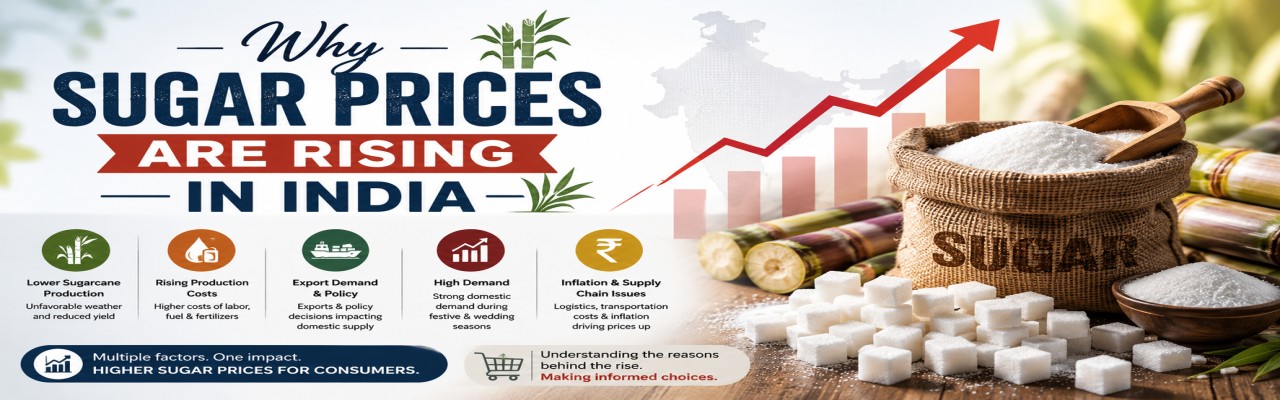
So why are sugar prices rising? There are several reasons behind it. Sugar prices are influenced by sugarcane production, sugar recovery, weather conditions, mill output, inventories, domestic demand, government policies, exports, ethanol production, and global sugar-market conditions.
For B2B buyers, understanding these factors matters because changes in wholesale and ex-mill prices can directly affect procurement costs and profit margins. This article explains the main reasons behind the recent rise in sugar prices in India, its impact on businesses, and the factors that could shape the market's direction in the coming months.
What is Happening to Sugar Prices in India?
The recent rise in sugar prices comes as the Indian market faces concerns about production, availability, and inventory levels. The government of India has taken several measures to address rising domestic sugar prices, including tighter stock limits for certain market participants. The government has also moved to allow duty-free sugar imports in an effort to improve domestic availability and contain price pressure.
These measures indicate that the recent increase is being treated primarily as a domestic supply and availability issue rather than simply a result of higher consumer demand. Sugar prices can vary depending on the:
-
Sugar variety and grade
-
Production region
-
Ex-mill or wholesale market
-
Transportation costs
-
Quantity purchased
-
Local availability
-
Contract terms
-
Seasonal demand
-
Government regulations
Why Are Sugar Prices Rising?
Several factors are contributing to the current pressure on sugar prices. Here are some of the most common reasons:
Lower-than-Expected Sugar Production:
Sugar production is one of the most important factors influencing domestic prices. India's sugar industry depends heavily on sugarcane availability and how much sugar mills can recover from harvested cane. If cane production or sugar recovery falls short of expectations, mills may produce less sugar. The basic relationship is straightforward:
Lower cane availability or recovery → lower sugar production → tighter supply → upward price pressure.
Recent market reports have pointed to concerns about India's sugar output and available stocks as one reason for the price increase. For businesses purchasing sugar in large quantities, production estimates are therefore an important market indicator.
Weather Conditions Are Affecting Sugarcane
Weather is another major factor because sugarcane is an agricultural crop and its productivity depends on growing conditions. Unfavourable weather can affect both the quantity and quality of sugarcane available to mills. Important weather-related risks include:
-
Excessive rainfall
-
Flooding
-
Drought
-
Heat stress
-
Irregular rainfall
-
Water shortages
-
Pest and disease outbreaks
Weather can affect the crop in different ways depending on the region and stage of cultivation. For example, inadequate water availability can reduce crop growth, while excessive rainfall can damage fields or interfere with harvesting and transportation. Weather conditions can also affect the sugar recovery rate mills achieve. This is why sugar prices should not be viewed only as a manufacturing or trading issue. The market is closely tied to farm-level agricultural conditions.
Lower Sugar Stocks and Tighter Supply
Production is only one side of the sugar market. Available inventory is equally important. Sugar produced during one period can be stored and released into the market later. When inventories are comfortable, buyers generally have more supply options. When stocks become tighter, sellers can gain greater pricing power. A simplified relationship is:
Lower available stocks + steady demand = greater price pressure. This matters especially for bulk buyers. A manufacturer may find that the headline production figure looks adequate, but the amount of sugar actually available for immediate purchase in its preferred region may be limited. Recent concerns about domestic availability have led to government intervention, including measures to control stocks and increase supply.
Festive and Seasonal Demand
Demand also drives sugar price movements. India has a large consumption base for sugar, and demand can increase during periods associated with:
-
Festivals
-
Weddings
-
Sweet production
-
Bakery production
-
Confectionery manufacturing
-
Beverage manufacturing
-
Ice cream production
-
Food processing
When demand rises while supply is already relatively tight, prices can respond more strongly. However, seasonal demand should not be considered the sole explanation for the recent increase. Demand effects are generally more significant when they occur alongside concerns about production and inventories.
Government Policies and Sugar Exports
Sugar is a strategically important agricultural commodity in India, so government policy strongly influences the market. The government can use different policy measures to balance the interests of:
-
Sugarcane farmers
-
Sugar mills
-
Consumers
-
Exporters
-
Food-processing industries
Government decisions concerning sugar exports are particularly important because exports reduce the quantity of sugar available in the domestic market. When domestic supply becomes tight, restrictions or changes in export policy can help preserve domestic availability. Conversely, when production is strong and stocks are comfortable, exports can provide mills with access to international markets.
Is Ethanol Production Responsible for the Sugar Price Increase?
The relationship between ethanol and sugar is an important part of India's sugar-market discussion. Sugarcane can be used to produce sugar and ethanol. Therefore, the amount of sugarcane-derived material directed toward ethanol can influence the quantity available for sugar production. In simplified terms:
More diversion toward ethanol → potentially less sugar available. However, it would be misleading to conclude that ethanol production alone is responsible for the current price increase.
Recent government and industry discussions indicate that ethanol diversion alone is not enough to explain the latest price movement. Changes in production, stocks, weather conditions, demand, and government policy also need to be considered. For this reason, businesses should assess the entire sugar balance sheet rather than focusing on ethanol alone.
How El Niño Is Affecting the Sugar Prices in 2026?
El Niño-related weather concerns in 2026 are another factor being watched by the sugar market. Changes in Pacific Ocean conditions can influence global weather patterns and raise concerns about rainfall and temperatures in major sugarcane-growing regions. In India, any prolonged weakness or uneven distribution of monsoon rainfall could affect sugarcane yields and sugar recovery, particularly where irrigation is limited.
These concerns can also influence market expectations before the actual impact on production is known. If traders anticipate weaker cane output or tighter global sugar supplies, prices can come under upward pressure.
However, the impact of El Niño depends on the actual monsoon, regional rainfall and crop conditions. Therefore, it should be considered an additional risk to sugar supply in 2026, alongside India's production, stock and demand conditions.
How Does a Sugar Price Increase Affect Businesses?
The impact of higher sugar prices extends well beyond households. Sugar is a key input for several industries, meaning a sustained increase can affect production costs throughout the supply chain.
Impact on Sugar Manufacturers
For sugar mills and manufacturers, higher market prices can improve selling realisations. However, mills also face costs associated with:
-
Sugarcane procurement
-
Processing
-
Labour
-
Energy
-
Maintenance
-
Storage
-
Transportation
-
Financing
Therefore, a higher selling price does not automatically translate into an equivalent increase in profitability.
Impact on Wholesalers and Traders
Wholesalers and traders face a different set of risks. When prices rise rapidly, earlier inventory can become more valuable. However, price volatility can also create procurement and working-capital challenges. Traders need to consider:
-
Purchase price
-
Available inventory
-
Storage costs
-
Market volatility
-
Buyer demand
-
Payment terms
-
Transportation
-
Expected replacement cost
Impact on Food and Beverage Manufacturers
Food-processing businesses are among the most directly exposed to higher sugar prices. Sugar is widely used by:
-
Bakeries
-
Confectionery manufacturers
-
Beverage companies
-
Dairy manufacturers
-
Ice cream producers
-
Sweet manufacturers
-
Biscuit manufacturers
-
Processed-food companies
Impact on Retail Consumers
Consumers may eventually feel the impact of higher sugar prices through sugar-containing products. However, the relationship between wholesale sugar prices and retail prices is not always one-to-one. The final retail price can also depend on:
-
Retail margins
-
Transportation
-
Packaging
-
Taxes
-
Processing costs
-
Brand pricing
-
Local market conditions
What Does the Sugar Price Increase Mean for Bulk Buyers?
For bulk buyers, a rising sugar market makes procurement planning more important. Businesses purchasing several tonnes of sugar should look beyond the headline market price and evaluate the total procurement cost. Before placing a bulk order, buyers should consider:
Compare Multiple Suppliers: Prices can vary according to location, quantity, grade, availability, and delivery terms. Comparing quotations from several suppliers can help businesses identify competitive offers.
Check Current Stock Availability: A low quotation is not useful if the supplier cannot deliver the required quantity on time. Buyers should confirm:
-
Available quantity
-
Dispatch timeline
-
Delivery location
-
Packaging
-
Product specifications
Consider Procurement Timing: When prices are volatile, businesses may need to review whether to purchase their full requirement at once or stagger procurement. The appropriate approach depends on consumption requirements, storage capacity, cash flow, and supplier terms.
Verify Suppliers: For large transactions, businesses should check supplier credentials, business information, product specifications, delivery history, and payment terms. B2B marketplaces can make supplier discovery and comparison easier, but buyers should still perform appropriate due diligence before entering into a transaction.
Conclusion
The recent rise in sugar prices in India is best understood as the result of several interconnected market forces rather than a single cause. Sugar production, sugarcane availability, weather conditions, inventories, domestic demand, government policies, ethanol diversion, exports and international market conditions all influence the price businesses ultimately pay.
For consumers, a change in sugar prices may be noticeable at the retail level. For B2B buyers, however, the implications can be considerably larger because sugar is an important input for multiple industries. The market's direction during the remainder of 2026 will depend largely on how domestic supply and demand evolve and how the government responds to changing market conditions.