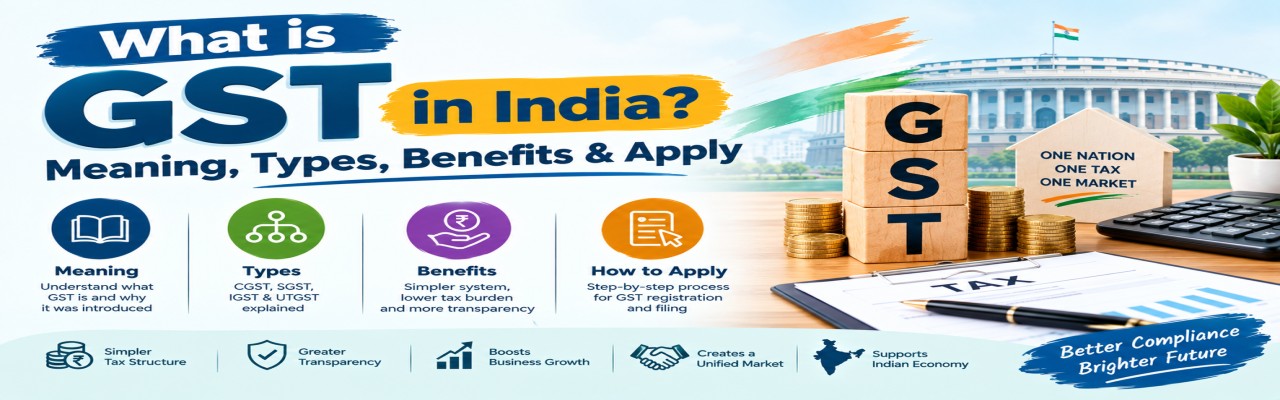
GST, or Goods and Services Tax, is India's single indirect tax on most goods and services. It replaced a tangle of central and state taxes on 1 July 2017. If you run a business, freelance, sell online, or simply want to understand the tax on your bills, this guide explains GST in plain language.
You will learn how GST works, who pays it, the types of GST with examples, HSN and SAC codes, registration limits, refunds, benefits, drawbacks, and the step-by-step application process. Tax rules change often, so confirm current rates and limits on the official GST portal (gst.gov.in) or the CBIC website (cbic.gov.in) before acting. This article is for general information and is not a substitute for advice from a qualified tax professional.
What is GST and Types of GST with Examples?
GST (Goods and Services Tax) is a destination-based indirect tax charged on the supply of goods and services in India. It is collected at every stage of the supply chain, but businesses can claim credit for the tax they have already paid, so the final burden falls on the consumer.
Before GST, a product could be taxed many times: excise duty, VAT, service tax, entry tax, octroi and more. Each layer added to the price, and tax was often charged on tax. GST brought these under one umbrella and introduced input tax credit to remove that cascading effect.
GST is:
-
Destination-based: tax goes to the state where the goods or services are consumed.
-
Multi-stage: it applies at each step from manufacturer to retailer.
-
Credit-based: businesses offset tax paid on purchases against tax collected on sales.
Types of GST in India
India follows a dual GST model, where both the Centre and the states levy tax on the same transaction. There are four types of GST:
|
Type |
Full form |
Who collects it |
When it applies |
|
CGST |
Central GST |
Central Government |
Sale within one state |
|
SGST |
State GST |
State Government |
Sale within one state |
|
UTGST |
Union Territory GST |
Union Territory Government |
Sale within a Union Territory without a legislature |
|
IGST |
Integrated GST |
Central Government (shared with states) |
Sale between two states, and imports/exports |
Examples of CGST, SGST and IGST
Example 1: Sale within the same state (CGST + SGST)
A shop in Jaipur sells a product worth ₹10,000 to a customer in Jaipur. The GST rate is 18%.
-
CGST at 9% = ₹900
-
SGST at 9% = ₹900
-
Total invoice value = ₹11,800
Example 2: Sale between two states (IGST)
A supplier in Delhi sells the same product worth ₹10,000 to a buyer in Punjab at 18%.
-
IGST at 18% = ₹1,800
-
Total invoice value = ₹11,800
The price is the same. What changes is how the tax is split between the Centre and the states.
How Does GST Work?
GST works by charging tax on every sale and allowing the seller to subtract the tax already paid on purchases (input tax credit). Only the "value added" at each stage is effectively taxed.
Here is a simple chain:
-
Manufacturer makes a product using raw material and sells it for ₹1,000 plus 18% GST (₹180). Suppose the manufacturer paid ₹50 of GST on raw material. They deposit ₹130 (₹180 − ₹50) with the government.
-
The wholesaler buys at ₹1,180 and sells at ₹1,500 plus 18% GST (₹270). They claim ₹180 as credit and pay ₹90.
-
Retailer buys at ₹1,770 and sells at ₹2,000 plus 18% GST (₹360). They claim ₹270 and pay ₹90.
-
The consumer pays ₹2,360 and cannot claim credit.
The government receives ₹360 in total, which is 18% of the final selling price of ₹2,000. There is no tax on tax. This is the main idea behind GST. Registered businesses also file periodic returns (such as GSTR-1 for outward supplies and GSTR-3B as a summary return) so that the government can match sales and purchases.
Who Pays GST?
The end consumer ultimately pays GST. Registered businesses collect it on the government's behalf and deposit it after adjusting input tax credit.
A few points make this clearer:
-
Consumers pay GST as part of the bill on goods and services.
-
Businesses collect and remit the tax. For them, GST is neutral as long as they can claim credit.
-
Unregistered or exempt businesses cannot charge GST but also cannot claim credit on their purchases.
-
Reverse charge: in certain cases, the buyer (not the seller) pays GST directly to the government. This applies to specified goods and services and to purchases from unregistered suppliers in defined situations.
Who Gets Money from GST?
GST revenue goes to both the Central Government and State Governments. CGST goes to the Centre, SGST goes to the state where the goods or services are consumed, and the Centre collects IGST and apportions it between the Centre and the destination state. UTGST goes to the relevant Union Territory.
The Finance Commission's formula also shares a portion of central taxes with states. So GST funds public spending at both levels, from infrastructure and health to welfare programmes.
Who Controls GST?
The GST Council, a constitutional body chaired by the Union Finance Minister, governs GST. It includes the Union Minister of State for Finance (Revenue) and the finance ministers of all states and legislature-bearing Union Territories.
The GST Council decides:
-
Tax rates and slabs
-
Exemptions
-
Registration thresholds
-
Procedural and law changes
The Central Board of Indirect Taxes and Customs (CBIC) handles day-to-day administration of central tax, and state tax departments handle state tax. The Goods and Services Tax Network (GSTN) runs the technology backbone (the GST portal).
Who is the CEO of GST?
GST itself has no CEO, because it is a tax, not a company. The nearest match is the GSTN, which has its own chief executive to manage the GST portal and IT systems. Policy decisions, however, are taken by the GST Council, not by any single officer. For the current GSTN leadership, check the official GSTN website.
Who Is Called the Father of GST?
No single person is officially called the "father of GST" in India. The idea developed over two decades across several governments.
-
In the early 2000s, the Vajpayee government initiated serious discussion on a national GST, and an empowered committee of state finance ministers led by Asim Dasgupta worked on the design.
-
Later governments continued the work, and the constitutional amendment for GST was passed in 2016.
-
The GST Council was set up, and GST was rolled out on 1 July 2017.
Different commentators credit different leaders, depending on their political view. It is more accurate to see GST as a shared effort between the Centre and states than to name one individual.
Which State Started GST First?
GST was launched across India together on 1 July 2017, so no state started it earlier than the others. Jammu and Kashmir joined shortly after, later that July.
Assam is often mentioned because it was the first state to ratify the constitutional amendment bill for GST, in August 2016. That is a separate milestone from the actual launch.
Is GST Only in India?
No. GST, or a similar Value Added Tax (VAT), exists in many countries worldwide. Canada, Australia, New Zealand, Singapore and others use a tax called GST. Many countries in Europe and Asia use VAT, which works on a similar principle. India's model is unusual because it is a dual GST, where the Centre and states both tax the same supply. Canada also has a dual-style system with federal and provincial components.
Which Country Has No GST?
The United States has no national GST or VAT. It relies on state and local sales taxes instead, and rates and rules vary by state. Some Gulf countries also have not introduced a broad VAT, though this can change. Check the latest position for any specific country before relying on it.
What Are the 7 Types of Taxes?
Taxes are broadly divided into direct taxes (paid on income or wealth) and indirect taxes (paid on goods and services). Seven commonly discussed taxes in India are:
|
Sr. No. |
Tax |
Category |
Brief description |
|
1 |
Income Tax |
Direct |
Levied on individual and HUF income |
|
2 |
Corporate Tax |
Direct |
Levied on company profits |
|
3 |
Capital Gains Tax |
Direct |
Levied on profit from selling assets like shares or property |
|
4 |
Property Tax |
Direct (local) |
Levied by municipal bodies on property owners |
|
5 |
GST |
Indirect |
Levied on the supply of goods and services |
|
6 |
Customs Duty |
Indirect |
Levied on imports (and some exports) |
|
7 |
Securities Transaction Tax (STT) |
Direct/Transaction |
Levied on trades of listed securities |
Other taxes also exist, such as stamp duty, professional tax and excise duty on a few products like petroleum and alcohol. The list above is a practical starting point, not an official classification of exactly seven taxes.
What Is TDS Full Form?
TDS stands for Tax Deducted at Source. It means tax is deducted when a payment is made (for example, salary, rent, interest or professional fees) and deposited with the government by the person making the payment.
TDS also exists under GST. Specified government departments and agencies must deduct TDS at 2% (1% CGST + 1% SGST, or 2% IGST) on payments to suppliers under a contract where the value exceeds ₹2.5 lakh. The supplier then claims this amount as a credit in their electronic cash ledger.
Is a 12 Lakh Salary Tax-Free?
Under the new income tax regime, income up to ₹12 lakh is effectively tax-free for resident individuals because of the rebate under Section 87A, as per the rules introduced from FY 2025-26. For salaried people, the standard deduction of ₹75,000 can extend the effective tax-free salary to around ₹12.75 lakh.
Important notes:
-
This is an income tax matter, not GST.
-
The rebate generally does not apply to income taxed at special rates, such as certain capital gains.
-
Above the limit, marginal relief may apply, but tax can arise quickly.
-
Rules are reviewed in every Budget, so check the latest slabs on the Income Tax Department website (incometax.gov.in).
GST Rates in India: A Quick Overview
The GST Council sets GST rates. Following the 2025 rate rationalisation, most goods and services fall into two main slabs, 5% and 18%, with a higher special rate of 40% on a small set of luxury and "sin" goods. Some essentials are exempt or taxed at 0%, and certain items like precious metals have separate low rates.
Because rates change over time, always check the rate for your specific product on the CBIC website or the GST portal. The rate depends on the HSN or SAC code, which brings us to the next topic.
Understanding HSN in GST
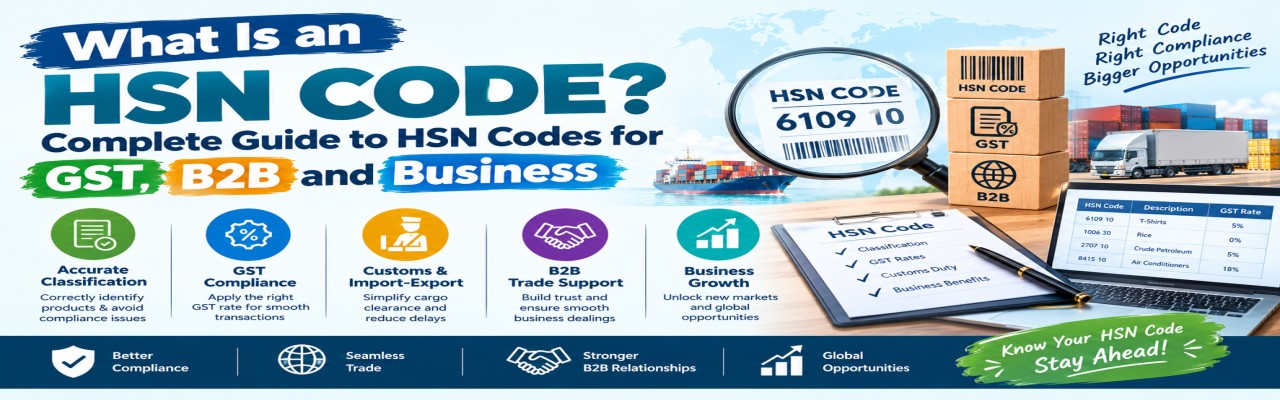
HSN stands for Harmonised System of Nomenclature. It is a standard code that classifies goods, so that the same product is identified the same way everywhere.
The World Customs Organisation developed the HSN system, and over 200 countries and economies use it for customs and trade. The international code is 6 digits long. India extends it to 8 digits for finer classification.
Under GST, HSN codes are used to:
-
Identify the correct GST rate for a product
-
Prepare invoices and returns
-
Report goods details in GSTR-1 and other filings
HSN Code in GST for Simple Taxes and Trade
In GST, the HSN code links each product to its tax rate, which keeps taxation and trade records uniform and simple. Instead of describing a product in words that could be interpreted differently, a numeric code removes ambiguity.
The number of digits you must show on invoices depends on your annual turnover:
|
Annual turnover (previous financial year) |
HSN digits required |
|
Up to ₹5 crore |
4 digits (mandatory on B2B invoices) |
|
Above ₹5 crore |
6 digits |
|
Exports and imports |
8 digits |
These requirements have been revised over time, so confirm the current notification before filing.
Purpose for Using HSN Code in GST
The purpose of the HSN code is to classify goods uniformly so that the right GST rate is applied and trade data is consistent. Specific benefits include:
-
Uniform classification: everyone identifies a product the same way.
-
Correct rate application: the code determines the tax rate.
-
Easier compliance: returns and invoices are more accurate.
-
Smoother international trade: exporters and importers use a globally recognised system.
-
Better data for authorities: helps the government track trade and prevent misclassification.
What Is SAC Code in GST?
SAC stands for Services Accounting Code. It is a 6-digit code used to classify services under GST, similar to how HSN classifies goods.
All SAC codes begin with "99". For example:
-
Legal and accounting services fall under a code starting with 9982.
-
Many software and IT services fall under codes starting with 9983.
Businesses use SAC to find the correct GST rate for their service and to mention it on invoices and returns. Since the code decides the rate, choosing the wrong one can lead to short payment of tax, notices or penalties. If unsure, verify with the official service code list or consult a professional.
Difference Between HSN Code and SAC Code Under GST
HSN codes classify goods, while SAC codes classify services. HSN codes have 4 to 8 digits depending on turnover, while SAC codes have 6 digits and always start with 99.
D/B HSN and SAC Code: Comparison Table
|
Point |
HSN Code |
SAC Code |
|
Full form |
Harmonised System of Nomenclature |
Services Accounting Code |
|
Applies to |
Goods |
Services |
|
Length |
4, 6 or 8 digits |
6 digits |
|
Starts with |
Varies by product chapter |
99 |
|
Origin |
World Customs Organisation |
Based on India's service classification |
|
Used for |
Identifying goods and their GST rate |
Identifying services and their GST rate |
|
Example use |
Mobile phones, textiles, machinery |
Consulting, transport, software services |
Some businesses supply both goods and services, such as an appliance seller who also charges installation. In such cases, they may need both HSN and SAC codes on their invoices, and they should follow the composite or mixed supply rules to decide the applicable rate.
How Do I Calculate GST?
To calculate GST, multiply the base price by the GST rate and divide by 100. To find GST from a GST-inclusive price, use: GST amount = Inclusive price × Rate ÷ (100 + Rate).
Adding GST to a price (exclusive price)
-
GST amount = (Original price × GST rate) ÷ 100
-
Final price = Original price + GST amount
Removing GST from a price (inclusive price)
-
GST amount = Inclusive price × GST rate ÷ (100 + GST rate)
-
Original price = Inclusive price − GST amount
Worked examples
|
Scenario |
Calculation |
Result |
|
Add 18% GST to ₹5,000 |
5,000 × 18 ÷ 100 |
GST ₹900, total ₹5,900 |
|
Add 5% GST to ₹2,000 |
2,000 × 5 ÷ 100 |
GST ₹100, total ₹2,100 |
|
Remove 18% GST from ₹11,800 |
11,800 × 18 ÷ 118 |
GST ₹1,800, base ₹10,000 |
|
Remove 5% GST from ₹1,050 |
1,050 × 5 ÷ 105 |
GST ₹50, base ₹1,000 |
For a sale within a state, split the GST equally between CGST and SGST. For a sale between states, show it as IGST.
Who Is Eligible to Apply for GST?
Any person or business that supplies goods or services in India can apply for GST registration. Registration is mandatory if your turnover crosses the threshold or if you fall under a compulsory category. You should apply if you are:
-
A business whose aggregate turnover exceeds the prescribed limit
-
Making inter-state supplies of goods (registration is generally required regardless of turnover)
-
An e-commerce seller supplying through an e-commerce platform (with limited exceptions)
-
An e-commerce operator
-
A casual taxable person or non-resident taxable person
-
Liable to pay tax under reverse charge
-
An input service distributor
-
Supplying goods or services on behalf of another registered person
-
A business that wishes to register voluntarily, even below the limit
Voluntary registration lets small businesses claim input tax credit and appear more credible to B2B buyers.
How Much Turnover Is Required for GST?
Registration is generally required when aggregate annual turnover exceeds ₹40 lakh for suppliers of goods and ₹20 lakh for suppliers of services. Lower limits apply in some special category states.
|
Type of supplier |
General limit |
Special category states |
|
Only goods |
₹40 lakh |
₹20 lakh (some states ₹10 lakh) |
|
Services (or goods and services) |
₹20 lakh |
₹10 lakh |
Special category states include several in the North-East and hill regions. Limits vary, so verify the applicable figure for your state. Some points to remember:
-
"Aggregate turnover" includes taxable, exempt, exports and inter-state supplies of persons with the same PAN. It excludes GST itself and reverse charge supplies.
-
Certain businesses must register regardless of turnover, such as those making inter-state supplies of goods or selling through most e-commerce platforms.
-
Thresholds have changed in the past and may change again.
Who Is Not Eligible for GST Registration?
People whose turnover is below the threshold and who do not fall under a compulsory category are not required to register. Some persons are also specifically exempt from registration. This generally includes:
-
Small suppliers below the limit making only intra-state supplies
-
Agriculturists supplying produce grown on their own land
-
Persons who supply only goods or services that are exempt or not liable to GST
-
Persons supplying only goods or services where the entire tax is payable by the recipient under reverse charge (with conditions)
If you are under the composition scheme, you also cannot make inter-state supplies or supply through e-commerce operators in most cases. Rules are detailed, so verify your situation before deciding not to register.
Can I Start a Small Business Without GST?
Yes. You can start a small business without GST registration if your turnover stays below the threshold and you are not in a category that requires compulsory registration.
Keep these trade-offs in mind:
Advantages of staying unregistered
-
Less paperwork and no periodic GST returns
-
Lower compliance cost at the start
Disadvantages
-
You cannot charge GST or issue tax invoices
-
You cannot claim input tax credit on purchases
-
Some B2B customers prefer registered suppliers
-
You cannot sell inter-state (goods) or on most e-commerce platforms without registration
Many small businesses register voluntarily once they begin dealing with businesses or selling online. Plan ahead so you register in time once your turnover nears the limit.
How to Apply for GST: Step-by-Step Process
You can apply for GST online on the official portal, gst.gov.in, by submitting Form GST REG-01 with your PAN, mobile number, email address and supporting documents. The process is free on the government portal.
Documents usually required
-
PAN card of the business or proprietor
-
Aadhaar card of the proprietor or authorised signatory
-
Proof of business address (rent agreement, electricity bill or property document)
-
Bank account details (cancelled cheque or statement)
-
Passport-size photograph
-
Business constitution proof (partnership deed, incorporation certificate, etc.)
-
Digital signature (for companies and LLPs) or authorisation letter
Application steps
-
Visit the portal. Go to gst.gov.in, click on "Services", then "Registration" and "New Registration".
-
Fill Part A. Enter your legal name, PAN, email and mobile number. You will receive OTPs on both. After verification, you get a Temporary Reference Number (TRN).
-
Log in with the TRN. Enter the TRN and the OTP to open Part B.
-
Fill Part B. Add business details, promoters or partners, authorised signatory, place of business, goods and services (with HSN and SAC codes) and bank details.
-
Upload documents. Submit the required documents in the prescribed format and size.
-
Verify and submit. Verify the application using a Digital Signature Certificate (DSC), e-Sign or EVC (Electronic Verification Code).
-
Get the ARN. After submission, you receive an Application Reference Number (ARN) by email and on your mobile. Use it to track the status.
-
Approval. If Aadhaar authentication is completed, registration is generally approved within a few working days. Otherwise, it may need physical verification and take longer. The officer may also raise a query, which you must answer in time.
-
Receive GSTIN. After approval, you receive your GST registration certificate and a 15-digit GSTIN.
Tips for a smooth application
-
Make sure names match across PAN, Aadhaar and bank records.
-
Keep documents clear and within the size limit.
-
Use a working mobile number and email that you will keep for years.
-
Choose HSN and SAC codes carefully.
Who Gives the GST Number?
The GST number (GSTIN) is issued by the GST system through the GSTN portal after the tax officer approves your application. It is a 15-character code: the first two digits are the state code, the next ten are your PAN, followed by an entity number, the letter "Z" by default and a check digit.
Can I File GST Without a CA?
Yes. You can register and file GST returns yourself on the GST portal without hiring a Chartered Accountant. The law does not require a CA for routine registration or return filing.
Many small businesses still use a CA or tax practitioner because of complex rules, input tax credit reconciliation and the risk of notices for mistakes. If your business is simple, you can self-file. As transactions grow, professional help often saves time and reduces errors.
How to Take GST Benefits?
To take GST benefits, register if you need to, use input tax credit (ITC) on your business purchases, choose the right scheme, and file returns on time.
1. Claim Input Tax Credit
ITC lets you subtract the GST you paid on purchases from the GST you collect on sales. Broadly, you can claim it if:
-
You hold a valid tax invoice or debit note
-
You have received the goods or services
-
The supplier has paid the tax to the government
-
You have filed your return
-
The credit appears in your GSTR-2B
Some credits are "blocked" under the law, such as certain expenses on motor vehicles, food and beverages, and personal consumption. Check Section 17(5) of the CGST Act.
2. Consider the Composition Scheme
Small taxpayers with turnover up to a prescribed limit (₹1.5 crore for most goods suppliers, with a separate lower limit for certain service providers) can pay tax at a fixed low percentage of turnover and file simpler returns. The trade-off is that they cannot claim ITC or collect tax from customers.
3. Use Simplified Return Options
Small taxpayers (up to ₹5 crore turnover) can opt for the QRMP scheme, which allows quarterly return filing with monthly payment.
4. Claim Refunds Where Eligible
Exporters, businesses with inverted duty structures and others can apply for refunds. This is explained further below.
5. Maintain Clean Records
Accurate invoices and timely filing help you avoid interest, late fees and ITC mismatches.
What Are the 10 Benefits of GST in India?
The main benefits of GST are a single unified tax, no cascading of taxes, simpler compliance, a wider tax base, better transparency, lower logistics costs, easier inter-state trade, support for exports, online processes and greater efficiency. Here are ten in detail:
-
One nation, one tax: it replaced many central and state levies with a unified structure.
-
Removes tax-on-tax: input tax credit prevents cascading.
-
Simpler compliance: registration, payment and returns happen online.
-
Wider tax base: more businesses have come into the formal tax system.
-
Transparency: invoice matching makes evasion harder.
-
Smoother movement of goods: removing many state check-posts and the e-way bill system has reduced delays.
-
Boost to logistics: a common market has encouraged consolidated warehousing and better supply-chain planning.
-
Support for exporters: exports are zero-rated, and eligible exporters can claim refunds.
-
Level playing field: small and large businesses in different states follow the same rules.
-
Digital records: electronic invoices and returns create a reliable audit trail.
What Are the 10 Advantages of GST?
The advantages of GST can be viewed from the viewpoint of businesses, consumers and the government. Here are ten more, grouped by who benefits:
For businesses
-
Credit for tax paid on inputs lowers the real cost of operations.
-
A single registration framework helps expansion across states, although separate state registration is still needed.
-
Composition and quarterly filing options ease the load on small taxpayers.
-
A common classification (HSN/SAC) reduces disputes over rate and category.
For consumers
5. Removal of cascading can reduce the tax component in the price of many goods over time, although the actual price effect depends on the product and market.
6. Clear, itemised tax on invoices makes it easier to see how much tax you pay.
7. Rate rationalisation, such as reducing many products to lower slabs, can lower prices on some everyday items.
For the government
8. Better tracking of transactions improves tax collection.
9. Reduced evasion through invoice matching.
10. Centralised data helps in policy planning and economic analysis.
What Are the 10 Disadvantages of GST?
GST's main drawbacks include the compliance burden on small businesses, frequent rule changes, multiple return filings, input credit mismatches, technical glitches, working-capital blockage, classification disputes, exclusion of some items, higher costs for certain sectors, and a steep learning curve. In more detail:
-
Compliance burden: even small businesses may need regular filings and reconciliations.
-
Frequent changes: rates, forms, and rules have been updated many times, making them hard to keep up with.
-
Technical issues: portal slowdowns and glitches, particularly near due dates, have stressed taxpayers.
-
Input tax credit mismatches: if a supplier does not file or pay, the buyer's credit can be delayed or denied.
-
Working-capital strain: businesses often must pay tax before receiving payment from customers, and refunds can take time.
-
Classification disputes: disagreements over HSN/SAC and the applicable rate can lead to litigation.
-
Multiple registrations: businesses operating in several states need a separate registration in each.
-
Cost of professional help: many small businesses have had to spend on accountants or software.
-
Some sectors burdened: certain industries have faced higher effective taxes after GST, or have struggled with inverted duty structures.
-
Items outside GST: petroleum products, alcohol for human consumption and electricity are outside GST, so tax cascading continues in those areas, and states still levy their own taxes there.
Is GST Good or Bad?
GST is good for India's tax structure in the long run, but it has real short-term costs, especially for small businesses. Whether it is "good" or "bad" depends on who you ask and which aspect you look at.
Where GST helps
-
It unified a fragmented indirect tax system.
-
It reduced cascading of taxes.
-
It brought many businesses into the formal economy.
-
It improved trade across state borders.
Where GST struggles
-
Compliance can be heavy for small traders.
-
Frequent changes create uncertainty.
-
Refunds and credit mismatches strain cash flow.
-
Multiple rate slabs and exclusions, though simplified over time, still cause disputes.
Most economists and industry bodies see the principle of GST as sound and debate its design and execution. Rate simplification and process improvements are ongoing, so taxpayers' experience continues to change.
Who Is Eligible to Claim GST?
Registered taxpayers who use goods or services for business purposes can claim GST paid on those purchases as input tax credit, subject to conditions. Consumers and unregistered persons cannot claim it.
You can generally claim ITC when:
-
You are registered under GST (and not under the composition scheme)
-
The purchase is used or intended for business
-
You have a valid invoice and have received the goods or services
-
The supplier has deposited the tax
-
You have filed the relevant returns
You cannot claim ITC on blocked items (for example, personal use, certain vehicles, and goods lost or stolen) or on supplies used to make exempt sales.
Who Claims GST?
Registered businesses claim GST as input tax credit against their output tax liability. Exporters and certain other taxpayers may also claim a refund of accumulated credit. Ordinary consumers do not claim GST.
Can I Claim GST Refund in India?
Yes, you can claim a GST refund in India, but only in specific situations defined by law. Refunds are not automatic for everyone.
Common refund situations include:
-
Exports of goods or services: either on IGST paid, or on unutilised ITC when exporting without paying tax under a Letter of Undertaking (LUT)
-
Inverted duty structure: when tax on inputs is higher than tax on outputs, leaving unused credit
-
Supplies to SEZ units or developers
-
Excess payment of tax or tax paid by mistake
-
Excess balance in the electronic cash ledger
-
Deemed exports
-
Finalisation of provisional assessment or order after appeal
How to apply for a GST refund
-
Log in to the GST portal.
-
Go to "Services" → "Refunds" → "Application for Refund".
-
Select the refund category and fill in the details.
-
Upload supporting documents where required.
-
Submit and track the application through the ARN.
The general time limit to apply is two years from the "relevant date", which differs by refund type. Always check the specific rule for your case.
Is GST Fully Refundable?
No. GST is not fully refundable. Refunds are allowed only in the situations listed above. For most businesses, the normal way to recover GST paid on purchases is to adjust it as input tax credit against GST payable on sales. Credit that cannot be used because of blocking rules is generally lost.
Will Everyone Get a GST Refund?
No. Not everyone gets a GST refund. Ordinary consumers do not receive refunds on the GST included in their purchases. Only eligible registered taxpayers who meet the conditions can claim one, and the department must approve the claim after verification. Delays or rejections can occur if documents or returns are incomplete.
GST Registration Types at a Glance
|
Registration type |
Who it is for |
|
Regular taxpayer |
Most businesses above the threshold |
|
Composition taxpayer |
Small taxpayers opting for a fixed low rate |
|
Casual taxable person |
Occasional supplies in a state with no fixed place of business |
|
Non-resident taxable person |
Foreign entities supplying in India occasionally |
|
E-commerce operator |
Platforms facilitating supplies |
|
Input service distributor |
Head offices distributing credit to branches |
Common GST Mistakes to Avoid
Getting GST right protects you from notices and penalties. Here are some of the most common mistakes to avoid:
-
Wrong HSN/SAC code, which leads to the wrong rate
-
Missing filing deadlines, which attracts late fees and interest
-
Claiming ITC without matching GSTR-2B
-
Not issuing proper invoices or issuing them late
-
Ignoring reverse charge liability
-
Failing to reconcile books with returns
-
Mixing personal and business expenses
A simple monthly routine of reconciliation and filing goes a long way toward avoiding these.
Conclusion
GST is India's unified indirect tax, designed to replace many overlapping taxes with a single structure based on input tax credit. It works through CGST, SGST, UTGST and IGST, uses HSN and SAC codes to classify goods and services and is administered online through the GST portal under the guidance of the GST Council.
For businesses, the practical steps are simple: check whether your turnover or business model requires registration, apply on gst.gov.in with the right documents, classify your products correctly, claim input tax credit properly, and file returns on time. For consumers, GST means a transparent, itemised tax on bills.
GST has real benefits, such as a common market and less tax-on-tax, and real challenges, such as compliance load and frequent changes. Since rates, limits and procedures are updated periodically, always verify current rules on the official GST portal or with a qualified tax professional before making decisions.