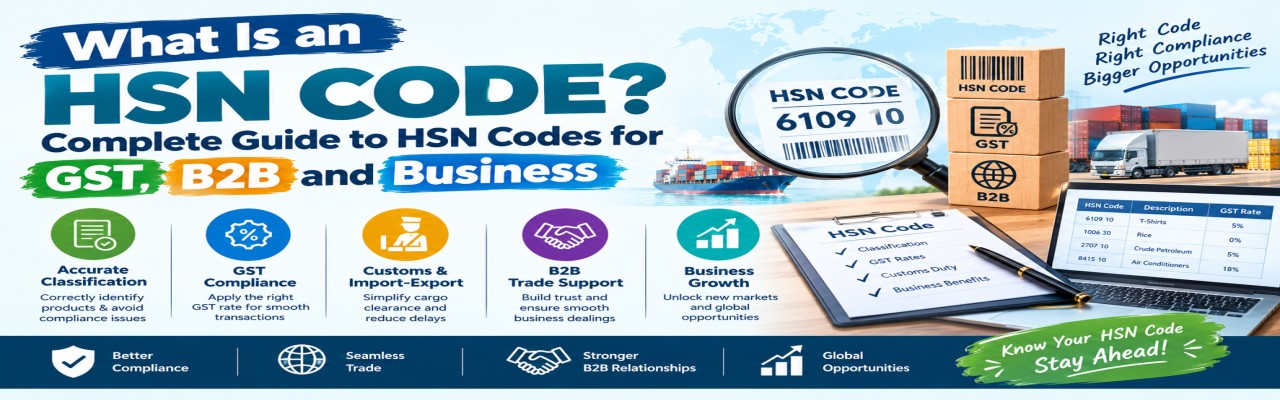
An HSN code is a standardised number used to classify goods for taxation, customs, invoicing, and international trade. Businesses use HSN codes to identify goods consistently across invoices, GST returns, e-invoices, e-way bills, and trade documents.
HSN stands for Harmonised System of Nomenclature. The system provides a structured way to classify products by type, composition, use, and other characteristics.
For Indian businesses, understanding HSN codes matters because correct classification can affect GST treatment, invoicing, input tax credit, customs procedures, and export documentation.
This guide explains the meaning, full form, and structure of HSN codes; 4-digit, 6-digit, and 8-digit HSN codes; GST requirements; B2B transactions; exports; how to find an HSN code; common mistakes; and the difference between HSN and SAC.
Important: GST rates, reporting requirements, tariff classifications, and government notifications can change. Always verify the latest information on the official GST, CBIC, or customs portals before using an HSN code for business or tax filing.
What Is an HSN Code?
An HSN code is a numerical classification code that identifies and categorizes goods. HSN stands for Harmonized System of Nomenclature. The World Customs Organization (WCO) developed the system to create a common way to classify products traded internationally.
Products such as tea, textiles, electronics, machinery, chemicals, food products, and other goods are classified under specific HSN codes.
The code belongs to the product, not to the business selling it.
For example, if a business sells packaged tea, it does not create its own product classification. It identifies the appropriate HSN code for that product and uses it on relevant business and tax documents.
Important Things to Know About HSN Codes
-
HSN codes classify goods, not businesses or individuals.
-
The international Harmonized System uses six-digit classifications.
-
India extends the classification to additional digits for customs purposes.
-
HSN codes are used in GST-related compliance for goods.
-
Exporters and importers use tariff classifications for customs declarations.
What Is the Full Form of HSN?
The full form of HSN is Harmonized System of Nomenclature. The term refers to a standardized system for naming and classifying traded goods.
What Does HSN Mean?
Harmonized refers to the standardized classification system used internationally.
System of Nomenclature refers to the structured system of names and numerical codes used to classify products.
The World Customs Organization maintains the Harmonized System and revises it periodically. Individual countries incorporate the system into their own customs and tariff classifications.
How Is an HSN Code Structured?
HSN classification is hierarchical. As you add more digits, the product classification becomes more specific.
|
Digits |
Classification Level |
What It Indicates |
|
First 2 digits |
Chapter |
Broad product category |
|
First 4 digits |
Heading |
More specific product group |
|
First 6 digits |
Sub-heading |
Internationally recognized product classification |
|
7th and 8th digits |
Tariff Item |
Country-specific detail used by India |
Example of HSN Classification
Consider the product category of tea:
-
09 identifies the broader chapter covering coffee, tea, mate and spices.
-
0902 identifies tea.
-
Further digits provide a more specific classification for particular types of tea.
-
Always verify the exact HSN code against the applicable tariff and product description, rather than selecting it simply because it looks similar.
What Is a 4-Digit HSN Code?
A 4-digit HSN code represents the heading level of the classification system. It identifies a relatively broad product family. For example, 0902 represents tea at the four-digit level.
A four-digit classification may not distinguish between every variation of a product. More detailed six- or eight-digit classifications can provide additional information. Under the turnover-based GST reporting framework described in the source material:
-
Businesses with annual aggregate turnover up to ₹5 crore report at least 4-digit HSN codes in the relevant GST return.
-
Businesses with annual aggregate turnover above ₹5 crore report at least 6-digit HSN codes.
Businesses should verify the reporting requirements that apply to them before filing.
4-Digit vs 6-Digit vs 8-Digit HSN Code
The number of digits used depends on the purpose and applicable reporting or customs requirements.
|
Feature |
4-Digit HSN |
6-Digit HSN |
8-Digit HSN |
|
Classification level |
Heading |
Sub-heading |
Tariff item |
|
Detail |
Broad |
More specific |
Most detailed Indian classification |
|
International use |
Classification level |
Internationally standardized level |
Country-specific |
|
GST reporting |
Applicable depending on turnover |
Applicable depending on turnover |
Used for customs and tariff purposes |
|
Common use |
GST reporting |
GST and international classification |
Imports and exports in India |
Even when a business can report a shorter code, using a more detailed, verified classification can reduce ambiguity between similar products.
How Many HSN Codes Are There?
There is no single permanent number of HSN codes because the Harmonized System is periodically revised and the number depends on the classification level being counted. The system includes:
-
21 sections
-
Approximately 96 numbered chapters currently used within the system
-
More than 1,000 four-digit headings
-
Several thousand six-digit sub-headings
-
Additional eight-digit tariff items in India
The exact number can change as the Harmonized System and India's tariff structure evolve. For a business, knowing the total number of HSN codes is less important than identifying the correct code for each product it sells or trades.
HSN Code vs SAC Code
HSN codes are used for goods, while services are classified using SAC (Services Accounting Code). SAC is a six-digit classification beginning with 99.
Why Is an HSN Code Important for Businesses?
HSN codes provide a common classification system for goods and connect product identification with tax and trade processes. The main benefits include:
1. Correct Product Classification
HSN provides a standard way to identify goods.
2. Accurate GST Treatment
GST rates are notified against specific product classifications and descriptions.
3. Better Invoice Accuracy
The correct HSN code helps businesses prepare consistent invoices.
4. Easier GST Compliance
HSN information is used in GST return reporting and related systems.
5. Input Tax Credit Matching
Correct product classification can help maintain consistency between buyer and seller documents.
6. Easier Customs Procedures
HSN-based tariff classification helps customs authorities identify imported and exported goods.
7. International Trade
The six-digit international classification provides a common reference for traded goods.
What Are the Benefits of HSN Codes Under GST?
HSN codes help GST administration by connecting products with their applicable tax classification. For businesses, the major benefits include:
-
More accurate tax classification
-
Consistency between buyers and sellers
-
Better GST return reporting
-
Easier invoice preparation
-
Support for e-invoicing
-
Support for e-way bill processes
-
Better input tax credit reconciliation
-
Greater readiness for imports and exports
For the government, HSN classification also helps analyse product-wise trade and supply data.
How Is an HSN Code Used Under GST?
HSN codes are used in several GST-related processes.
Tax Invoices
The applicable HSN code is included against goods supplied on tax invoices.
GSTR-1
HSN-wise information is reported in the relevant HSN summary of GSTR-1.
E-Invoices
The e-invoice format includes an HSN field for goods.
E-Way Bills
HSN information is required when applicable for the movement of goods.
GST Rate Classification
The product's HSN classification helps identify the relevant GST rate entry.
How Many HSN Digits Are Required Under GST?
The required number of HSN digits can depend on the taxpayer's turnover and the applicable GST reporting rules.
|
Aggregate Annual Turnover in Previous Financial Year |
Minimum HSN Digits in GSTR-1 Table 12 |
|
Up to ₹5 crore |
4 digits |
|
Above ₹5 crore |
6 digits |
The original source identifies this framework with Notification No. 78/2020 – Central Tax dated 15 October 2020. Businesses should check the latest GST notifications for any subsequent changes before filing.
Does HSN Code Determine the GST Rate?
The HSN code helps identify the applicable GST classification, but it does not include the GST rate.
The government notifies GST rates for specific HSN classifications and product descriptions.
This distinction matters because a single broad HSN heading can include products that receive different tax treatment.
How to Find the GST Rate for an HSN Code?
-
Identify the correct HSN code.
-
Check the latest applicable GST rate notification.
-
Read the exact product description.
-
Check whether any conditions or exemptions apply.
-
Confirm whether any applicable cess needs to be considered.
-
Keep a record of the notification or source used for classification.
Do not select a product classification simply because it carries a lower GST rate. Base classification on the product's actual characteristics.
Why Is HSN Code Mandatory?
HSN codes provide a common classification system that helps GST authorities, businesses, and buyers identify goods consistently. The requirement supports:
-
Uniform product classification
-
GST rate identification
-
Return validation
-
Buyer-seller data matching
-
Input tax credit processes
-
Customs and international trade
-
Product-wise government reporting
The exact reporting obligation varies by taxpayer and applicable rules.
Is HSN Code Mandatory for B2B Transactions?
Yes. HSN reporting applies to B2B supplies of goods by registered taxpayers, subject to the applicable GST requirements.
HSN information is particularly important in B2B transactions because the buyer may rely on the supplier's invoice for input tax credit. An incorrect HSN code or tax rate can therefore create problems for both the seller and buyer.
B2B vs B2C HSN Reporting
|
Point |
B2B |
B2C |
|
Buyer |
Registered business |
Consumer or unregistered buyer |
|
Input tax credit |
May be claimed by eligible buyer |
Generally not applicable to consumers |
|
HSN reporting |
Applicable according to GST rules |
Applicable according to GST rules |
|
Risk of incorrect classification |
ITC mismatch and compliance issues |
Tax and reporting issues |
Businesses should follow the current GST portal requirements for their particular category of supply.
Why Are HSN Codes Important for Traders?
HSN codes are particularly useful for traders, wholesalers, distributors, and B2B suppliers because they may handle many different products. A trader may sell products belonging to multiple HSN classifications and GST rates.
HSN Code Requirements for Traders
A trader needs to consider:
-
Correct HSN for each product
-
Applicable GST rate
-
Accurate invoices
-
Input tax credit on purchases
-
E-way bill requirements
-
GST return reporting
-
Consistent product records
Practical Tip for Traders
Create an item master containing:
-
Product name
-
Product description
-
HSN code
-
GST rate
-
Product category
-
Supplier information
Review the item master whenever relevant tax notifications or classifications change. This can reduce repeated classification errors across invoices and GST returns.
What Is an HSN Code Used For in Business?
HSN codes support several business processes.
Invoicing
Businesses include HSN information against applicable products on invoices.
GST Returns
HSN information forms part of GST reporting.
Tax Calculation
The classification helps identify the relevant GST treatment.
Procurement
Businesses can compare product classifications across supplier invoices.
Inventory Management
Businesses can include HSN codes in ERP and inventory systems.
Pricing
Businesses can consider applicable tax treatment while preparing quotations and pricing.
Logistics
HSN information is used in relevant goods movement documentation.
Import and Export
HSN/tariff classifications are used for customs declarations.
HSN Code and Domestic Trade in India
Within India, HSN classification helps ensure consistent treatment of goods across states. For businesses engaged in domestic B2B trade, this can support:
-
Consistent product classification
-
Accurate GST invoicing
-
Interstate transactions
-
Input tax credit processes
-
Inventory management
-
GST return reporting
For manufacturers, suppliers, wholesalers, and distributors, maintaining consistent HSN information across their product catalogue can make their billing and compliance processes easier to manage.
What Is the Role of HSN Codes in Global Trade?
HSN codes are also important for international trade. The first six digits of the Harmonised System provide a common international classification framework, while countries can add additional digits. For Indian exporters and importers, the classification can affect:
-
Customs declarations
-
Import duties
-
Export documentation
-
Certificates of origin
-
Trade agreement benefits
-
Customs clearance
-
Trade statistics
Domestic vs. International Use of HSN
|
Aspect |
Domestic Trade |
International Trade |
|
Main Purpose |
GST classification and compliance |
Customs classification and trade |
|
Common classification level |
4 or 6 digits depending on requirement |
Six-digit international base plus national extensions |
|
Main users |
GST portal, businesses, tax authorities |
Customs authorities, importers, exporters |
|
Key impact |
GST treatment and reporting |
Customs duty and clearance |
What Is the HSN Code Used for in Export Business?
For exporters, HSN/tariff classification is an important part of export documentation.
Where Exporters Use HSN Classification
Shipping Bill
Export declarations use the applicable customs tariff classification.
Commercial Invoice
You can include the product classification on commercial documentation.
Packing List
Relevant product information can support shipment documentation.
Certificates of Origin
Correct product classification can be important when claiming preferential treatment under trade agreements.
Export Incentives and Refunds
Correct classification can support applicable export-related tax and incentive processes.
Destination-Country Customs
The importing country uses its own tariff structure, generally based on the international six-digit HS classification with possible country-specific extensions.
HSN Code and Free Trade Agreements
HSN classification also matters when a business exports under a Free Trade Agreement (FTA) or another preferential trade arrangement. Trade agreements generally identify eligible products by tariff line. Therefore, an exporter needs to know:
-
Correct HS classification
-
Applicable tariff treatment
-
Rules of origin
-
Preferential duty
-
Certificate of origin requirements
-
Destination-country customs requirements
An incorrect classification can affect whether the buyer receives the intended preferential tariff.
Common HSN Mistakes Exporters Should Avoid
Export businesses should be careful about:
-
Using a four-digit code where a more detailed tariff code is required
-
Using different classifications on different documents
-
Assuming India's eight-digit code is identical to another country's complete tariff code
-
Failing to check the six-digit international base
-
Not updating classifications after Harmonised System revisions
-
Assuming the product's tariff treatment without checking the destination country
Before a first shipment, exporters should reconcile their Indian classification with the buyer, customs broker, freight forwarder, or relevant trade professional.
Who Is Eligible for an HSN Code?
No separate process makes a business "eligible" for an HSN code. An HSN code applies to the goods supplied, not the business. What varies is the obligation to report the classification.
Businesses and HSN Classification
-
GST-registered businesses supplying goods use HSN codes according to applicable GST rules.
-
Service providers use SAC codes.
-
Importers and exporters use applicable customs tariff classifications.
-
Certain taxpayers may have specific or simplified invoicing requirements depending on their status.
A business does not receive a personal HSN certificate. If a website claims that it can sell or register a personal HSN code for your business, verify the claim carefully.
How Do I Find My HSN Code?
Finding the correct HSN code starts with understanding the product itself. Before searching, collect information such as:
-
Product name
-
Material or composition
-
Physical form
-
Intended use
-
Manufacturing process
-
Packaging
-
Technical specifications
Then follow a structured classification process.
Step-by-Step Method to Find an HSN Code
Step 1: Describe Your Product
Write down exactly what the product is made of, what form it takes, and how it is used.
Step 2: Identify the Relevant Chapter
Start with the broad product category.
Step 3: Find the Heading
Read the four-digit heading descriptions and identify the most appropriate category.
Step 4: Identify the Six-Digit Sub-heading
Narrow the classification according to the product's specific characteristics.
Step 5: Read the Section and Chapter Notes
These notes can include important rules, inclusions, and exclusions.
Step 6: Check the Applicable GST Entry
Confirm the product description and GST treatment in the current notification.
Step 7: Cross-Check Supplier Information
If you purchase the same product from another supplier, compare their invoice classification. However, do not treat another supplier's HSN code as automatic proof that it is correct.
Step 8: Record the Classification
Maintain the selected code, product description, and supporting reasoning in your business records.
Where Can I Find an HSN Code for Free?
Yes, businesses can search for HSN information using free official resources.
-
GST Portal: The GST portal provides an HSN search facility for product classification and related information.
-
CBIC: The Central Board of Indirect Taxes and Customs provides GST notifications and customs-related information.
-
ICEGATE: ICEGATE is useful for customs and import-export tariff information.
-
Customs Tariff Resources: The Indian customs tariff provides detailed tariff classifications.
-
WCO Resources: The World Customs Organisation provides information about the Harmonised System and its structure.
HSN Code Search: Which Source Should You Use?
|
Source |
Best For |
Important Note |
|
GST Portal |
GST-related HSN lookup |
Official source |
|
CBIC |
Notifications and legal/tax information |
Useful for current GST rules |
|
ICEGATE / Customs Tariff |
Import and export classification |
Useful for detailed tariff information |
|
Supplier Invoice |
Cross-checking |
Should not replace independent verification |
|
CA / GST Consultant |
Complex classifications |
Useful for borderline products |
Third-party HSN lookup websites can help with initial research, but businesses should verify the final classification through official sources.
Common HSN Code Mistakes to Avoid
Incorrect HSN classification can create tax and compliance problems. Here are some common mistakes:
1. Copying a Competitor's HSN Code
Another business may sell a similar-looking product with different specifications.
2. Choosing the Lowest GST Rate
HSN classification should be based on the actual product, not the desired tax rate.
3. Using Too Few Digits
Businesses should report the number of digits required under the applicable GST or customs rules.
4. Ignoring Product Descriptions
The same broad heading can contain different products and tax treatments.
5. Failing to Update Product Masters
Classification and tax requirements can change.
6. Mixing HSN and SAC
HSN applies to goods, while SAC applies to services.
7. Using Different Codes Across Documents
Invoices, GST returns, e-way bills, and customs documents should be consistent where the same classification is required.
8. Failing to Document Borderline Classifications
Keep a record of how and why you selected a classification, especially for complex products.
HSN vs SAC: What Is the Difference?
|
Point |
HSN |
SAC |
|
Full Form |
Harmonised System of Nomenclature |
Services Accounting Code |
|
Applies To |
Goods |
Services |
|
International basis |
Harmonised System |
Indian service classification |
|
Typical length under GST |
4 or 6 digits for reporting, with 8-digit customs classification |
6 digits |
|
Starting structure |
Based on goods chapters |
Begins with 99 |
Simple Example
If a business sells industrial machinery, it uses an HSN classification for the goods. f a business provides consulting or professional services, the applicable service classification is SAC.
Why Is HSN Important for Manufacturers and Suppliers?
For manufacturers and suppliers, HSN classification is not just a GST requirement. It can affect several parts of the B2B sales process. A manufacturer needs accurate product classification for:
-
Product catalogues
-
Invoices
-
GST returns
-
Supplier documentation
-
Buyer communication
-
Inventory records
-
E-invoicing
-
E-way bills
-
Export documentation
For B2B suppliers selling multiple products, maintaining a verified HSN database can also help standardise product information across the business.
Why Is HSN Important for Wholesalers and Distributors?
Wholesalers and distributors often deal with products from several manufacturers.
This makes accurate HSN classification especially important. A wholesaler should maintain:
-
Product name
-
Product description
-
HSN code
-
GST rate
-
Supplier details
-
Purchase price
-
Selling price
Maintaining this information consistently can make invoicing, stock management, GST reporting, and buyer communication easier.
HSN Code and B2B E-Commerce
HSN codes are also relevant to businesses selling products through online B2B channels.
A B2B seller may need accurate product classification when preparing:
-
Product catalogues
-
Business invoices
-
Quotations
-
Tax documents
-
Shipping documentation
-
Export documents
For manufacturers and suppliers listing products on B2B marketplaces, accurate product information can also help buyers understand exactly what is being offered. HSN should therefore be treated as part of a broader product data and compliance system, rather than simply as an invoice field.
Conclusion
An HSN code provides a standard way to classify goods for GST, invoicing, customs, and international trade. For Indian manufacturers, suppliers, traders, wholesalers, exporters, and other B2B businesses, using the correct HSN classification can help maintain consistent invoices, GST reporting, product records, and trade documentation.
The key is not simply to find an HSN code but to find the correct HSN code for the specific product. Businesses should:
-
Understand the product and its characteristics
-
Identify the appropriate HSN classification
-
Use the required number of digits
-
Verify the applicable GST rate
-
Maintain consistent product records
-
Review classifications when rules change
-
Check official sources before filing or invoicing
-
Seek professional advice for complex or borderline classifications
HSN classification is an important part of business compliance, particularly for companies involved in B2B sales, wholesale trade, manufacturing, imports, and exports. Use this guide as a starting point, but always confirm current GST rates, reporting requirements, and tariff classifications through official government sources before making tax or commercial decisions.