For an Indian manufacturer, exporter, supplier, or trading business, entering international markets involves more than finding buyers. Import duties, customs procedures, product standards, documentation, and market regulations can affect a product's final cost.
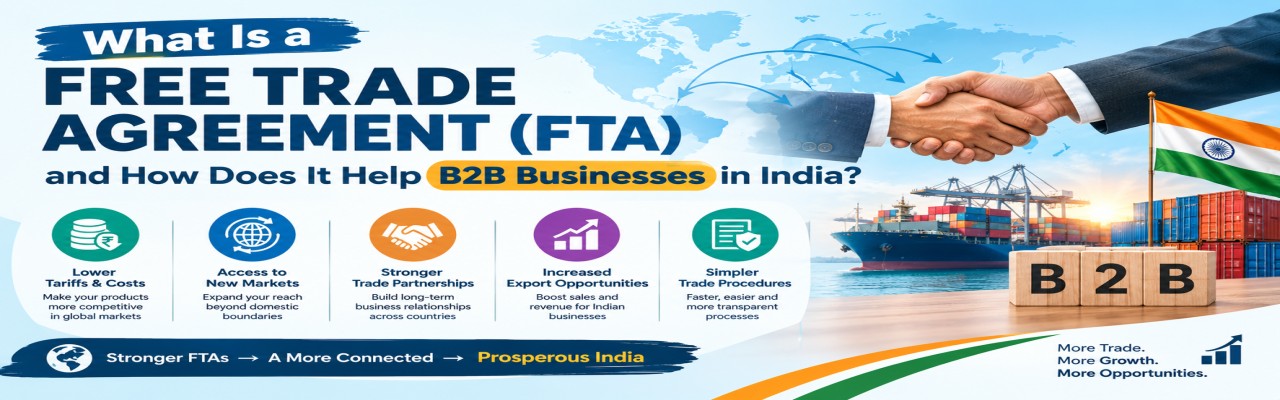
A Free Trade Agreement (FTA) can help businesses trade with partner countries on more favorable terms. Depending on the agreement and the product, an FTA may reduce or remove import duties and create clearer rules for international trade.
For Indian B2B businesses, this can create opportunities to reach new buyers, improve price competitiveness, reduce certain input costs, and participate more effectively in global supply chains.
This guide explains what a Free Trade Agreement is, how an FTA works, why FTAs matter for India, and how they can benefit Indian exporters, manufacturers, suppliers, wholesalers, and MSMEs.
Important: FTA terms, tariff schedules, rules of origin, and entry-into-force dates can change. Always check the official agreement text, tariff schedule, and current notifications for your product and target market before making commercial decisions.
What Is a Free Trade Agreement (FTA)?
A Free Trade Agreement (FTA) is an agreement between two or more countries that reduces or removes customs duties and other trade barriers on goods and, in some cases, services traded between them. The main objective is to make trade between participating countries more affordable, predictable, and accessible.
Without an FTA, imported products generally face the normal customs duty applicable to that trading partner. Under an FTA, eligible products may receive a preferential tariff, meaning the importer pays a lower rate or, in some cases, no customs duty. However, not every product automatically qualifies for an FTA benefit. The product must satisfy the agreement's rules of origin and documentation requirements.
What Can an FTA Cover?
Modern trade agreements can cover much more than import duties. Depending on the agreement, they may include:
-
Trade in goods
-
Trade in services
-
Investment
-
Customs procedures
-
Trade facilitation
-
Technical standards
-
Sanitary and phytosanitary measures
-
Rules of origin
-
Intellectual property
-
Dispute settlement
-
Other areas of economic cooperation
This means an FTA's impact can extend beyond simply reducing tariffs.
Key FTA Terms Every B2B Business Should Know
Before using an FTA, businesses should understand some basic international trade terms.
|
Term |
Simple Meaning |
|
Tariff |
A tax or customs duty charged on imported goods |
|
Preferential Tariff |
A reduced duty rate available to qualifying goods from FTA partner countries |
|
Rules of Origin (RoO) |
Conditions that determine whether a product qualifies as originating from the partner country |
|
Certificate of Origin |
A document used to prove that goods satisfy applicable origin requirements |
|
Non-Tariff Barriers (NTBs) |
Trade requirements other than duties, such as testing, standards, certification, and licensing |
|
Tariff Line |
A specific product classification within a country's customs tariff schedule |
|
HS Code |
A product classification system used for customs and international trade |
How Does a Free Trade Agreement Work?
An FTA gives eligible goods and, depending on the agreement, services from partner countries preferential access to each other's markets.
The process generally involves several stages.
1. Negotiation:
The participating governments negotiate which products will receive tariff reductions, how quickly tariffs will be reduced, and what other trade rules will apply.
2. Signing and Ratification:
Once negotiations are completed, the agreement is signed and goes through the relevant legal or approval processes.
3. Entry Into Force:
The agreement becomes operational from the date specified under its terms.
4. Tariff Reduction: Depending on the product, tariffs may:
-
Become zero immediately
-
Be reduced gradually over several years
-
Remain partially protected
-
Be excluded from tariff concessions
5. Claiming the FTA Benefit
The exporter must demonstrate that the product satisfies the agreement's origin requirements. This may involve a certificate of origin or an origin declaration, depending on the agreement. The importer can then claim the preferential tariff at customs if it meets all requirements.
What Are the Main Product Categories Under an FTA?
Countries generally do not eliminate tariffs on every product immediately. Products may fall into different categories, such as:
-
Immediate Tariff Elimination: The applicable duty becomes zero when the agreement enters into force.
-
Phased Tariff Reduction: The duty is reduced gradually according to a schedule over a specified period.
-
Excluded or Sensitive Products: Some products may remain subject to normal duties or receive only limited tariff reductions because countries want to protect sensitive domestic industries.
Why Is This Important for B2B Businesses?
An FTA does not automatically benefit every product an Indian business sells.
A business needs to check:
Product → HS Code → Tariff Schedule → Rules of Origin → Documentation → Preferential Duty
The actual benefit depends on how the agreement treats the specific product.
Why Do Rules of Origin Matter in an FTA?
Rules of origin determine whether a product actually qualifies for preferential treatment.
They help prevent products from third countries from simply being routed through an FTA partner country to receive lower duties. Common approaches to determining origin include:
-
Wholly Obtained: The product is completely grown, mined, harvested, or produced in the exporting country.
-
Change in Tariff Classification: The manufacturing process changes the product's customs classification sufficiently to satisfy the applicable rule.
-
Regional or Domestic Value Content: A specified percentage of the product's value must originate within the relevant FTA region.
-
Specific Processing Requirements: Certain products may need particular manufacturing or processing activities to take place in the partner country.
The exact rule depends on the agreement and the product. For manufacturers, this makes tracking raw materials, components, production processes, and sourcing particularly important.
Why Are Free Trade Agreements Important for India?
India has a large domestic market, but Indian businesses also participate extensively in international trade. FTAs can help Indian companies access partner markets on preferential terms and can support broader objectives such as export growth, market diversification, manufacturing, and integration into global supply chains.
Major Ways FTAs Can Matter to India
-
Better Market Access: Lower duties can make Indian products more competitive in partner markets.
-
Market Diversification: Exporters can explore additional countries and reduce dependence on a limited number of destinations.
-
Supply Chain Integration: Manufacturers may be able to source certain raw materials, components, or machinery from partner countries at more favorable duty rates.
-
Investment Opportunities: More predictable trade arrangements can support investment and international business relationships.
-
Services Opportunities: Some broader trade agreements include provisions relating to services and professional mobility.
-
Stronger Trade Relationships: FTAs can also include provisions relating to customs, standards, regulations, and other areas of economic cooperation.
At the same time, FTAs can increase competition. Lower duties on imports from partner countries can put pressure on some domestic producers. Sensitive products may therefore receive exclusions, longer tariff-reduction periods, or other protections.
India's Free Trade Agreements: An Overview
India participates in different forms of trade agreements, including Free Trade Agreements (FTAs), Comprehensive Economic Partnership Agreements (CEPAs), Comprehensive Economic Cooperation Agreements (CECAs), Preferential Trade Agreements (PTAs), and regional arrangements. Some well-known agreements and arrangements involving India include:
|
Agreement |
Type / Partner |
General Notes |
|
India–Sri Lanka FTA |
Bilateral FTA |
One of India's earlier bilateral FTAs |
|
SAFTA |
Regional, South Asia |
Covers participating South Asian countries |
|
India–ASEAN |
Goods Agreement Regional bloc, goods |
Covers goods, services, and investment |
|
India–South Korea CEPA |
Comprehensive economic partnership |
Covers goods, services, and investment |
|
India–Japan CEPA |
Comprehensive economic partnership |
Covers goods, services, and investment |
|
India–UAE CEPA |
Comprehensive economic partnership |
Came into effect in 2022 |
|
India–Australia ECTA |
Economic cooperation and trade agreement |
Interim agreement in effect since late 2022 |
|
APTA |
Asia-Pacific Trade Agreement |
Preferential regional arrangement |
|
India–Mercosur / India–Chile and similar PTAs |
Preferential trade agreements |
Limited product coverage |
Recent FTA Developments in India
India’s trade-agreement agenda has expanded in recent years. Here are some of India's most recent FTA developments.
India-EETA TEPA: The Trade and Economic Partnership (TEPA) between India and the European Free Trade Association countries took effect in October 2025.
India-UK CETA: The India-UK Comprehensive Economic and Trade Agreement (CETA) has been in effect since 15 July 2026. Government information describes duty-free access for 99% of Indian exports to the UK.
India-EU FTA: Negotiations for the India-EU FTA were concluded on 27 January 2026. However, the agreement still requires the applicable legal and ratification processes before it can become operational. Because trade agreements and their implementation schedules can evolve, businesses should verify the latest position with official sources before relying on a particular tariff benefit.
How Does an FTA Help Indian B2B Businesses?
For B2B businesses, one of the most direct effects of an FTA can be reduced import duty paid by the buyer in a partner country. This can reduce the buyer’s landed cost and make an Indian product more competitive.
For example, if an Indian manufacturer supplies industrial components to a distributor in an FTA partner country, the buyer may pay a lower preferential duty if the product meets all applicable conditions.
The lower landed cost may improve the buyer’s purchasing economics. However, an FTA does not guarantee an order. Product quality, price, delivery reliability, compliance, production capacity, and supplier reputation continue to matter.
What are the Main FTA Benefits for B2B Businesses?
Here are some of the benefits of FTAs for B2B businesses:
-
Lower landed cost: A qualifying product may enter the partner market at a lower duty rate, reducing the importer’s overall cost.
-
Better price competitiveness: An Indian supplier may be able to compete more effectively with suppliers from countries that do not receive the same preferential tariff.
-
Access to new buyers: Improved cost competitiveness can make it easier to approach buyers in markets where Indian products were previously less competitive.
-
Greater pricing predictability: Known tariff schedules can help businesses plan quotations and longer-term commercial arrangements.
-
Potentially lower input costs: Where an agreement reduces India’s import duties on eligible inputs, manufacturers may benefit from lower costs for certain raw materials, components, or machinery.
FTA Benefits for B2B Businesses at a Glance
|
Benefit |
What It Can Mean for a Business |
|
Lower or zero import duty |
Buyer may pay less to import the product |
|
Better price competitiveness |
Supplier can compete without necessarily reducing its own margin |
|
Greater predictability |
Tariff schedules can support pricing and contract planning |
|
Market diversification |
Businesses can explore additional partner markets |
|
Supply chain flexibility |
Certain inputs may be sourced more efficiently |
|
Services opportunities |
Some agreements include services and mobility provisions |
|
Trade facilitation |
Certain agreements include customs and procedural measures |
How Does an FTA Benefit Indian Exporters?
Indian exporters can potentially benefit from preferential tariff rates when their products qualify under the applicable FTA. For exporters, the key advantage is often the impact on the buyer’s landed cost. Here are some of the major FTA benefits for Indian exporters:
-
Preferential duty rates: Eligible goods may enter the partner market at reduced or zero duty.
-
Stronger price position: Lower landed costs can give an Indian exporter more flexibility in price negotiations.
-
Opportunity for larger contracts: Large international buyers often evaluate total landed cost. A duty advantage can therefore become an important part of a supplier’s commercial proposition.
-
Long-term planning: Phased tariff schedules can help exporters plan production, pricing, and capacity.
-
New market opportunities: Exporters can identify partner markets where tariff preferences improve the commercial potential of their products.
Does an FTA Guarantee More Exports?
No. An FTA creates a potential trade advantage, but it does not guarantee export orders. An Indian exporter still needs to compete on these factors:
Product quality
Pricing
-
Delivery timelines
-
Productions capacity
-
Certifications
-
Packaging
-
Payment terms
-
Reliablity
-
Market demand
The agreement can reduce trade barriers, but the exporter still needs to win the buyer.
How Can Indian Manufacturers Benefit From FTAs?
Indian manufacturers can benefit from FTAs on both sides of their business: Selling finished products abroad and buying inputs from international suppliers.
Export-Side Benefits:
Manufacturers also benefit from:
-
Lower duties on eligible finished products
-
Better competitiveness against suppliers from non-FTA countries
-
Greater access to partner markets
-
Potential for higher export volumes
-
Better integration into international supply chains
Input-Side Benefits
Manufacturers may also benefit from:
-
Potentially lower duties on imported raw materials
-
Lower-cost components
-
Access to additional sources of machinery and equipment
-
Greater sourcing flexibility
-
Integration with regional supply chains
What are the FTA Benefits for Indian manufacturers?
|
Area |
Possible Benefit |
|
Export pricing |
More competitive landed cost in partner markets |
|
Production scale |
Larger addressable market may support higher volumes |
|
Input costs |
Potentially lower cost for eligible imported inputs |
|
Supply chain |
Greater participation in regional and global value chains |
|
Machinery |
Potential access to equipment at lower duty |
|
Long-term planning |
Tariff schedules can support investment decisions |
How Can Indian Suppliers Benefit From FTAs?
The impact of FTAs is not limited to companies that export finished products. Indian suppliers that provide components, packaging, raw materials, machinery, and other inputs to exporters can also benefit indirectly. For example, if an Indian manufacturer receives more international orders because of an FTA-related cost advantage, it may need to purchase more:
-
Packaging materials
-
Components
-
Industrial inputs
-
Raw materials
-
Machinery
-
Business services
This can create additional demand throughout the domestic B2B supply chain. For MSME suppliers, understanding the FTAs relevant to their major customers can therefore help them anticipate changes in demand.
FTA Impact on Different B2B Industries
The impact of an FTA varies significantly by industry and product. Tariff reductions, rules of origin, product standards, competition, and market demand all influence the outcome.
|
Industry |
How an FTA May Help |
What to Watch |
|
Textiles & apparel |
Lower duties can improve competitiveness |
Rules of origin, yarn/fabric requirements, competition |
|
Pharmaceuticals |
Tariff reductions and regulatory cooperation may help |
Regulatory approvals and standards |
|
Engineering goods |
Lower duties on selected components and finished goods |
Value-content rules and technical standards |
|
Agriculture & food processing |
Better market access for eligible products |
Food safety rules and sensitive-product exclusions |
|
Chemicals |
Lower duty on selected products |
Environmental and regulatory compliance |
|
Leather & footwear |
Improved price competitiveness |
Origin rules and buyer standards |
|
Gems & jewellery |
Potential duty advantages in certain markets |
Product-specific tariff treatment |
|
IT & professional services |
Some agreements include service provisions |
Agreement-specific commitments |
|
Automotive components |
Better access for parts suppliers |
Often strict origin requirements Industries That Rely on Imported Inputs |
Industries That Rely on Imported Inputs
-
An FTA can have both positive and challenging effects on an industry.
-
A manufacturer that imports important inputs may benefit from lower import duties.
-
At the same time, a domestic producer competing against imported finished goods may face greater competition when those imports become cheaper.
-
Businesses should therefore assess both sides of an agreement.
FTAs and Global Market Access for Indian Businesses
Market access is one of the most important reasons B2B businesses pay attention to trade agreements. An FTA can make products more competitive in partner markets, but market access involves more than tariffs. Depending on the agreement, businesses may also encounter provisions relating to:
-
Product standards
-
Testing
-
Customs procedures
-
Trade facilitation
-
Regulatory cooperation
-
Administrative processes
These factors can influence how easily an exporter can build repeat business with overseas buyers.
For Indian exporters, the goal should therefore be to look at the complete trade environment, rather than focusing only on the headline tariff reduction.
How Can Indian Businesses Use FTAs to Find International Buyers?
An FTA can give Indian exporters a reason to revisit markets that were previously difficult to serve competitively. Businesses can look for potential buyers through:
-
International trade fairs
-
Export exhibitions
-
B2B marketplaces
-
Export platforms
-
Export promotion council events
-
Chambers of commerce
-
Industry associations
-
Indian missions abroad
-
Direct outreach to importers and distributors
B2B platforms can also help manufacturers and suppliers showcase their products to potential buyers looking for Indian suppliers. For example, exporters can use product catalogs, business profiles, supplier listings, and direct inquiry channels to present their products to international buyers. The FTA advantage can then become part of the commercial conversation when the product qualifies for preferential treatment.
FTA vs WTO: What's the Difference?
The World Trade Organization (WTO) provides a broad international framework for trade between its members. An FTA, by contrast, is a separate agreement between specific countries or groups of countries that provides preferential terms to participating partners.
|
Feature |
WTO |
FTA |
|
Coverage |
Global framework with broad membership |
Specific participating countries |
|
Purpose |
Establish common trade rules |
Provide preferential market access |
|
Tariff treatment |
General tariff framework |
Preferential rates for qualifying partners |
|
Scope |
General trade rules |
Can include goods, services, investment, and other areas |
|
Beneficiaries |
WTO members under applicable rules |
Participating FTA partners |
|
Negotiation |
Multilateral |
Bilateral or regional |
FTA vs PTA vs CEPA vs CECA
Trade agreements can have different names and scopes.
FTA – Free Trade Agreement
Generally reduces or removes tariffs on a broad range of goods and may also cover other areas.
PTA – Preferential Trade Agreement
Provides preferential tariff treatment for a more limited list of products.
CEPA – Comprehensive Economic Partnership Agreement
A broader economic agreement that can cover goods, services, investment, and economic cooperation.
CECA – Comprehensive Economic Cooperation Agreement
A broad agreement covering economic cooperation and trade, potentially including goods, services, investment, and related areas.
|
Agreement |
Full Form |
General Scope |
|
FTA |
Free Trade Agreement |
Broad tariff preferences, mainly goods |
|
PTA |
Preferential Trade Agreement |
Limited product preferences |
|
CEPA |
Comprehensive Economic Partnership Agreement |
Goods, services, investment, cooperation |
|
CECA |
Comprehensive Economic Cooperation Agreement |
Broad economic and trade cooperation |
What Should B2B Businesses Check Before Using an FTA?
Before using an FTA for an export or import transaction, businesses should verify whether the product actually qualifies.
FTA Eligibility Checklist
1. Confirm That the Agreement Is in Force
Check whether the agreement is currently operational and which tariff schedule or phase applies.
2. Identify the Correct HS Code
Correct product classification is essential because tariff treatment is generally linked to specific tariff lines.
3. Check the Tariff Schedule
Find out whether the product receives:
-
Immediate duty elimination
-
Phased reduction
-
Partial preference
-
No preference
4. Check the Rules of Origin
Confirm that your manufacturing process and sourcing meet the applicable origin requirements.
5. Check Documentation Requirements
Determine whether you need a certificate of origin, origin declaration, or another form of proof.
6. Review Non-Tariff Requirements
-
Lower customs duty does not necessarily remove:
-
Testing requirements
-
Product standards
-
Labelling rules
-
Certifications
-
Licensing
-
Other regulatory requirements
7. Compare Costs and Benefits
The compliance process may involve additional work. Businesses should determine whether the expected duty benefit justifies that effort.
8. Coordinate With the Buyer
The overseas buyer should understand how to claim the preferential rate at customs.
9. Maintain Records
Keep relevant:
-
Invoices
-
Production records
-
Bills of materials
-
Supplier declarations
-
Cost records
-
Origin documentation
10. Monitor Changes
FTA tariff schedules and procedures can change or be clarified over time.
Common FTA Mistakes Businesses Should Avoid
Businesses can lose the benefit of an FTA if they overlook important compliance requirements. Here are the common mistakes:
-
Assuming every product qualifies
-
Using an incorrect HS code
-
Ignoring rules of origin
-
Applying for the wrong certificate
-
Failing to maintain supporting records
-
Missing documentation requirements
-
Ignoring non-tariff barriers
-
Assuming an FTA eliminates every import duty
-
Failing to verify the agreement's current status
-
Assuming a tariff advantage guarantees export demand
FTA Documentation: What Do Exporters Need?
The exact documentation varies by agreement. Exporters generally need to:
-
Correctly classify the product
-
Establish that the product meets the applicable rules of origin
-
Maintain evidence relating to production and sourcing
-
Obtain the required certificate of origin or origin declaration
-
Provide origin documentation to the buyer
-
Keep supporting records in case verification is required
If the required documentation is incomplete or inaccurate, the buyer may not receive the preferential tariff. That can increase the buyer's landed cost and potentially affect the commercial relationship.
What Should Indian Importers and Buyers Know About FTAs?
FTAs can also matter to businesses importing goods into India. An Indian importer should not assume that goods shipped from an FTA partner automatically qualify for preferential treatment. The importer should verify:
-
Product classification
-
Applicable agreement
-
Rules of origin
-
Origin documentation
-
Tariff treatment
-
Customs requirements
-
Other applicable regulatory requirements
Customs authorities may verify origin claims, so businesses should keep the relevant documents and information available.
Challenges and Limitations of Free Trade Agreements
FTAs can create opportunities, but they also have limitations.
-
Compliance Burden: Origin documentation and record-keeping can require additional time and resources, particularly for smaller businesses.
-
Import Competition: Lower duties can make imported products more competitive in the domestic market.
-
Non-Tariff Barriers: Standards, testing, certification, labeling, and regulatory requirements can still make market entry difficult.
-
Complex Rules of Origin: Rules can vary considerably between agreements and products.
-
Limited Awareness: Some businesses may not know which agreements apply to their products or how to claim the available preferences.
-
Phased Tariff Benefits: A product may receive tariff reductions gradually rather than immediately.
-
Changing Trade Conditions: Currency movements, international demand, logistics costs, regulations, and broader trade policy can all influence the final commercial outcome.
How Indian Businesses Can Benefit From Free Trade Agreements?
Indian businesses can take a structured approach to identifying FTA opportunities.
Step 1: List Your Products and Target Markets
Start with the products you already manufacture or supply and identify the countries where you want to find buyers.
Step 2: Identify Relevant Trade Agreements
Check whether India has an applicable trade agreement with your target market.
Step 3: Check Your Product's Tariff Treatment
Find the correct HS code and compare the normal tariff with the preferential tariff under the agreement.
Step 4: Review Rules of Origin
Determine whether your manufacturing process and inputs satisfy the applicable requirements.
Step 5: Prepare Documentation
Build a process for maintaining production, sourcing, and origin records.
Step 6: Approach Potential Buyers
Use trade fairs, B2B marketplaces, export platforms, industry networks, and direct outreach to connect with potential buyers.
Step 7: Include the FTA Advantage in Your Sales Discussion
If your product qualifies, explain the potential preferential tariff treatment to buyers as part of the commercial discussion.
Step 8: Review Performance
Track:
-
Enquiries
-
Orders
-
Export markets
-
Margins
-
Compliance costs
-
Buyer feedback
This can help determine whether a particular FTA is creating a meaningful commercial opportunity.
How Can MSMEs Benefit From FTAs?
FTAs are not relevant only to large exporters. Indian MSMEs can potentially benefit by:
-
Exporting eligible products directly
-
Supplying larger export-oriented manufacturers
-
Entering new B2B markets
-
Finding international distributors
-
Sourcing certain inputs more efficiently
-
Building relationships with overseas buyers
For smaller businesses, it can be practical to start with one product and one target market. Once the business understands the tariff treatment, documentation, rules of origin, logistics, and buyer requirements, it can consider expanding to additional markets.
Where Can Indian Businesses Find International B2B Buyers?
Businesses looking to benefit from export opportunities created by trade agreements can explore several channels.
B2B Marketplaces
Online B2B platforms allow manufacturers and suppliers to showcase products and connect with buyers.
Trade Fairs
Industry-specific exhibitions can help exporters meet importers, distributors, and procurement teams.
Export Promotion Events
Export promotion councils and industry associations can provide opportunities to meet international buyers.
Chambers of Commerce
Business associations can help companies identify trade networks and international contacts.
Indian Missions Abroad
Indian missions and commercial wings can provide information and business networking opportunities.
Direct Buyer Outreach
Exporters can also approach importers, distributors, wholesalers, and procurement teams directly. An FTA can strengthen the commercial proposition, but businesses still need to demonstrate product quality, competitive pricing, reliable delivery, and compliance.
Conclusion
A Free Trade Agreement (FTA) can be an important tool for Indian businesses looking to expand into international markets. For exporters and manufacturers, preferential tariff treatment can reduce the landed cost of eligible products and improve their price position in partner markets. Manufacturers may also benefit from potentially lower duties on eligible imported inputs. Suppliers can benefit indirectly when export-oriented businesses receive greater overseas demand.
However, an FTA does not automatically make every product cheaper or guarantee export growth. Businesses need to check the HS code, tariff schedule, rules of origin, documentation requirements, and non-tariff regulations before claiming an FTA benefit.
For Indian B2B businesses, the practical approach is simple: identify relevant markets, check whether your products qualify, understand the compliance requirements, and then use the potential tariff advantage as part of your international sales strategy. As India's network of trade agreements develops, understanding FTAs can become an increasingly useful part of export planning, international sourcing, and B2B market expansion.