
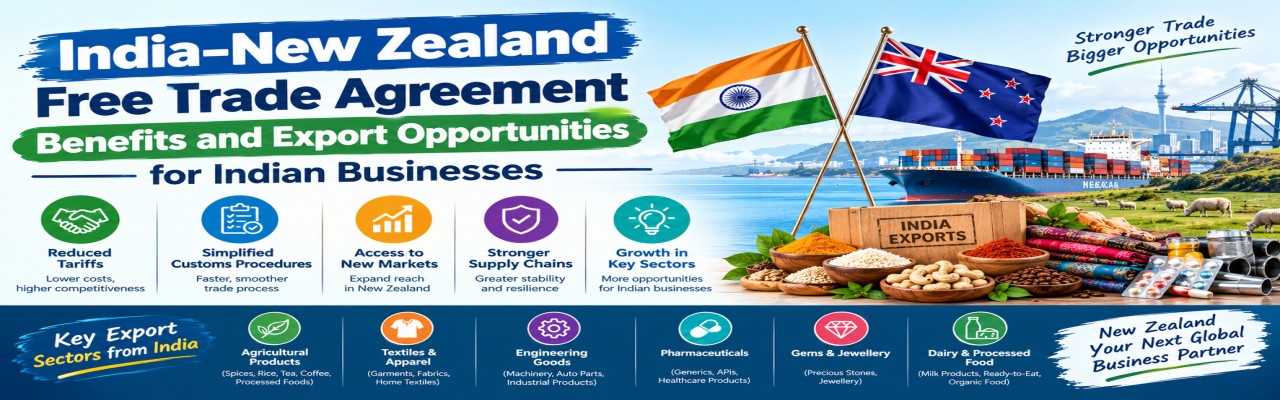
India and New Zealand have taken an important step in strengthening their trade relationship through a Free Trade Agreement. The agreement aims to improve market access, reduce trade barriers, and create new opportunities for businesses in both countries.
For Indian exporters, manufacturers, wholesalers, and small businesses, the India-New Zealand free trade agreement could open doors to a wider international market. Businesses dealing in textiles, apparel, engineering goods, pharmaceuticals, leather products, processed foods, and other eligible products may find new opportunities to connect with buyers in New Zealand.
However, the benefits will depend on the agreement’s implementation, product-specific tariff concessions, rules of origin, and applicable import regulations. In this article, we explain the key aspects of the India-New Zealand trade agreement, its potential benefits for Indian businesses, the industries that could benefit, and the steps exporters could take to explore the New Zealand market.
What is the India-New Zealand Free Trade Agreement?
The India-New Zealand free trade agreement is a trade agreement designed to strengthen economic cooperation between the two countries. It aims to make cross-border trade easier by addressing tariffs and other barriers, improving market access, and establishing clearer conditions for businesses trading between India and New Zealand.
The agreement follows negotiations aimed at expanding bilateral trade and creating new opportunities for businesses, investors, and service providers. For Indian companies New Zealand represents a potential export destination for a range of manufactured goods, consumer products, industrial supplies, and other eligible products.
For New Zealand the agreement improves access to India’s larger consumer market and creates opportunities for businesses looking to expand their presence in the Indian economy.
Why is the India-New Zealand Trade Agreement Important?
The India-New Zealand Trade Agreement is important because of several reasons which are mentioned below:
- Improved market access: Eligible Indian products may receive professional access to the New Zealand market under the agreed tariff schedules.
- Export opportunities: Indian manufacturers and suppliers can explore new customers, distributors, and business partnerships.
- Support for trade diversification: Businesses can consider New Zealand as an additional export destination instead of relying on a limited number of overseas markets.
- Greater economic cooperation: The agreement provides a framework for strengthening commercial relationships between the two countries.
- Opportunities for MSMEs: Small and medium-sized businesses with export ready products may be able to explore new international markets.
It is important to remember that an FTA does not automatically guarantee higher sales. Exporters still need higher pricing, reliable product quality, appropriate certification, and a clear understanding of the target market.
Key Highlights of the India New Zealand Trade Agreement
The agreement focuses on improving trade conditions and expanding cooperation between the two countries. Its practical benefits depend on the specific provisions and implementation agreements.
1. Tariff Concessions and Market Access
One of the main purposes of a free trade agreement is to reduce or eliminate customs duties on eligible products. If a product receives a preferential tariff under the India-New Zealand FTA, Indian exporters may be able to offer more competitive prices to the New Zealand buyers. For example, an Indian manufacturer exporting eligible textile products may benefit from a lower applicable import duty, depending on the product's tariff classification and the concession schedule.
However, not every product necessarily receives the same treatment. Some products may receive immediate concessions, while others may be subject to phased reductions, exclusions, or specific conditions. Exporters should therefore check the applicable tariff schedule and compare the preferential rate with the normal import duty before calculating their potential savings.
2. Greater Opportunities for Indian Exporters
The agreement may help Indian exporters explore new commercial relationships with importers, distributors, wholesalers, and manufacturers in New Zealand. Indian businesses can assess demand for products such as:
- Textiles, garments, and home furnishings
- Leather goods and footwear
- Engineering goods and industrial components
- Pharmaceuticals and eligible healthcare products
- Processed foods and selected agricultural products
- Gems, jewellery, and other manufactured goods
These are potential areas to investigate, not a guarantee that every product will receive preferential treatment or experience increased demand. Businesses should examine New Zealand's import requirements, competing suppliers, product prices, and buyer preferences before entering the market.
3. Trade in Services and Business Cooperation
Modern trade agreements can cover services alongside physical goods. Depending on the agreement’s specific commitments, businesses may find opportunities in areas such as professional services, information technology, business services, and other eligible services.
Indian service providers should manage the relevant provisions rather than assuming that every service category receives unrestricted market access. Businesses may also partnerships with New Zealand companies for distribution, sourcing product distribution, and other commercial activities.
4. More Opportunities to Diversify Export Opportunities
Exporting to multiple countries can help businesses reduce their dependence on the single market. For example an Indian buyer that primarily sells to buyers in one region could investigate whether its products are suitable for New Zealand.
However, market diversification requires proper planning. Businesses should evaluate the freight costs, delivery timelines, currency fluctuations, payment terms, and the cost of meeting overseas product standards. An FTA can improve trade conditions, but a suitable export strategy still depends on commercial feasibility.
Which Indian Industries Could Benefit from the FDA?
The potential benefits will vary by industry and product category. Indian businesses should focus on sectors where they have competitive advantages, export-ready products, and a realistic opportunity to meet demand in New Zealand.
1. Textiles, Garments, and Home Furnishings
India has a broad textile and apparel manufacturing base, ranging from cotton fabrics and ready-made garments to bed linen, towels, and other home furnishings. These products may offer opportunities for Indian manufacturers looking to supply New Zealand importers, retailers, wholesalers, and private-label brands. Potential products include:
- Cotton and blended fabrics
- T-shirts, shirts, and other garments
- Bed sheets, pillowcases, and towels
- Curtains and home furnishing fabrics
- Made-ups and selected textile accessories
Manufacturers should assess product quality, fabric specifications, sizing requirements, labelling rules, order quantities, and delivery schedules. If preferential tariffs are available for a particular product, exporters should also verify the relevant rules of origin before quoting prices to buyers.
2. Engineering Goods and Industrial Components
India manufactures a wide range of engineering products, including metal components, machinery parts, tools, and industrial equipment. New Zealand businesses in manufacturing, construction, maintenance, agriculture, and infrastructure-related activities may source suitable products from international suppliers. Indian manufacturers can investigate opportunities involving:
- Metal components and fabricated products
- Industrial tools and equipment
- Selected machinery and spare parts
- Electrical components
- Fasteners and hardware products
For this sector, product specifications and technical compliance are especially important. Buyers may require testing reports, quality certifications, documentation, or evidence that products meet relevant technical standards. Exporters should identify the exact product classification and applicable import requirements before making commercial commitments.
3. Leather Goods and Footwear
India has an established leather and footwear manufacturing industry serving domestic and international markets. Manufacturers may explore opportunities to supply shoes, bags, wallets, belts, and other leather or non-leather accessories to New Zealand importers and retailers.
Businesses can also investigate private-label manufacturing for overseas brands. To compete effectively, suppliers should focus on consistent quality, reliable production capacity, material specifications, product design, and responsible sourcing requirements. Any tariff advantage will depend on the product concerned and the applicable agreement provisions.
4. Pharmaceuticals and Healthcare Products
India is an important producer of pharmaceutical products and supplies medicines and healthcare-related products to international markets.
- The New Zealand market may present opportunities for eligible Indian pharmaceutical and healthcare businesses, but this sector requires particular care.
- Exporters must verify the relevant regulatory requirements, product approvals, import permissions, and quality standards before supplying medicines or other regulated healthcare products.
- A trade agreement does not automatically authorise a product for sale in New Zealand or remove the need to meet applicable regulatory requirements.
- Businesses should confirm the requirements with the relevant New Zealand authorities and qualified regulatory professionals.
5. Processed Foods and Agricultural Products
India produces a wide range of food products, spices, processed ingredients, and agricultural goods that may interest international buyers. Depending on market demand and product eligibility, Indian suppliers can investigate opportunities involving:
- Processed and packaged foods
- Selected spices and food ingredients
- Rice and other eligible agricultural products
- Ready-to-cook food products
- Shelf-stable food preparations
Food exports require careful attention to import conditions. New Zealand has biosecurity and food safety requirements, and some products may face restrictions or additional documentation requirements.
Exporters should verify whether their particular product is permitted for import and what documentation, treatment, testing, or certification may be required. They should not assume that tariff concessions override food safety or biosecurity rules.
6. Gems, Jewellery, and Consumer Products
India has a substantial jewellery and consumer goods manufacturing sector. Exporters may investigate opportunities to supply jewellery, accessories, decorative items, and other products to New Zealand businesses. Potential customers include retailers, wholesalers, importers, and distributors.
Suppliers should prepare accurate product descriptions, material details, specifications, wholesale pricing, and clear order terms. They should also check applicable customs classification, import requirements, and rules of origin. The commercial opportunity will depend on demand, competition, pricing, and the specific tariff treatment of each product.
Export Opportunities for Indian MSMEs and Manufacturers
The India–New Zealand trade agreement is relevant not only to large exporters but also to MSMEs and manufacturers that are preparing to expand internationally.
Smaller businesses may be able to explore overseas markets by working with importers, distributors, wholesale buyers, and established trading companies. However, successful exporting requires more than finding a buyer. Businesses need a suitable product, a competitive offer, reliable fulfilment, and the ability to comply with import requirements.
1. Find Importers, Wholesalers, and Distributors
Indian manufacturers can research New Zealand businesses that already import products in their category. For example, a home textile manufacturer could approach homeware wholesalers, retailers, or private-label sourcing companies. An industrial component manufacturer could investigate distributors serving relevant engineering or maintenance industries.
Before contacting potential buyers, suppliers should prepare a clear product catalogue, company profile, product specifications, and wholesale pricing information. They should also verify that potential buyers are legitimate businesses with relevant purchasing requirements.
2. Explore Bulk Supply Opportunities
Bulk orders can be relevant for manufacturers that have sufficient production capacity and can maintain consistent quality. Businesses should calculate their costs carefully, including:
- Manufacturing and packaging costs
- Inland transportation and export handling
- International freight and insurance, where applicable
- Customs-related charges and documentation
- Applicable taxes, duties, and compliance costs
- Payment processing and currency-related expenses
These calculations help exporters determine whether a potential order is commercially viable.
A lower import tariff alone does not necessarily make a product competitive if freight, compliance, or production costs remain high.
3. Consider Private-Label Manufacturing
Some overseas retailers and distributors source products from manufacturers and sell them under their own brands. Indian manufacturers may explore private-label opportunities in categories such as apparel, home furnishings, accessories, and eligible consumer products.
Before accepting an order, both parties should agree on product specifications, branding rights, packaging, quality checks, minimum order quantities, delivery schedules, and payment terms.
Manufacturers should also confirm whether the proposed products meet the destination market's applicable standards and labelling requirements.
4. Build Long-Term Buyer Relationships
International trade often depends on repeat orders and dependable supplier relationships. Indian exporters can strengthen buyer confidence by providing accurate quotations, communicating production timelines, maintaining consistent product quality, and responding promptly to enquiries.
They should also agree on delivery terms, inspection procedures, payment methods, and how any product disputes will be handled. For MSMEs entering a new market, starting with a manageable order can help both parties evaluate the supplier relationship before expanding the volume of business.
How Can Indian Businesses Start Exporting to New Zealand?
Indian businesses interested in the New Zealand market should follow a structured export process. The following steps can help manufacturers and suppliers prepare for international trade.
Step 1: Research the New Zealand Market
- Start by identifying products that have a realistic opportunity in New Zealand.
- Research import demand, competing suppliers, retail and wholesale prices, and the types of businesses that purchase your products.
- Trade statistics can help identify existing import trends, while industry directories and business websites can help locate potential buyers.
- Businesses should also consider whether their product offers a clear advantage in quality, design, pricing, availability, or customisation.
Step 2: Obtain the Necessary Export Documentation
Businesses exporting goods from India generally need an Importer Exporter Code (IEC) issued by the Directorate General of Foreign Trade, subject to applicable exceptions.
Other documents may be required depending on the product, shipment, payment arrangement, and destination-market requirements.Common export documents can include:
- Commercial invoice
- Packing list
- Shipping bill or applicable customs export declaration
- Bill of lading or air waybill, depending on the transport method
- Certificate of origin, where required
Product-specific certificates, permits, or test reports, where applicable. The precise requirements vary. Exporters should confirm the documentation needed for their product and transaction before shipping.
Step 3: Check Product Classification and Tariff Benefits
- Correct product classification is essential when assessing customs duties.
- Exporters should identify the applicable HS code and check the relevant New Zealand tariff schedule.
- They should then establish whether the product qualifies for preferential treatment under the India–New Zealand agreement, including whether the agreement is in force for the relevant shipment date.
- A product's eligibility may depend on its classification, the applicable tariff schedule, and compliance with the rules of origin.
- Businesses should not quote a preferential duty rate to a buyer until they have verified the applicable conditions.
Step 4: Understand Rules of Origin
- Rules of origin determine whether a product qualifies as originating in a country under a trade agreement.
- Depending on the product-specific rule, eligibility may depend on where the product was manufactured, the materials used, the value added, or the processing performed.
- Simply shipping a product from India does not automatically make it eligible for preferential tariff treatment.
- Exporters should review the relevant origin criteria and understand what supporting records or origin documentation are required.
Step 5: Check New Zealand's Import Requirements
- Before accepting an order, confirm that the product can be imported and sold in New Zealand under the applicable regulations.
- Requirements can differ significantly by product category.
- Food and agricultural products may be subject to biosecurity conditions, while medicines and certain healthcare products may require regulatory approval. Other goods may be subject to labelling, safety, technical, or product-specific requirements.
- Importers and exporters should verify these conditions with the relevant New Zealand authorities before dispatching goods.
Step 6: Calculate the Complete Export Cost
- Prepare a quotation that accounts for the full cost of delivering the goods.
- Consider manufacturing costs, packaging, transportation, freight, insurance where applicable, export documentation, and other relevant expenses.
- Also clarify which party is responsible for import duties, taxes, customs clearance, and delivery costs under the agreed shipping terms.
- A complete cost calculation helps businesses set realistic prices and avoid unexpected expenses after an order has been confirmed.
Step 7: Find and Verify New Zealand Buyers
- Once the product and pricing are ready, start approaching suitable importers, distributors, wholesalers, and procurement teams.
- Businesses can use trade directories, industry associations, trade fairs, company websites, and B2B platforms to identify potential customers.
- For example, Indian suppliers can use B2B TradeMart to present their products and business profiles and explore opportunities to connect with international buyers.
However, appearing on a B2B platform does not guarantee enquiries or orders. Suppliers should maintain complete company information, respond to enquiries promptly, and carry out appropriate checks before entering into a transaction.
How Can B2B TradeMart Help Indian Exporters Explore the New Zealand Market?
For Indian manufacturers and suppliers, discovering relevant overseas buyers is an important part of building an export business. B2B TradeMart can support this process by providing a platform for businesses to showcase their products and company information and explore potential international trade connections. Businesses preparing to enter the New Zealand market can use a B2B platform as part of a broader export strategy.
Showcase Products to International Buyers
- Manufacturers can create detailed product listings with specifications, product images, available quantities, and relevant business information.
- Clear listings help prospective buyers understand what a supplier offers and whether its products match their requirements.
Build a Professional Business Profile
- A complete company profile can help overseas buyers assess a supplier's experience, product range, manufacturing capabilities, and contact information.
- Businesses should ensure that their profile is accurate and includes relevant certifications or quality information where applicable.
Explore Wholesale and Bulk Enquiries
- Suppliers can present products suitable for bulk purchasing and communicate with prospective buyers about quantities, specifications, and commercial terms.
- Before accepting an enquiry, businesses should evaluate the buyer's requirements and verify the commercial details of the proposed transaction.
Support International Market Research
- B2B platforms can complement other market research methods by helping businesses discover suppliers, product categories, and potential commercial contacts.
- For the best results, exporters should combine online product visibility with direct buyer outreach, market research, trade data, and proper buyer verification.
- The India–New Zealand FTA may create additional reasons for businesses to investigate this market, but exporters should confirm product eligibility and buyer demand before investing in a new export programme.
Conclusion
The India–New Zealand Free Trade Agreement represents an important development in the trade relationship between the two countries. By improving market access for eligible products and establishing a framework for closer economic cooperation, it may create new opportunities for Indian manufacturers, exporters, wholesalers, and MSMEs.
Sectors such as textiles, engineering goods, leather products, pharmaceuticals, processed foods, and other manufactured goods are worth investigating, subject to product eligibility and market demand.
However, businesses should not assume that the agreement automatically makes every product duty-free or guarantees additional export orders. Understanding tariff schedules, rules of origin, regulatory requirements, freight costs, and buyer expectations remains essential.
Indian businesses that combine careful market research with competitive products, reliable supply, and effective buyer outreach will be better positioned to evaluate opportunities in New Zealand.
For exporters looking to expand their international reach, B2B platforms such as TradeMart can complement these efforts by helping them showcase their products and explore potential business connections.