
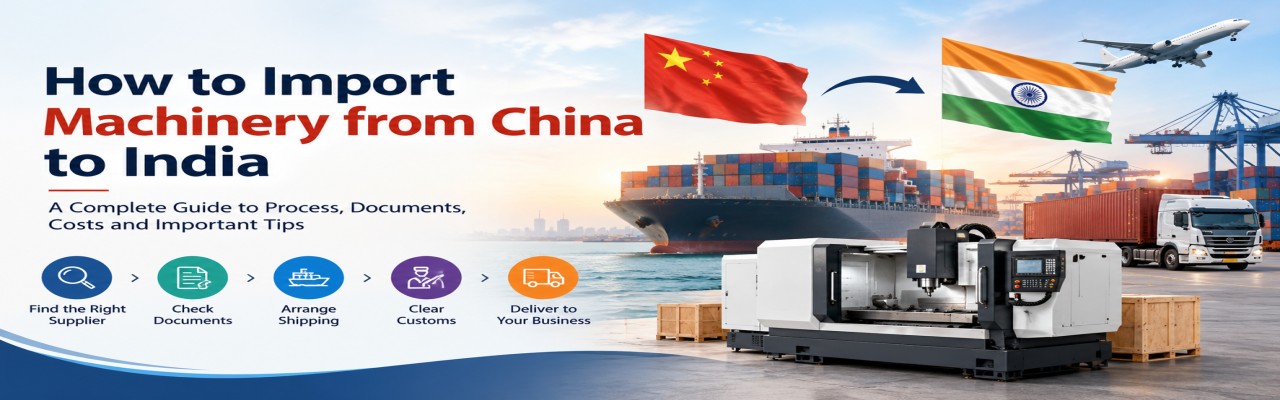
Importing machinery from China can help businesses access industrial equipment, automation systems, packaging machines and manufacturing technologies at competitive prices. Chinese manufacturers offer a wider range of machinery for small businesses, factories, construction companies and large industrial operations.
However, buying machinery from China involves more than finding a low priced supplier. Indian importers must check product specifications, verify the manufacturer, understand import regulations, calculate customs duty, arrange international shipping and complete custom clearance.
So whether you want to import single machinery for your factory or purchase equipment for resale, understanding the process can help you control and avoid unnecessary delays. In this guide, we explain how to import machinery from China to India, the documents required, import-duty calculations, shipping options, supplier verification and important compliance requirements.
Why Import Machinery from China to India?
China is an important manufacturing hub for industrial equipment, electrical machinery, automation systems and production technology. Indian businesses can explore Chinese suppliers when they need equipment that meets their technical requirements and budget. Here are some reasons why businesses consider importing machinery from China.
-
Wide product selection: Chinese manufacturers offer machinery for packaging, food processing, textiles, construction, agriculture and industrial manufacturing.
-
Different price ranges: Buyers can compare basic, semi-automatic and advanced automated equipment.
-
Customisation options: Some manufacturers can modify machine dimensions, production capacity, voltage specifications and other features.
-
Access to manufacturing technology: Importers can explore specialised equipment that may not be readily available from their existing domestic suppliers.
-
Bulk purchasing opportunities: Businesses importing several machines may be able to negotiate pricing, spare parts and technical support.
-
Private-label and OEM options: Certain manufacturers offer equipment under a buyer's brand or according to specific requirements.
However, importing is not always cheaper than purchasing machinery in India. Freight, customs duty, taxes, installation, spare parts and after-sales service can significantly increase the final cost. Before deciding to import goods from China to India, compare the complete landed cost with the price of equivalent machinery available locally.
Types of Machinery You Can Import from China to India
The types of machinery you can import from China to India depend on your business requirements and the applicable Indian import policy. The common categories are mentioned below:
Industrial Manufacturing Machinery
Industrial machinery is used in factories, workshops, and manufacturing units to produce or process goods. Some of the examples include:
-
CNC machining centers and metal cutting-machines
-
Industrial drilling, milling and grinding machines
-
Injection molding machines
-
Metal fabrication and welding equipment
-
Industrial compressors and pumps
-
Production-line machinery
-
Plastic processing equipment
Before ordering, check the machine’s production capacity, power consumption, dimensions, accuracy, operating requirements and availability of spare parts.
Packaging and Food Processing Machinery
Food manufacturers, FMCG companies, packaging businesses and exporters may require machinery for processing, filling, sealing and packing products. Some of the examples include:
-
Automatic and semi-automatic filling machines
-
Pouch packing and sealing machines
-
Labelling and coding machines
-
Food mixing and grinding equipment
-
Bottling and capping machines
-
Vacuum packaging machines
-
Industrial weighing and sorting machines
Machinery used in the food production or packaging may need additional food contact, hygiene, electrical or product-specific requirements. Check the relevant rules before shipment.
CNC Machines and Automatic Equipment
CNC machines and industrial automation systems may help businesses improve manufacturing accuracy and production efficiency. Some of the common products include:
-
CNC routers and milling machines
-
CNC lathes
-
Robotic arms
-
Automated assembly systems
-
Programmable logic controllers (PLCs)
-
Industrial sensors and control systems
-
Laser cutting and engraving machines
Ask suppliers for controller details, software compatibility, installation requirements, training warranty coverage and technical support.
Textile and Agricultural Machinery
-
Chinese manufacturers also supply equipment for textile production and agricultural operations.
-
Textile machinery may include knitting machines, embroidery machines, weaving equipment and fabric cutting systems.
-
Agricultural machinery may include seeders, harvesters, irrigation equipment, grain processing machines and selected farm implements.
-
The import requirements vary according to the equipment's design and intended use. Check whether any product-specific standards, safety rules or import conditions apply.
Construction Machinery
Construction companies and infrastructure contractors may consider importing equipment such as:
-
Excavators and loaders
-
Concrete mixing and batching equipment
-
Road construction machinery
-
Industrial lifting equipment
-
Compaction machines
-
Selected material-handling equipment
For heavy equipment, check transport dimensions, weight, lifting points, shipping arrangements and whether the machine can be transported on standard cargo equipment.
New vs. Second-Hand Machinery
You can explore both new and used machinery, but the decision should account for the machine's condition, price and compliance requirements.
|
Factor |
New machinery |
Second-hand machinery |
|
Purchase price |
Generally higher |
May be lower |
|
Equipment condition |
Usually supplied as new |
Depends on age, usage and maintenance |
|
Warranty |
Often available under the manufacturer's terms |
May be limited or unavailable |
|
Maintenance risk |
Depends on design and usage |
Can be higher for older equipment |
|
Spare parts |
Availability should be confirmed |
Parts for older models may be difficult to obtain |
|
Compliance |
Product-specific rules apply |
Import policy and additional conditions may apply |
Used machinery should not be imported solely because it is cheaper. Check the applicable DGFT import policy, machine condition, remaining service life and any required inspection or certification before placing an order.
How to Import Machinery from China to India: Step-by-Step Process
The following process explains how Indian businesses can plan and manage a machinery import.
Step 1: Identify Your Machinery Requirements
Start by defining exactly what you need the machine to do. Prepare a specification sheet covering:
-
Machine type and intended application
-
Required production capacity
-
Dimensions, weight and installation space
-
Power supply, voltage and frequency
-
Automation level and control system
-
Material compatibility
-
Safety features
-
Required accessories and spare parts
-
Warranty and after-sales support
For example, if you need a packaging machine, specify the product being packed, packaging material, required output per minute and acceptable filling accuracy. Clear specifications make it easier to compare suppliers and reduce the risk of receiving unsuitable equipment.
Step 2: Find Reliable Machinery Suppliers in China
-
Search for manufacturers and exporters that specialise in your machinery category.
-
You can explore B2B sourcing platforms, manufacturer websites, trade exhibitions and supplier directories. Some commonly used platforms include Alibaba, Made-in-China.com and Global Sources.
-
When searching, use specific terms such as "industrial pouch packing machine manufacturer" instead of a broad search like "machinery supplier."
-
Shortlist several suppliers and compare their product catalogues, manufacturing capabilities, export experience and technical support.
-
A supplier's presence on a B2B platform is not, by itself, proof that the business is genuine or that its machinery meets Indian requirements.
Step 3: Request Quotations and Compare Prices
Ask shortlisted suppliers to provide written quotations based on the same technical specifications.The quotation should ideally include:
-
Machine model and technical specifications
-
Unit price and total order value
-
Included accessories and spare parts
-
Manufacturing and dispatch timelines
-
Warranty terms
-
Packaging details
-
Payment schedule
-
Incoterms, such as FOB or CIF
-
Installation and training charges
-
Availability of manuals and technical support
Compare quotations on a like-for-like basis. One supplier may quote only the machine price, while another may include accessories, packaging or installation support.Do not select a supplier based only on the lowest quoted price.
Step 4: Verify the Supplier and Machinery Quality
Before making a substantial payment, conduct appropriate supplier and product checks.
You can request the supplier's business registration details, factory address, references, product specifications and export history. Where practical, arrange an independent factory audit or pre-shipment inspection. For the machinery itself, ask for:
-
A live video demonstration or factory inspection
-
Machine photographs and serial-number details, where applicable
-
Technical drawings and electrical specifications
-
Performance test results
-
Relevant test reports and certificates
-
A list of included accessories
-
Details of warranty and spare parts
For expensive equipment, an independent inspection before shipment can help identify problems before the machine leaves China.
Step 5: Check Indian Import Regulations
This is one of the most important steps in the process. Before placing the final order, determine the correct Indian tariff classification for the machine and check its import policy under the applicable ITC (HS) classification. Verify the following:
-
Whether the product is freely importable, restricted or prohibited.
-
Whether an import licence or other authorisation is required.
-
Whether a Quality Control Order (QCO) or mandatory Indian Standard applies.
-
Whether BIS certification or another product-specific approval is required.
-
Whether electrical, environmental or safety regulations apply.
-
Whether special rules apply to second-hand machinery.
-
Whether the product is subject to anti-dumping duty, safeguard measures or other additional customs charges.
-
Do not assume that machinery can be imported without approval simply because a Chinese supplier regularly exports it to other countries.
Where to check: The Directorate General of Foreign Trade (DGFT) provides import policy information, while the Bureau of Indian Standards (BIS) publishes information about applicable standards and certification requirements. Customs tariff and clearance information is available through the Central Board of Indirect Taxes and Customs (CBIC) and ICEGATE. Check the rules that apply to your exact product before the supplier dispatches the machine.
Step 6: Calculate the Total Import Cost
The machine's purchase price is only one part of the total cost. Your budget should include:
-
Machine purchase price
-
Packing and export handling
-
International freight
-
Marine cargo insurance
-
Customs duty and applicable taxes
-
Port and terminal charges
-
Customs broker fees
-
Inland transportation
-
Unloading and installation
-
Electrical connections and civil work
-
Training, testing and spare parts
Request a landed-cost estimate before confirming the order. This will help you compare the imported machine with an equivalent machine available in India.
Step 7: Finalize the Purchase Order and Payment Terms
Once you have selected a supplier and confirmed the import requirements, prepare a purchase order or sales contract. Include the machine model, specifications, quantity, price, delivery schedule, Incoterm, packaging requirements, warranty, inspection conditions and dispute-resolution terms.
Agree on the payment method and milestones in writing. Depending on the transaction, options may include a bank transfer or a letter of credit, subject to bank requirements and the agreed commercial terms. For a large order, consider linking part of the payment to an agreed inspection or shipping milestone. Avoid transferring money to an unrelated personal account without independently verifying the reason and the recipient.
Step 8: Arrange Shipping and Cargo Insurance
Choose a suitable shipping method based on the machine's dimensions, weight, value and urgency. Sea freight is often practical for heavy machinery, while air freight may suit small, urgent or high-value components. Coordinate with your supplier and freight forwarder to confirm:
-
Cargo dimensions and gross weight
-
Packaging and lifting requirements
-
Container or transport requirements
-
Port of loading and Indian destination port
-
Shipping schedule
-
Cargo insurance
-
Required shipping documents
For large machines, check whether special handling, open-top containers, flat racks or other project-cargo arrangements are necessary.
Step 9: Complete Customs Clearance in India
When the machinery arrives in India, the importer or its authorised customs broker must complete the applicable customs formalities. The customs process generally involves:
-
Filing the Bill of Entry.
-
Submitting the required commercial and shipping documents.
-
Providing classification, valuation and other information requested by Customs.
-
Meeting applicable regulatory or inspection requirements.
-
Paying the assessed customs duty and taxes.
-
Obtaining clearance and release of the cargo.
Customs may examine the cargo or request additional documents. Incorrect classification, inconsistent invoice details or missing approvals can cause delays. Use a customs broker familiar with industrial machinery imports, particularly for high-value, oversized or regulated equipment.
Step 10: Arrange Machinery Delivery and Installation
After customs clearance, arrange transportation from the port or customs location to your factory or warehouse. Before dispatch, confirm that the route, vehicle and unloading equipment can accommodate the machinery's dimensions and weight. Once delivered:
-
Inspect the packaging and machine for transit damage.
-
Compare the delivered equipment with the purchase order.
-
Record any visible damage or missing components.
-
Arrange installation by qualified technicians.
-
Check electrical connections and safety systems.
-
Conduct performance testing before regular production.
-
Keep invoices, manuals, warranty documents and service records.
-
For specialised machinery, arrange commissioning, operator training and after-sales support before finalising the project.
What are the Documents Required to Import Machinery from China to India?
The documents required depend on the product, shipping arrangement and applicable regulations. The following are common documents for machinery imports.
Import Export Code (IEC)
-
An Importer Exporter Code is generally required for businesses importing goods into India, subject to applicable exemptions.
-
It is issued by DGFT. Confirm that your business details and IEC status are in order before shipment.
Commercial Invoice and Packing List
-
The commercial invoice records the seller, buyer, description of the machinery, quantity, price, currency and relevant sale terms.
-
The packing list describes the packages, their contents, dimensions and weight.
-
Ensure that the documents accurately describe the machinery and match the purchase order and shipping records.
Bill of Lading or Air Waybill
-
The Bill of Lading is commonly used for sea freight, while an Air Waybill is used for air cargo.
-
These documents contain shipment details and information about the parties involved in the transportation.
Bill of Entry
-
The Bill of Entry is filed with Indian Customs for import clearance.
-
It contains details needed for customs assessment, including the goods' description, classification, value and applicable duties.
-
Your customs broker can help prepare the filing based on the required documents and transaction details.
Certificate of Origin and Other Supporting Documents
A Certificate of Origin identifies the country in which goods originate, subject to the applicable origin rules.
-
Other documents may include:
-
Insurance certificate or policy
-
Freight documents
-
Purchase order or sales contract
-
Technical catalogue and product specifications
-
Packing or weight certificates, where required
-
Inspection or test reports, where applicable
A Certificate of Origin is not universally mandatory for every machinery import, but it may be needed for a specific regulatory or customs purpose.
Machinery-Specific Licences and Certificates
-
Depending on the machinery, additional documents may be required. These can include relevant BIS certification, licences, authorisations, test reports or other compliance records.
-
Check these requirements before shipment rather than waiting until the machinery reaches an Indian port.
Import Duty on Machinery from China to India
Import duty on machinery from China is not a single fixed percentage. It depends on the correct HS code, the customs assessable value, the applicable tariff rate and any relevant exemptions or additional duties.
Common components of the import tax calculation may include Basic Customs Duty (BCD), Social Welfare Surcharge (SWS) and Integrated Goods and Services Tax (IGST). Other charges may apply to specific products.
How to Find the Correct HS Code for Machinery
The Harmonized System (HS) is used to classify traded products. India uses its own tariff classification, including ITC (HS) codes for import policy and customs purposes. To identify the correct classification:
-
Review the machinery's technical specifications and intended function.
-
Check the relevant Indian Customs Tariff headings.
-
Review the applicable DGFT import policy entry.
-
Compare the product description with the classification notes.
-
Ask a qualified customs professional to confirm the classification if uncertain.
-
Do not choose an HS code simply because the supplier has used it on a previous invoice. The Indian classification must be appropriate for the actual product.
Basic Customs Duty (BCD)
BCD is a customs duty levied on imported goods. Its rate depends on the applicable tariff classification and any relevant notifications or exemptions.
Different types of machinery may attract different BCD rates. Certain imports may also qualify for specific exemptions, subject to the conditions of the relevant notification.
Social Welfare Surcharge (SWS)
-
SWS may be levied on the applicable customs duty base, commonly at 10% of the relevant customs duties, subject to the governing rules and exemptions.
-
It should not automatically be calculated as 10% of the machine's purchase price.
Import IGST and Other Applicable Charges
-
IGST is generally calculated on the applicable import tax base, which can include the customs assessable value and relevant customs duties.
-
Depending on the product and transaction, other duties or charges may also apply. These can include anti-dumping duty, safeguard duty or other product-specific levies.
-
Some eligible businesses may be able to claim input tax credit for import IGST, subject to applicable GST rules and documentation. The commercial cost should therefore distinguish between taxes that are recoverable and costs that are not.
How to Calculate Customs Duty on Imported Machinery?
A simplified example can help explain how the calculation works. Assume the following hypothetical values:
|
Component |
Illustrative amount |
|
Customs assessable value |
₹10,00,000 |
|
Assumed BCD rate |
7.5% |
|
Basic Customs Duty |
₹75,000 |
|
Assumed SWS at 10% of BCD |
₹7,500 |
|
Illustrative IGST rate |
18% |
|
IGST calculation base |
₹10,82,500 |
|
IGST amount |
₹1,94,850 |
|
Total illustrative customs duties and taxes |
₹2,77,350 |
|
Value including these duties and taxes |
₹12,77,350 |
Important: This is a mathematical illustration, not a statement of the current duty rate for any particular machine. The actual BCD, SWS treatment, IGST rate, assessable value and other charges must be checked against the applicable tariff classification and notifications.
In a real import, the customs assessable value is determined under Indian customs valuation rules and may differ from the invoice amount alone. Freight, insurance and other relevant elements may affect the valuation.
For an actual shipment, use the applicable CBIC/ICEGATE tariff information and consult a customs broker before finalising your budget.
Cost of Importing Machinery from China to India
The total import cost depends on the machine, shipment size, freight arrangement, applicable customs charges and installation requirements.
Machinery Purchase Price
The supplier's quotation is the starting point. Confirm whether the price includes accessories, control systems, spare parts, packaging, training and installation.
Shipping and Freight Charges
Freight depends on cargo dimensions, weight, shipping method, route, season and handling requirements.
Heavy or oversized machinery may require specialised transport and loading arrangements.
Customs Duty and Taxes
The applicable customs charges depend on the machinery's classification, customs value, tariff rates and relevant notifications.
Estimate these costs before placing the order, not after the cargo arrives.
Port Handling and Customs Clearance Charges
Other expenses may include terminal handling, documentation, customs broker fees, storage, examination and container-related charges.
These costs vary by port, carrier, cargo type and the time taken to clear the shipment.
Inland Transportation and Installation Costs
After clearance, you may need a suitable truck, crane, forklift or specialised transporter.
Installation costs can include technician visits, electrical work, foundations, commissioning, operator training and testing.
Example of Total Landed Cost Calculation
The following example illustrates how different expenses add up. All figures are hypothetical and do not represent current market quotations or the duty applicable to a specific machine.
|
Cost component |
Illustrative amount |
|
Machinery purchase price |
₹8,50,000 |
|
International freight and insurance |
₹1,50,000 |
|
Illustrative customs duties and taxes |
₹2,77,350 |
|
Port and customs clearance charges |
₹35,000 |
|
Inland transportation |
₹40,000 |
|
Installation and commissioning |
₹50,000 |
|
Illustrative total |
₹14,02,350 |
In this example, the machine's purchase price is ₹8.5 lakh, but the total project cost is approximately ₹14.02 lakh. The example assumes a customs assessable value of ₹10 lakh for the duty calculation shown in the previous section.
In an actual shipment, confirm that the assessable value and cost components are calculated consistently under the applicable customs valuation rules. If import IGST is eligible for input tax credit, the effective business cost may differ from the cash amount paid during import. Other eligible or non-eligible costs must also be considered separately.
Shipping Machinery from China to India
The right shipping method depends on the machine's size, weight, value and delivery deadline.
Sea Freight vs. Air Freight
|
Factor |
Sea freight |
Air freight |
|
Best suited for |
Heavy machinery and large shipments |
Smaller, urgent or high-value cargo |
|
Cost structure |
Often more economical for heavy cargo |
Usually more expensive for bulky machinery |
|
Transit time |
Generally longer |
Generally shorter |
|
Cargo limitations |
Container size and port handling restrictions |
Airline size and weight restrictions |
|
Special equipment |
Containers or project-cargo arrangements may be needed |
Large machinery may not be suitable |
Sea freight is commonly considered for industrial machinery because equipment can be heavy and bulky. Air freight may be practical for urgent components, spare parts or compact machines. Compare the complete logistics cost rather than just the freight quotation.
Full Container Load (FCL) vs. Less than Container Load (LCL)
FCL means the shipment uses a full container allocated to one shipper's cargo. LCL means the shipment shares container space with cargo from other shippers.
|
Factor |
FCL |
LCL |
|
Cargo volume |
Often suitable for larger shipments |
Often suitable for smaller shipments |
|
Container use |
Dedicated container |
Shared container |
|
Handling |
Fewer consolidation steps |
Additional consolidation and deconsolidation |
|
Cost |
Depends on container size and route |
Depends on cargo volume, weight and handling charges |
The most economical option depends on the machine's dimensions, total volume and destination charges. Machinery that cannot be safely consolidated with other cargo may require a dedicated arrangement even when it does not fill a standard container.
Shipping Heavy and Oversized Machinery
-
Large industrial machines may not fit into standard containers. Depending on their dimensions and weight, they may require flat-rack or open-top containers, breakbulk shipping or specialised project cargo services.
-
Before booking, provide the freight forwarder with accurate dimensions, weight, centre-of-gravity details where relevant, lifting points and packaging information.
-
Also confirm whether the destination port and inland route can handle the cargo safely.
Estimated Shipping Time from China to India
Shipping time varies by origin, destination, service, port congestion, customs clearance and the type of cargo. As a broad planning estimate:
-
Air freight: May take several days to around one or two weeks for transportation and related handling.
-
Sea freight: May take several weeks, with some routes requiring longer.
-
Complete import process: Allow additional time for manufacturing, inspections, documentation, customs clearance and inland delivery.
These are planning ranges, not guaranteed transit times. Ask the freight forwarder for a current route-specific schedule and allow a buffer for delays.
Choosing the Right Freight Forwarder
A freight forwarder coordinates the movement of cargo and related logistics arrangements. When selecting one, check:
-
Experience handling industrial machinery
-
Access to suitable shipping services
-
Ability to manage oversized cargo, if required
-
Transparent freight and destination charges
-
Cargo insurance options
-
Documentation support
-
Communication and shipment tracking
-
Experience coordinating with Indian customs brokers
-
Request a written quotation that clearly states what is included and excluded.
Incoterms for Machinery Imports
Incoterms define important responsibilities between buyers and sellers, including delivery, transportation costs and the transfer of risk. Common terms include:
-
EXW (Ex Works): The buyer takes on substantial responsibility for collecting the goods from the seller's premises.
-
FOB (Free on Board): For applicable sea or inland waterway transport, the seller's delivery obligations extend to loading the goods on board the nominated vessel at the agreed port.
-
CIF (Cost, Insurance and Freight): For applicable sea or inland waterway transport, the seller pays the cost, insurance and freight to the named destination port, but risk transfers earlier, when the goods are loaded on board the vessel.
-
FCA (Free Carrier): The seller delivers the goods to the carrier or other nominated party at the agreed place under the contract.
-
DAP (Delivered at Place): The seller arranges delivery to the named destination, ready for unloading; the buyer generally handles import clearance and import duties.
Confirm the named place or port and the version of Incoterms used in the contract. Do not assume that a CIF quotation includes Indian customs duty, port charges, inland delivery or installation.
How to Find Reliable Machinery Manufacturers in China?
Finding a suitable supplier requires more than comparing online prices. Focus on manufacturing capability, product quality, export experience and the support available after delivery.
Best Platforms to Find Chinese Machinery Suppliers
You can explore the following channels:
-
Alibaba: A B2B marketplace where buyers can search for manufacturers, suppliers and exporters across machinery categories.
-
Made-in-China.com: A sourcing platform with supplier listings for industrial products and machinery.
-
Global Sources: A B2B sourcing platform that connects international buyers with suppliers.
-
Trade fairs: Industrial exhibitions in China can provide opportunities to inspect machinery and meet suppliers.
-
Manufacturer websites: Direct enquiries can help you assess a company's product range and manufacturing specialisation.
-
B2B supplier directories: Platforms such as B2B TradeMart can help businesses discover relevant suppliers and compare potential sourcing options.
These channels are starting points, not guarantees of supplier reliability. Conduct independent checks before paying.
How to Verify Chinese Machinery Manufacturers?
Before finalising a purchase, check the following:
-
Verify the company's registered business name and registration details.
-
Confirm that the bank account beneficiary matches the contracted business or is otherwise independently verified.
-
Request the factory address and evidence of manufacturing capability.
-
Ask for references from previous international buyers, where available.
-
Check whether the company can provide the technical documents required for your machinery.
-
Arrange a factory visit, video inspection or independent audit when appropriate.
-
Request a pre-shipment inspection for high-value equipment.
-
Confirm the warranty, service arrangements and availability of spare parts.
A company may be a trading business rather than the actual manufacturer. This is not automatically a problem, but you should understand who is responsible for quality, warranty and technical support.
Questions to Ask Before Placing an Order
Ask the supplier clear, specific questions before signing the contract.
-
Are you the manufacturer or a trading company?
-
What is the machine's rated production capacity?
-
What power supply and electrical specifications does it require?
-
What accessories and spare parts are included?
-
Can you provide a live demonstration?
-
What inspections or performance tests will be completed before dispatch?
-
What is the manufacturing lead time?
-
What warranty coverage is included?
-
Are installation, training and commissioning available?
-
What technical documents and certificates can you provide?
-
Can you supply spare parts over the expected service life?
-
What happens if the machine fails the agreed acceptance test?
Record the agreed answers in the purchase order or contract where they affect the purchase decision.
How to Avoid Machinery Import Scams?
Be cautious if a supplier offers a price far below comparable quotations, refuses independent inspection or pressures you to make immediate payment. Other warning signs include inconsistent company names, unverifiable factory addresses, incomplete technical documents and last-minute changes to bank account details. To reduce the risk:
-
Verify the business independently.
-
Use a written purchase contract.
-
Confirm bank details through a trusted communication channel.
-
Avoid sending payments to unverified personal accounts.
-
Arrange independent inspections where appropriate.
-
Keep records of quotations, specifications and payment confirmations.
-
Agree on a clear process for defects, delays and disputes.
BIS Certification and Compliance Requirements for Imported Machinery
BIS certification is not automatically mandatory for every machine imported into India. The requirement depends on the product, applicable Indian Standard, Quality Control Order (QCO) and other regulations in force. A machine may also contain electrical components or accessories that are independently subject to mandatory compliance requirements.
Is BIS Certification Mandatory for Imported Machinery?
The answer depends on the exact product and the rules applicable at the time of import. Before ordering, identify the machinery's correct classification and check whether it falls under a mandatory BIS certification scheme or an applicable QCO.
-
Do not rely solely on the supplier's statement that a product is "CE certified" or "internationally certified."
-
A CE marking, where relevant, does not automatically replace an Indian mandatory certification requirement.
-
Consult the official BIS website and the relevant QCO or product notification. If the position is unclear, obtain advice from a qualified compliance professional before shipment.
Quality Control Orders (QCOs) and Applicable Standards
-
A QCO can make compliance with a specified Indian Standard mandatory for products covered by that order.
-
The exact scope, implementation date, exemptions and certification requirements depend on the applicable order and its amendments.
-
Check whether the machinery itself or any separately regulated component is covered. Also verify whether any exemption applies to your particular import, rather than assuming that all industrial equipment is exempt.
Electrical and Safety Compliance Requirements
-
Depending on the machine, additional requirements may apply to electrical safety, electromagnetic compatibility, hazardous substances, energy efficiency or other regulated aspects.
-
Check the machine's voltage, frequency, earthing, protective devices, emergency stops, guarding and operating instructions.
-
If the machine will be installed in a factory, ensure that it is suitable for the intended operating environment and that installation complies with applicable safety requirements.
Import Restrictions and Required Approvals
-
Some products may be restricted, prohibited or subject to special approvals under India's import policy.
-
Other requirements may arise from environmental rules, hazardous-material regulations or product-specific legislation.
-
Confirm all relevant requirements before dispatch. A supplier's ability to export machinery from China does not guarantee that the same equipment can be imported into India without additional formalities.
How to Import Second-Hand Machinery from China to India
Second-hand machinery can sometimes offer a lower purchase price, but the buyer must assess both its condition and its import eligibility.
Rules for Importing Used Machinery
Do not assume that every used machine is freely importable. The applicable DGFT import policy depends on the product's classification and the specific conditions in force. Before purchasing used machinery, check:
-
Whether the equipment is freely importable or restricted
-
Whether any licence or authorisation is required
-
Whether age, condition or intended-use conditions apply
-
Whether mandatory standards or certifications apply
-
Whether any inspection or additional documentation is required
Seek confirmation from a customs broker or trade-compliance professional if the rules are unclear.
Inspection and Machinery Condition Verification
-
Ask the seller for the machine's manufacturing year, operating hours, service history and maintenance records.
-
Inspect the machine for wear, corrosion, missing components, obsolete controls and damage. Where possible, arrange an independent technical inspection and a functional test before shipment.
-
Also confirm whether replacement parts, software, manuals and technical support are available.
Documents and Approvals for Second-Hand Machinery
Depending on the product and applicable rules, you may need:
-
Commercial invoice and packing list
-
Bill of Lading or Air Waybill
-
Bill of Entry
-
Technical specifications and machine identification details
-
Evidence of age or condition, where required
-
Inspection reports, where applicable
-
Relevant licences or regulatory approvals, if required
-
Check the actual requirements for your machinery before paying the supplier or arranging shipment.
What are the Common Mistakes to Avoid When Importing Machinery from China?
Here are some of the common mistakes to avoid when importing machinery from China:
-
Choosing an Unverified Supplier: A low quotation does not guarantee good quality. Verify the supplier, request technical documentation and arrange inspection where appropriate.
-
Ignoring Import Regulations and Certifications: Do not wait until the machine reaches India to check BIS certification, QCOs, import restrictions or other product-specific requirements. Verify these before placing the order.
-
Underestimating Total Import Costs: The machine's purchase price is only one part of the expense. Include freight, insurance, customs duty, taxes, port charges, transport and installation when comparing options.
-
Incorrect HS Code Classification: An incorrect tariff classification can lead to reassessment, additional duty demands, penalties where applicable and clearance delays. Confirm the Indian classification using the machinery's actual technical details.
-
Overlooking Warranty and Spare Parts: A machine that cannot be repaired quickly can interrupt production and increase costs. Confirm warranty coverage, spare-part availability, service response times and remote technical support.
-
Failing to Define Acceptance Criteria: If the contract does not specify production capacity, performance, included components and testing requirements, disputes may arise after delivery. Agree on measurable acceptance criteria before the supplier starts manufacturing.
-
Using Unclear Shipping and Payment Terms: Confirm the Incoterm, named destination, payment schedule, insurance responsibilities and delivery obligations in writing. Make sure you understand which costs remain your responsibility.
Conclusion
Importing machinery from China to India can help businesses access a wide range of industrial equipment and production technology. However, a successful import requires careful planning, supplier verification and a clear understanding of Indian customs and compliance requirements.
Start by defining your technical requirements and comparing reliable suppliers. Check the correct HS code, confirm applicable import restrictions and certification requirements, and calculate the complete landed cost before making payment.
Choose a suitable shipping method, prepare the necessary documents and work with experienced logistics and customs professionals when needed. For used machinery, carry out additional checks on import eligibility, equipment condition and remaining service life. With the right preparation, businesses can make more informed purchasing decisions, reduce avoidable delays and import machinery that meets their operational requirements.